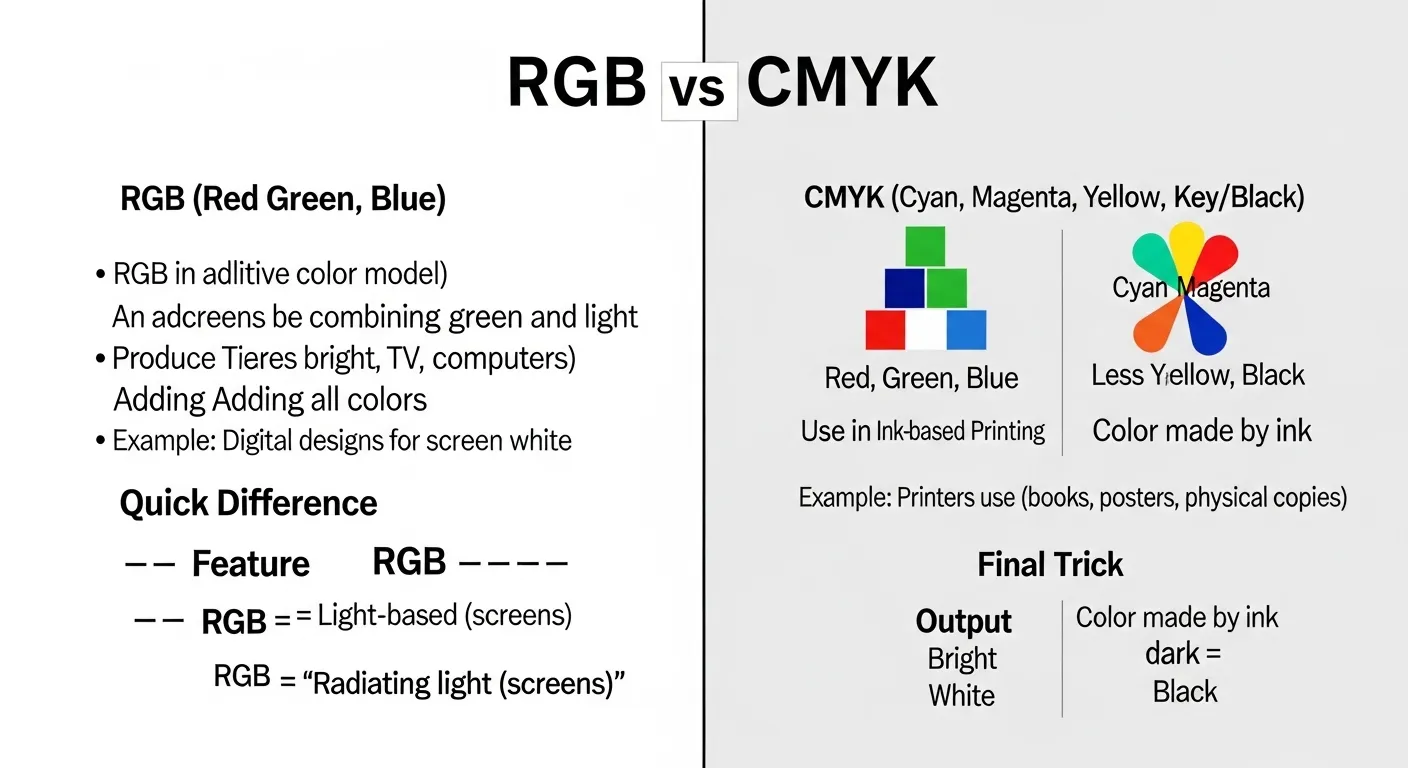
The difference between RGB and CMYK is that RGB is a color model used for digital screens that mixes red, green, and blue light, while CMYK is used for printing and mixes cyan, magenta, yellow, and black inks.
Many designers and beginners get confused about the difference between RGB and CMYK, especially when working on digital vs print projects.
If you’ve ever wondered what is RGB vs CMYK, how they work, or which one to use, this guide will clearly explain the difference between RGB and CMYK in a simple and practical way.
⚡ Quick Answer: Difference Between RGB and CMYK
- RGB: Used for screens (phones, TVs, computers)
- CMYK: Used for printing (paper, magazines, packaging)
👉 Example: A design on screen uses RGB, but printing it requires CMYK.
📖 Definition of Difference Between RGB and CMYK
- RGB: A color model that creates colors by combining red, green, and blue light.
- CMYK: A color model that creates colors using cyan, magenta, yellow, and black ink for printing.
🔊 Pronunciation (US & UK)
- RGB: UK /ˌɑː.dʒiːˈbiː/ | US /ˌɑːr.dʒiːˈbiː/
- CMYK: UK /ˌsiː.em.waɪˈkeɪ/ | US /ˌsiː.em.waɪˈkeɪ/
Now let’s explore their differences clearly.
📊 Comparison Table: RGB vs CMYK
| Feature | RGB | CMYK | Explanation |
| Type | Additive color model | Subtractive color model | Core difference |
| Colors Used | Red, Green, Blue | Cyan, Magenta, Yellow, Black | Color components |
| Medium | Digital screens | Printing materials | Usage |
| Brightness | High, vibrant | Less bright | Output difference |
| Color Range | Wide (more colors) | Limited | Gamut |
| Mixing Method | Light-based | Ink-based | Process |
| Black Color | Mixed RGB | Separate black ink | Color depth |
| Usage Example | Websites, apps | Books, brochures | Application |
🔍 KEY DIFFERENCES EXPLAINED BETWEEN RGB AND CMYK
1️⃣ Color Mixing Method
RGB uses light, CMYK uses ink.
👉 Example: Screens glow, paper absorbs ink
2️⃣ Usage Area
RGB is for digital displays, CMYK is for printing.
👉 Example: Social media vs printed poster
3️⃣ Brightness and Vibrancy
RGB colors are brighter than CMYK.
👉 Example: Screen colors look more vivid
4️⃣ Color Range (Gamut)
RGB supports more colors than CMYK.
👉 Example: Some bright colors can’t print exactly
5️⃣ Black Representation
RGB mixes colors to create black, CMYK uses a separate black ink.
👉 Example: CMYK gives deeper black in print
6️⃣ Conversion Issues
Designs can look different when converted from RGB to CMYK.
👉 Example: Bright colors may appear dull in print
💡 What Is the Difference Between RGB and CMYK in Simple Words?
In simple words, RGB is for screens, while CMYK is for printing.
👉 Light vs ink.
🧠 Why Do RGB and CMYK Exist?
They exist because digital screens and printing work differently:
- Screens emit light → RGB
- Paper reflects ink → CMYK
👉 Different systems need different color models.
🌍 Difference Between RGB and CMYK in Real Life
In real scenarios:
- Designers use RGB for websites and apps
- They switch to CMYK for printing materials
👉 Using the wrong model can affect results.
⚖️ DIFFERENCE + SIMILARITY TABLE
| Feature | RGB | CMYK | Similarity |
| Purpose | Display colors | Print colors | Color representation |
| Type | Color system | Color system | Same concept |
| Use | Digital | Visual output | |
| Design | Graphics | Graphics | Creative work |
| Format | Digital files | Print files | Design tools |
| Function | Show colors | Produce colors | Visual communication |
This table clearly shows the difference and similarity between difference between RGB and CMYK for quick understanding.
❌ Common Mistakes with Difference Between RGB and CMYK
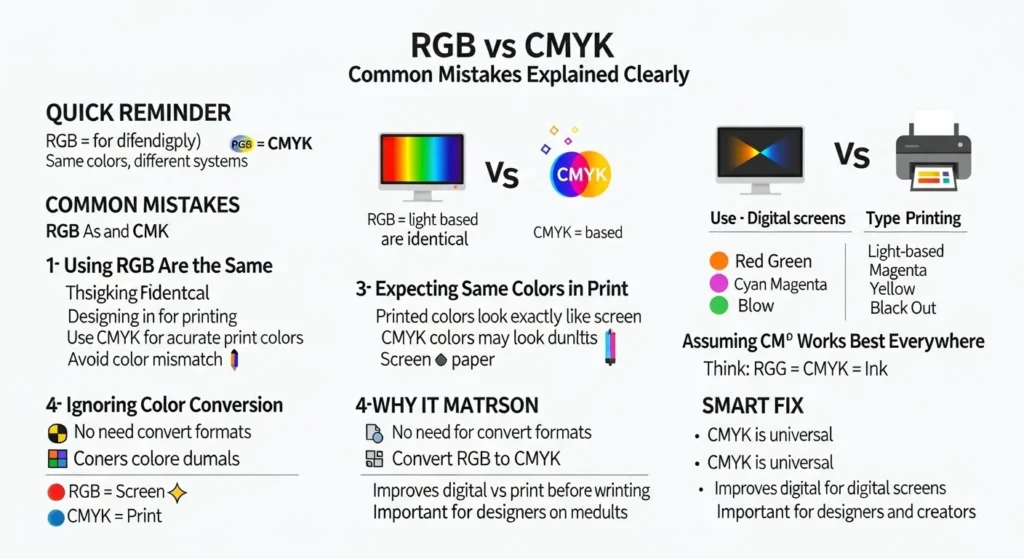
❌ Mistake 1: Using RGB for printing
✔ Fix: Convert to CMYK before printing
❌ Mistake 2: Expecting same colors after conversion
✔ Fix: Adjust colors for print
❌ Mistake 3: Ignoring color model selection
✔ Fix: Choose based on final output
❌ Mistake 4: Not checking print preview
✔ Fix: Always preview in CMYK
🌍 Real Life Examples with Difference Between RGB and CMYK
1️⃣ Social Media Design
Use RGB for digital platforms
2️⃣ Business Cards
Use CMYK for printing
3️⃣ Website Graphics
RGB for screen display
4️⃣ Posters & Magazines
CMYK for accurate print colors
🎯 WHEN TO USE EACH
Use RGB when:
✔ Designing for screens
✔ Creating digital content
Use CMYK when:
✔ Preparing for printing
✔ Working with physical materials
🤔 WHY PEOPLE GET CONFUSED IN DIFFERENCE BETWEEN RGB AND CMYK
- Both are color systems
- Similar design tools
- Lack of understanding of output medium
- Color differences after printing
⚙️ How Design Systems Understand RGB or CMYK
Design tools and platforms like Adobe Photoshop, Adobe Illustrator, and Canva handle RGB and CMYK differently:
- RGB for screen-based previews
- CMYK for print-ready output
👉 This ensures correct color results depending on usage.
🧑💼 EXPERT INSIGHT
In real scenarios, one of the biggest mistakes beginners make is designing everything in RGB and then converting to CMYK at the end. This often leads to dull or unexpected colors in print.
Experienced designers start with the correct color model based on the final goal. If the design is meant for print, they work in CMYK from the beginning to avoid surprises.
👉 Key insight:
Design for the final output, not the convenience.
❓ FAQ:
❓ What is the difference between RGB and CMYK?
RGB is for digital screens, while CMYK is for printing.
❓ Which is better, RGB or CMYK?
It depends on usage—RGB for screens, CMYK for print.
❓ Why do colors change when printing?
Because RGB and CMYK use different color systems.
❓ Can I convert RGB to CMYK?
Yes, but colors may slightly change.
❓ Which has more colors?
RGB has a wider color range.
❓ Is CMYK less bright than RGB?
Yes, printed colors appear less vibrant.
❓ Should I design in RGB or CMYK?
Choose based on final output.
❓ Do all printers use CMYK?
Most standard printers use CMYK.
🏁 Conclusion
The difference between RGB and CMYK comes down to how colors are created and where they are used. RGB uses light to produce vibrant colors on screens, while CMYK uses ink to create colors for printing.
Understanding this difference is essential for achieving accurate and professional results in design work. In simple terms, RGB is best for digital content, and CMYK is best for print materials.
Once you understand this, you can avoid color issues and create designs that look perfect in their final form.
Discover More Articles:

I’m Owen Parker, and I write articles that focus on explaining the differences between common concepts, tools, and ideas. I enjoy simplifying complex information and turning it into clear comparisons that anyone can understand. My work often covers science , education, technology, and everyday knowledge topics.