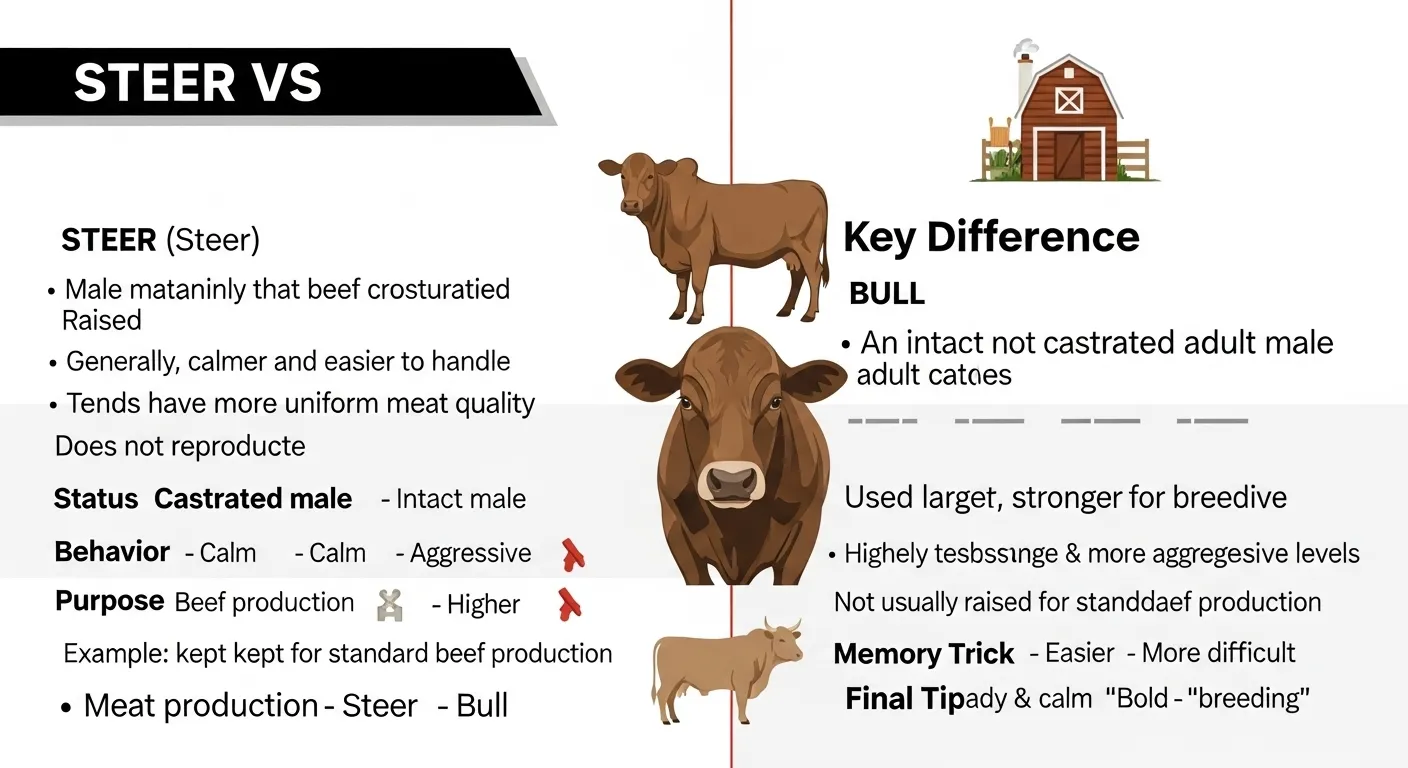
The difference between steer and bull is that a bull is an intact (uncastrated) adult male cattle used for breeding, while a steer is a castrated male cattle raised mainly for meat and easier handling.
Many people get confused about the difference between steer and bull because both are male cattle and can look similar at first glance.
If you’ve ever wondered what is a steer vs bull, how they are different, or why farmers treat them differently, this guide will clearly explain the difference between steer and bull in a simple and practical way.
⚡ Quick Answer: Difference Between Steer and Bull
- Bull: Male cattle used for breeding, not castrated
- Steer: Castrated male cattle raised for meat
👉 Example: Bulls are stronger and more aggressive, steers are calmer and easier to manage.
📖 Definition of Difference Between Steer and Bull
- Bull: An adult male cattle that has not been castrated and is capable of reproduction.
- Steer: A male cattle that has been castrated, usually raised for beef production.
🔊 Pronunciation (US & UK)
- Steer: UK /stɪə(r)/ | US /stɪr/
- Bull: UK /bʊl/ | US /bʊl/
Now let’s explore their differences clearly.
📊 Comparison Table: Steer vs Bull
| Feature | Steer | Bull | Explanation |
| Status | Castrated male | Intact male | Core difference |
| Purpose | Meat production | Breeding | Main use |
| Behavior | Calm | Aggressive | Temperament |
| Growth | Balanced | Faster muscle growth | Development |
| Meat Quality | Better for beef | Less preferred | Industry use |
| Handling | Easy | Difficult | Management |
| Hormones | Lower | Higher | Biological factor |
| Use in Farming | Beef industry | Reproduction | Role |
🔍 KEY DIFFERENCES EXPLAINED BETWEEN STEER AND BULL
1️⃣ Castration Status
Steers are castrated, bulls are not.
👉 Example: This affects behavior and purpose
2️⃣ Behavior and Temperament
Steers are calm, bulls are more aggressive.
👉 Example: Bulls can be dangerous to handle
3️⃣ Farming Purpose
Steers are raised for meat, bulls for breeding.
👉 Example: Beef production relies on steers
4️⃣ Meat Quality
Steers produce better-quality beef than bulls.
👉 Example: Meat is more tender
5️⃣ Hormonal Differences
Bulls have higher testosterone levels.
👉 Example: Leads to aggressive behavior
6️⃣ Ease of Handling
Steers are easier to manage than bulls.
👉 Example: Farmers prefer steers for safety
💡 What Is the Difference Between Steer and Bull in Simple Words?
In simple words, a bull is a male cattle used for breeding, while a steer is a male cattle raised for meat after castration.
👉 Breeding vs beef.
🧠 Why Do Bulls and Steers Exist?
They exist for different agricultural purposes:
- Bulls for reproduction
- Steers for meat production
👉 This improves farming efficiency.
🌍 Difference Between Steer and Bull in Real Life
In real scenarios:
- Farmers keep a few bulls for breeding
- Most male cattle are raised as steers for beef
👉 Each has a specific role.
⚖️ DIFFERENCE + SIMILARITY TABLE
| Feature | Steer | Bull | Similarity |
| Species | Cattle | Cattle | Same animal |
| Gender | Male | Male | Same gender |
| Diet | Grass, feed | Grass, feed | Same food |
| Habitat | Farms | Farms | Same environment |
| Use | Agriculture | Agriculture | Farm animals |
| Care | Managed | Managed | Require care |
This table clearly shows the difference and similarity between difference between steer and bull for quick understanding.
❌ Common Mistakes with Difference Between Steer and Bull
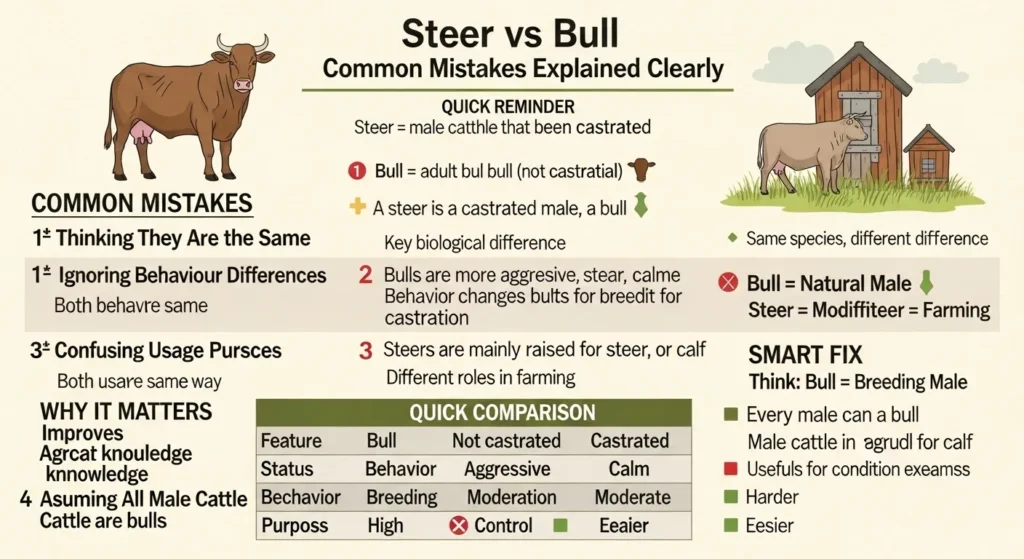
❌ Mistake 1: Thinking both are the same
✔ Fix: Steers are castrated, bulls are not
❌ Mistake 2: Assuming all male cattle are bulls
✔ Fix: Most are steers
❌ Mistake 3: Ignoring behavior differences
✔ Fix: Bulls are more aggressive
❌ Mistake 4: Confusing meat sources
✔ Fix: Beef mostly comes from steers
🌍 Real Life Examples with Difference Between Steer and Bull
1️⃣ Beef Industry
Steers are raised for meat production
2️⃣ Breeding Farms
Bulls are kept for reproduction
3️⃣ Farm Management
Steers are easier to handle daily
4️⃣ Safety Considerations
Bulls require more caution
🎯 WHEN TO USE EACH
Use steer when:
✔ Talking about beef production
✔ Referring to calm, managed cattle
Use bull when:
✔ Talking about breeding
✔ Referring to strong, intact males
🤔 WHY PEOPLE GET CONFUSED IN DIFFERENCE BETWEEN STEER AND BULL
- Both are male cattle
- Similar appearance
- Same environment
- Lack of farming knowledge
⚙️ How Farming Systems Understand Steer or Bull
Agricultural systems classify them based on:
- Reproductive status
- Hormonal levels
- Purpose (breeding vs meat)
👉 This helps manage livestock efficiently.
🧑💼 EXPERT INSIGHT
In real scenarios, the difference between steer and bull is crucial for both safety and productivity.
Most farmers limit the number of bulls because they are harder to manage and can be aggressive. Steers, on the other hand, are preferred for meat production due to their calmer nature and better-quality beef.
👉 Key insight:
Bull = breeding power, Steer = beef production.
❓ FAQ
❓ What is the difference between steer and bull?
A steer is a castrated male cattle and a bull is not.
❓ Which is used for meat?
Steers are mainly used for beef.
❓ Are bulls dangerous?
They can be aggressive and require careful handling.
❓ Why are steers calmer?
Because they have lower hormone levels.
❓ Can a steer reproduce?
No, it is castrated.
❓ Do bulls produce better meat?
No, steers are preferred for meat quality.
❓ Why are bulls kept on farms?
For breeding purposes.
❓ Are both male cattle?
Yes, both are male.
🏁 Conclusion
The difference between steer and bull mainly comes down to purpose, behavior, and biology.
A bull is an intact male cattle used for breeding, if a steer is a castrated male raised for meat production.
Understanding this difference is important in farming, agriculture, and general knowledge. In simple terms, bulls provide reproduction, if steers provide beef.
Once you understand this, the confusion between them becomes clear and easy to remember.
Discover More Articles:

Hi, I’m Nabeel Hassan. I love exploring interesting topics and explaining how different things compare with each other. Through my writing, I aim to provide clear, helpful, and easy to read explanations. I cover subjects related to learning, science, technology and general knowledge.