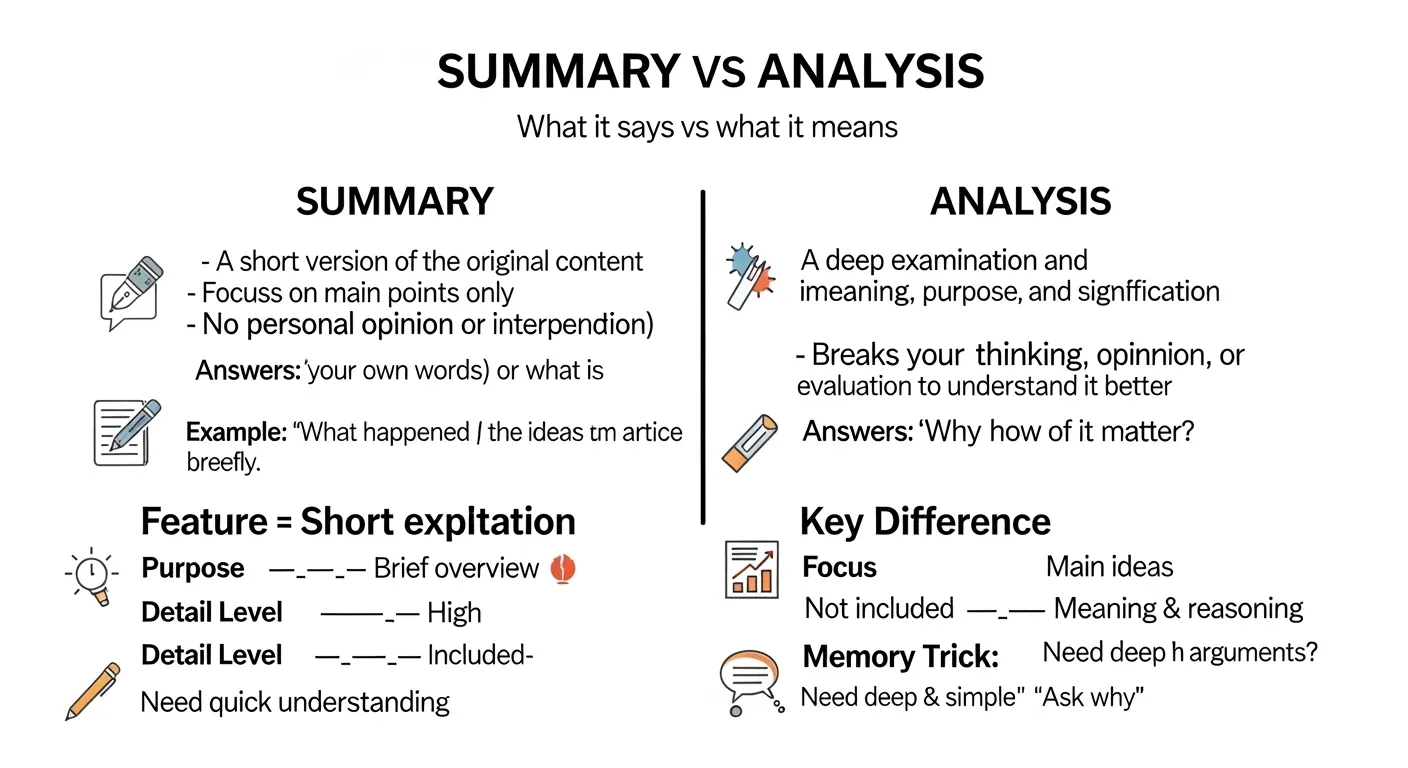
The difference between summary and analysis is that a summary briefly explains the main points of content, while an analysis goes deeper by examining meaning, purpose, and interpretation.
Many students and writers get confused about the difference between summary and analysis, especially when writing essays or reports.
If you’ve ever wondered what is a summary vs analysis, how they work, or when to use each, this guide will clearly explain the difference between summary and analysis in a simple and practical way.
⚡ Quick Answer: Difference Between Summary and Analysis
- Summary: Short version of main ideas
- Analysis: Deep explanation and interpretation
👉 Example: Summary tells what happened, analysis explains why it matters.
📖 Definition of Difference Between Summary and Analysis
- Summary: A brief restatement of key points without adding personal opinion.
- Analysis: A detailed examination that explains meaning, purpose, and insights.
🔊 Pronunciation (US & UK)
- Summary: UK /ˈsʌm.ər.i/ | US /ˈsʌm.ə.ri/
- Analysis: UK /əˈnæl.ə.sɪs/ | US /əˈnæl.ə.sɪs/
Now let’s break it down clearly.
📊 Comparison Table: Summary vs Analysis
| Feature | Summary | Analysis | Explanation |
| Purpose | Inform | Explain | Core difference |
| Depth | Surface-level | Deep understanding | Detail level |
| Content | Main points | Interpretation | Information type |
| Opinion | Not included | Included | Perspective |
| Length | Short | Longer | Structure |
| Focus | What | Why/How | Thinking level |
| Use | Overview | Evaluation | Writing purpose |
| Example | Story outline | Meaning discussion | Application |
🔍 KEY DIFFERENCES EXPLAINED BETWEEN SUMMARY AND ANALYSIS
1️⃣ Purpose
A summary gives an overview, while analysis explains meaning.
👉 Example: Summary = story outline, analysis = deeper insight
2️⃣ Depth of Content
Summaries are short and simple, analysis is detailed and complex.
👉 Example: Analysis explores ideas deeply
3️⃣ Personal Input
Summaries avoid opinion, analysis includes interpretation.
👉 Example: Analysis adds your thinking
4️⃣ Focus Area
Summary focuses on “what happened,” analysis focuses on “why and how.”
👉 Example: Analysis explains causes and effects
5️⃣ Usage in Writing
Summaries are used in notes, analysis in essays and research.
👉 Example: Academic writing requires analysis
6️⃣ Thinking Level
Summary requires basic understanding, analysis requires critical thinking.
👉 Example: Analysis involves reasoning
💡 What Is the Difference Between Summary and Analysis in Simple Words?
In simple words, a summary tells the main idea, while an analysis explains the meaning behind it.
👉 One informs, the other explains.
🧠 Why Do Summary and Analysis Exist?
They exist to serve different purposes:
- Summary helps quickly understand content
- Analysis helps deeply understand content
👉 Both are important for learning and communication.
📚 Difference Between Summary and Analysis in Writing
In real writing scenarios:
- Summaries are used to shorten content
- Analysis is used to explain and evaluate
👉 Good writing often includes both.
⚖️ DIFFERENCE + SIMILARITY TABLE GENERATION
| Feature | Summary | Analysis | Similarity |
| Goal | Explain briefly | Explain deeply | Both explain content |
| Use | Notes | Essays | Writing tools |
| Content | Key points | Detailed ideas | Based on same material |
| Skill | Understanding | Critical thinking | Learning process |
| Format | Short text | Structured text | Written form |
| Purpose | Clarity | Insight | Improve understanding |
This table clearly shows the difference and similarity between difference between summary and analysis for quick understanding.
❌ Common Mistakes with Difference Between Summary and Analysis
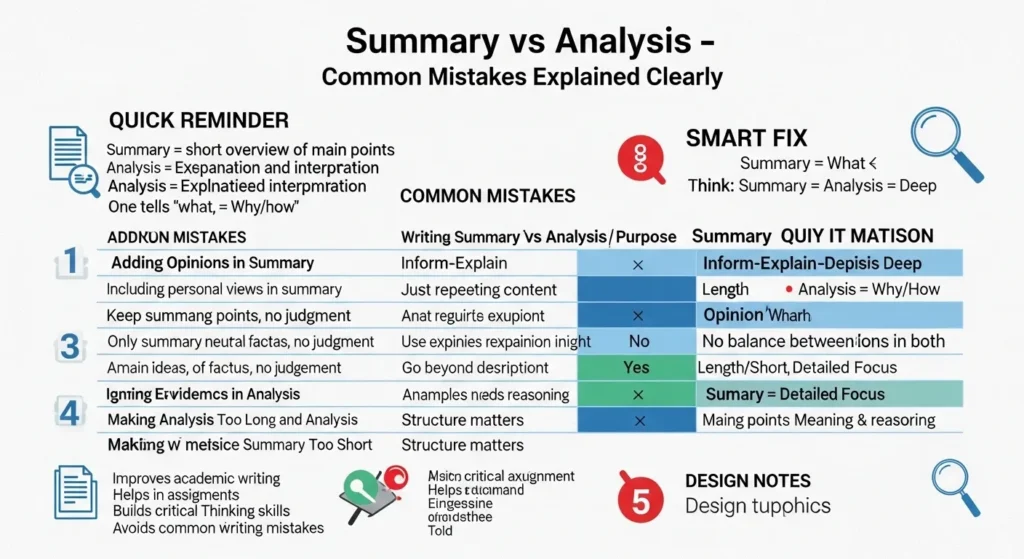
❌ Mistake 1: Writing summary instead of analysis
✔ Fix: Add explanation and reasoning
❌ Mistake 2: Adding opinion in summary
✔ Fix: Keep summary neutral
❌ Mistake 3: Making analysis too short
✔ Fix: Include depth and examples
❌ Mistake 4: Not understanding purpose
✔ Fix: Know when to summarize vs analyze
🌍 Real Life Examples with Difference Between Summary and Analysis
1️⃣ School Work
Summary of a chapter vs analysis in an essay
2️⃣ Business Reports
Summary for quick overview, analysis for decision-making
3️⃣ Content Creation
Summary explains content, analysis adds value
4️⃣ Research
Summary reviews data, analysis interprets it
🎯 WHEN TO USE EACH
Use summary when:
✔ You need quick understanding
✔ You want to shorten content
Use analysis when:
✔ You need deep explanation
✔ You are writing essays or reports
🤔 WHY PEOPLE GET CONFUSED IN DIFFERENCE BETWEEN SUMMARY AND ANALYSIS
- Both deal with same content
- Used together in writing
- Lack of clear understanding
- Similar structure
⚙️ How Writing Systems Understand Summary or Analysis
Writing and academic systems treat them differently:
- Summary = information
- Analysis = interpretation
👉 This helps in evaluating writing quality and depth.
🧑💼 EXPERT INSIGHT
In real scenarios, strong writing always balances summary and analysis.
Most beginners rely too much on summary, which makes their work shallow. Experienced writers focus on analysis to add depth, originality, and value.
👉 Key insight:
Summary tells the story, analysis gives it meaning.
❓ FAQ About Analysis or Summary
❓ What is the difference between summary and analysis?
A summary explains main points, while analysis explains meaning and purpose.
❓ Can a summary include opinion?
No, summaries should remain neutral.
❓ Is analysis longer than summary?
Yes, because it includes deeper explanation.
❓ Do essays require analysis?
Yes, most academic writing requires analysis.
❓ Can both be used together?
Yes, good writing often uses both.
❓ Which is easier, summary or analysis?
Summary is easier, analysis requires deeper thinking.
❓ Why is analysis important?
It adds insight and understanding.
❓ What comes first, summary or analysis?
Usually summary comes first, then analysis.
🏁 Conclusion
The difference between summary and analysis lies in depth and purpose. A summary provides a short and clear overview of main points, while an analysis goes deeper to explain meaning, reasons, and insights.
Understanding this difference helps you improve writing, thinking, and communication skills. In simple terms, summary helps you understand quickly, while analysis helps you understand deeply.
Once you master both, your writing becomes more powerful, clear, and meaningful.
Discover More Articles:

Hi, I’m Nabeel Hassan. I love exploring interesting topics and explaining how different things compare with each other. Through my writing, I aim to provide clear, helpful, and easy to read explanations. I cover subjects related to learning, science, technology and general knowledge.