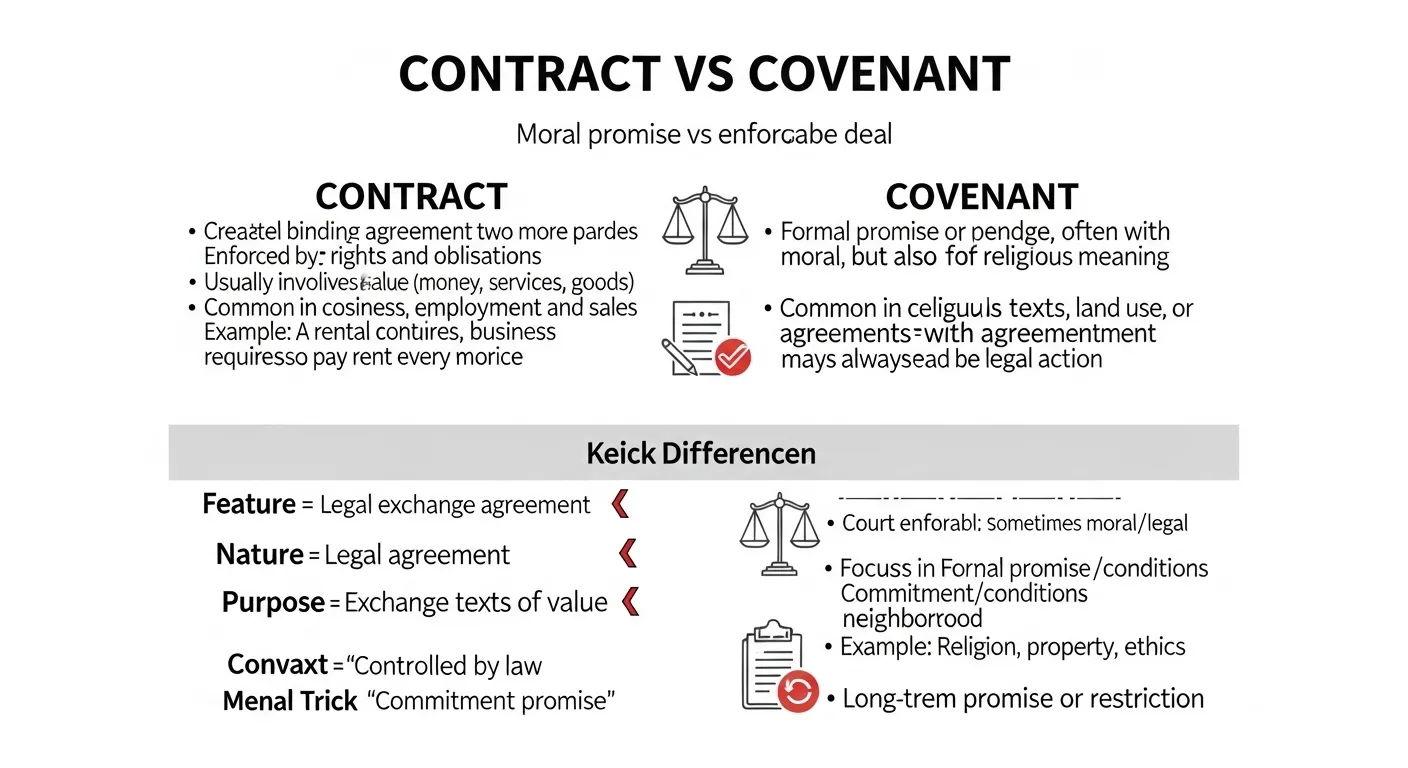
The difference between covenant and contract is mainly related to their legal nature, enforceability, and scope.
Both terms describe agreements between parties, but they are not the same. A contract is a legally binding agreement enforceable by law, while a covenant is a formal promise or clause often found within contracts, deeds, or religious and legal contexts.
Understanding the difference between covenant and contract helps in law, business, and property matters. Simply put, every contract can include covenants, but not every covenant stands alone as a contract.
⚖️ Key Difference Between the Both
The main difference lies in enforceability and structure.
- Contract: A complete legal agreement between two or more parties
- Covenant: A specific promise or condition within an agreement or deed
Examples:
- A business deal is a contract.
- A promise to maintain property condition can be a covenant.
📜 Why Is Their Difference Important?
Understanding the difference between covenant and contract is important in law, real estate, and business agreements. Misunderstanding them can lead to legal disputes or broken obligations. Knowing the difference between covenant and contract ensures clarity in responsibilities, rights, and legal consequences.
🔊 Pronunciation (US & UK)
| Term | US Pronunciation | UK Pronunciation |
| Covenant | /ˈkʌv.ə.nənt/ | /ˈkʌv.ə.nənt/ |
| Contract | /ˈkɒn.trækt/ | /ˈkɒn.trækt/ |
➡️ Now let’s explore the detailed difference between covenant and contract step by step.
🌐 Difference Between Covenant and Contract
1️⃣ Definition
Contract is a legally enforceable agreement between parties.
Covenant is a formal promise or restriction within a legal document.
Examples:
- Contract governs full agreement terms.
- Covenant defines specific obligations.
2️⃣ Legal Nature
Contract is fully enforceable by law.
Covenant may or may not be independently enforceable.
Examples:
- Breach of contract leads to legal action.
- Breach of covenant depends on context.
3️⃣ Scope
Contract covers the entire agreement.
Covenant covers a single condition or promise.
Examples:
- Employment contract includes salary, duties, terms.
- Covenant may restrict competition or usage.
4️⃣ Usage Context
Contract is used in business, employment, and trade.
Covenant is common in property law and agreements.
Examples:
- Service contract between companies.
- Property covenant restricting land use.
5️⃣ Independence
Contract can exist independently.
Covenant usually exists within a contract or deed.
Examples:
- Contract stands alone.
- Covenant is part of a larger agreement.
6️⃣ Breach Consequences
Contract breach leads to damages or penalties.
Covenant breach may lead to injunction or restriction.
Examples:
- Contract violation = compensation case.
- Covenant violation = legal restriction enforcement.
7️⃣ Flexibility
Contract is more flexible and detailed.
Covenant is more specific and rigid.
Examples:
- Contracts can be renegotiated.
- Covenants are harder to modify.
8️⃣ Duration
Contract lasts for a defined period or condition.
Covenant may last longer, even permanently in property cases.
Examples:
- Employment contract ends after term.
- Property covenant may run with land.
9️⃣ Formality
Contract is formal but widely used.
Covenant is more formal and legalistic.
Examples:
- Contracts are common in daily life.
- Covenants appear in legal documents.
🔟 Purpose
Contract ensures mutual exchange of obligations.
Covenant ensures compliance with specific conditions.
Examples:
- Contract ensures deal completion.
- Covenant ensures rules are followed.
🧠 Nature and Behaviour of Both Of Covenant and Contract
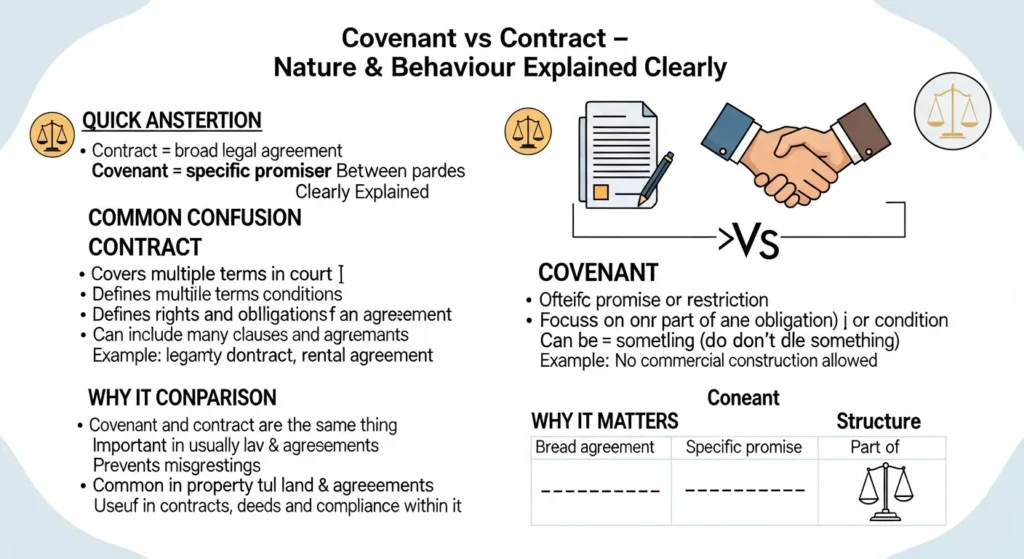
Contract
- Broad legal agreement
- Clearly enforceable
- Covers multiple terms
Covenant
- Specific promise or restriction
- Often part of contract or deed
- Focuses on one obligation
📊 Comparison Chart
🌐 Difference Between Covenant and Contract
| Feature | Contract 📄 | Covenant 📜 |
| Meaning | Legal agreement between parties | Specific promise or condition |
| Scope | Broad | Narrow |
| Enforceability | Fully enforceable by law | May be condition-based |
| Independence | Can exist alone | Usually part of contract |
| Usage | Business, employment, trade | Property, legal restrictions |
| Breach Result | Damages or penalties | Injunction or restriction |
| Flexibility | More flexible | More rigid |
| Duration | Fixed term | Often long-term |
| Nature | Comprehensive | Specific |
| Purpose | Complete agreement | Specific obligation |
⚖️ Which Is Better in What Situation?
Contract
Best for business deals, employment, and service agreements where full legal structure is needed.
Covenant
Best for property laws, restrictions, and specific legal promises within agreements.
🎭 Use in Metaphors and Similes
Metaphor example:
- A contract is a bridge connecting two parties, while a covenant is a single strong pillar holding it steady.
Simile example:
- A covenant is like a rule carved in stone within a contract.
💬 Connotative Meaning
| Term | Connotation | Example |
| Contract | Formal agreement, business deal | It felt like a strict contract. |
| Covenant | Promise, restriction, obligation | It was like a binding covenant. |
🗣️ Expressions
- Sign a contract
- Honor a covenant
- Break a contract
- Uphold a covenant
📚 Legal Context
Contracts are widely used in business law, while covenants are commonly found in property law, deeds, and land regulations.
❔ Frequently Asked Questions
1. Is a covenant a contract?
Not exactly, but it can be part of a contract.
2. Which is legally stronger?
A contract is generally broader and more enforceable.
3. Where are covenants used?
Mostly in property and legal restrictions.
4. Can a contract contain covenants?
Yes, many contracts include covenants.
5. What happens if a covenant is broken?
It may lead to legal restriction or enforcement action.
🌍 Importance in Daily Life
Contracts and covenants help maintain legal order in business, property ownership, and agreements by clearly defining rights and responsibilities.
✍️ Final Words
The difference between covenant and contract is clear: a contract is a full legal agreement, while a covenant is a specific promise or restriction within an agreement. Both work together in law to ensure clarity and enforcement of obligations.
🏁 Conclusion
Understanding the difference between covenant and contract is essential in legal and business contexts.
A contract defines the overall relationship between parties, while a covenant defines specific duties or restrictions. Knowing this difference helps avoid legal confusion and ensures proper agreement handling.
Discover More Articles:

I’m Owen Parker, and I write articles that focus on explaining the differences between common concepts, tools, and ideas. I enjoy simplifying complex information and turning it into clear comparisons that anyone can understand. My work often covers science , education, technology, and everyday knowledge topics.