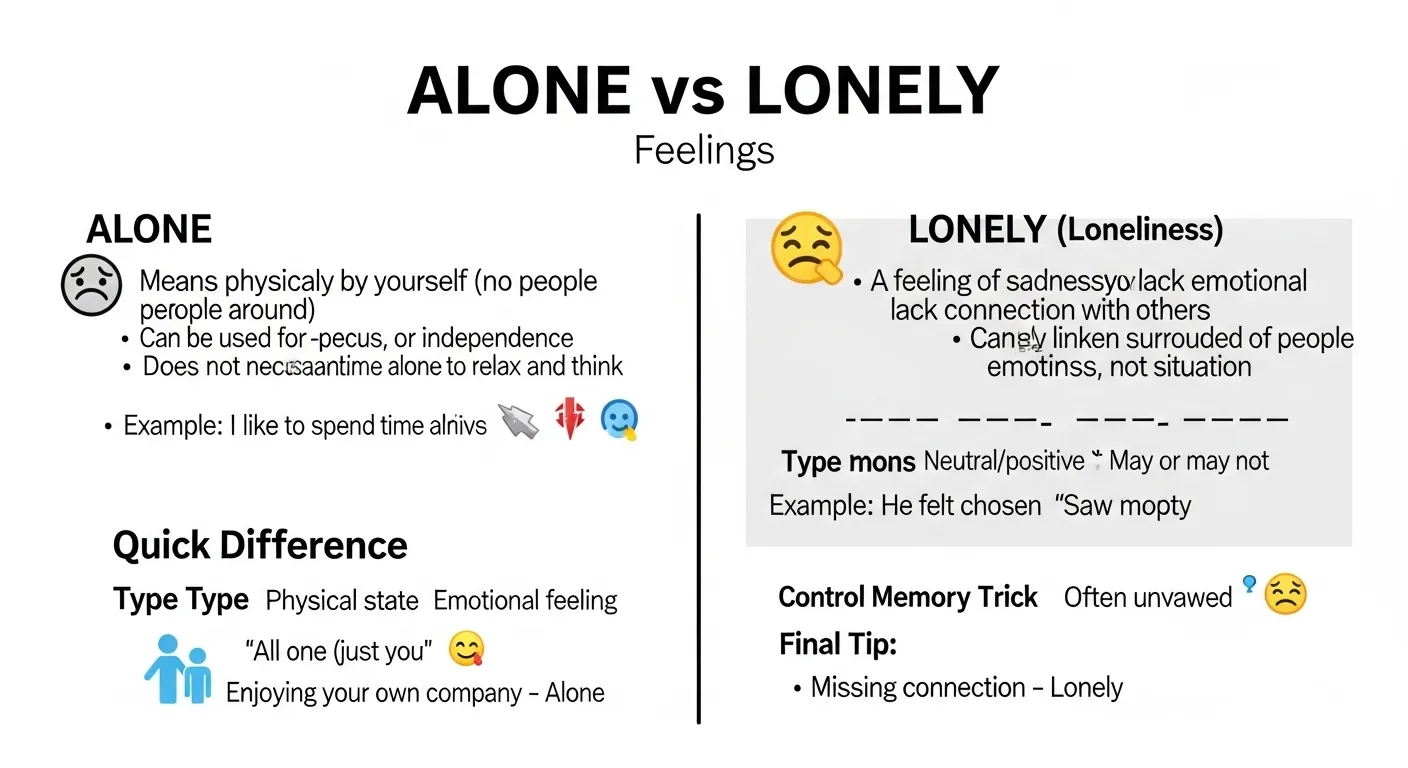
The difference between alone and lonely is that “alone” describes being physically by yourself, while “lonely” describes an emotional feeling of sadness or isolation.
Many people get confused about the difference between alone and lonely because both words seem similar but carry very different meanings in real life.
If you’ve ever wondered what is alone vs lonely, why someone can feel lonely even in a crowd, or how to use these words correctly, this guide will clearly explain the difference between alone and lonely in a simple and meaningful way.
⚡ Quick Answer: Difference Between Alone and Lonely
- Alone: Being physically by yourself
- Lonely: Feeling emotionally disconnected or sad
👉 Example: You can be alone and happy, but lonely even with people around.
📖 Definition of Difference Between Alone and Lonely
- Alone: Being without other people physically present.
- Lonely: Feeling sadness or emptiness due to lack of connection.
🔊 Pronunciation (US & UK)
- Alone: UK /əˈləʊn/ | US /əˈloʊn/
- Lonely: UK /ˈləʊn.li/ | US /ˈloʊn.li/
Now let’s understand this clearly.
📊 Comparison Table: Alone vs Lonely
| Feature | Alone | Lonely | Explanation |
| Type | Physical state | Emotional state | Core difference |
| Meaning | No people around | Feeling isolated | Definition |
| Emotion | Neutral/positive | Negative | Emotional impact |
| Control | Often by choice | Often not by choice | Experience |
| Example | Sitting by yourself | Feeling sad in a crowd | Real case |
| Impact | Peaceful sometimes | Distressing | Effect |
| Usage | Descriptive | Emotional | Language use |
| Context | Situation | Feeling | Perspective |
🔍 KEY DIFFERENCES EXPLAINED BETWEEN ALONE AND LONELY
1️⃣ Physical vs Emotional
Alone is about physical presence, lonely is about feelings.
👉 Example: Sitting alone vs feeling unwanted
2️⃣ Emotional Impact
Being alone can feel peaceful, loneliness feels painful.
👉 Example: Alone time can be relaxing
3️⃣ Choice vs Feeling
Alone is often a choice, loneliness is often unwanted.
👉 Example: Choosing solitude vs feeling isolated
4️⃣ Social Presence
You can be lonely even in a group.
👉 Example: Feeling disconnected in a crowd
5️⃣ Mental State
Loneliness affects mental well-being more than being alone.
👉 Example: Loneliness can cause sadness
6️⃣ Usage in Language
Alone describes a situation, lonely describes a feeling.
👉 Example: Different sentence usage
💡 What Is the Difference Between Alone and Lonely in Simple Words?
In simple words, alone means no one is around, while lonely means you feel sad because of it.
👉 Alone = situation, Lonely = emotion.
🧠 Why Do Both Words Exist?
They exist to express different human experiences:
- Alone describes physical reality
- Lonely describes emotional state
👉 This helps us communicate feelings clearly.
🌍 Difference Between Alone and Lonely in Real Life
In real scenarios:
- People enjoy being alone for peace
- People feel lonely when lacking connection
👉 Same situation, different feelings.
⚖️ DIFFERENCE + SIMILARITY TABLE GENERATION
| Feature | Alone | Lonely | Similarity |
| State | Physical | Emotional | Human experience |
| Use | Situation | Feeling | Communication |
| Impact | Neutral | Emotional | Affects people |
| Context | Personal space | Emotional state | Life experience |
| Occurrence | Common | Common | Everyday life |
| Expression | Descriptive | Emotional | Language use |
This table clearly shows the difference and similarity between difference between alone and lonely for quick understanding.
❌ Common Mistakes with Difference Between Alone and Lonely
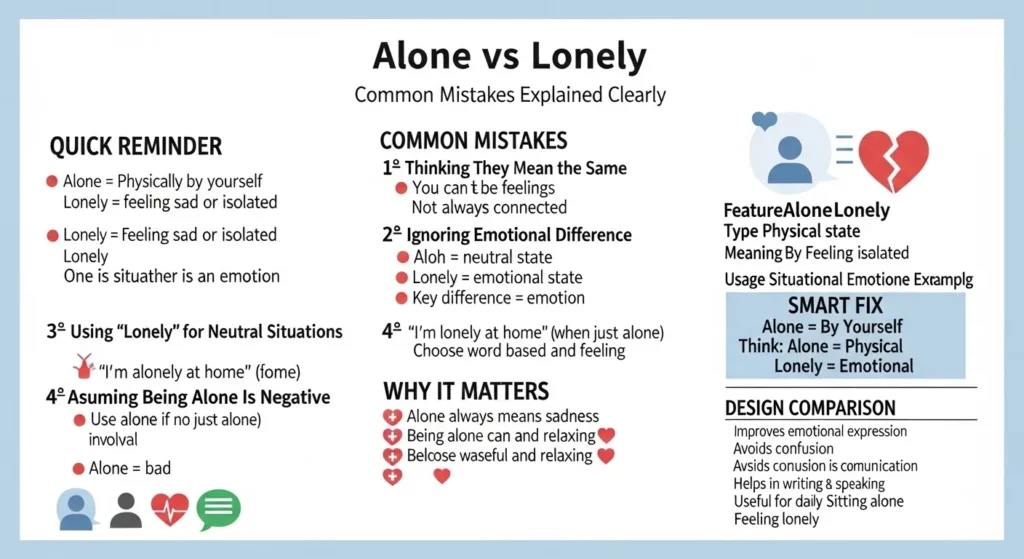
❌ Mistake 1: Using both words the same
✔ Fix: Alone ≠ lonely
❌ Mistake 2: Assuming alone means sad
✔ Fix: Alone can be peaceful
❌ Mistake 3: Ignoring emotional meaning
✔ Fix: Lonely is about feelings
❌ Mistake 4: Misusing in sentences
✔ Fix: Use correctly based on context
🌍 Real Life Examples with Difference Between Alone and Lonely
1️⃣ Personal Time
Enjoying quiet time alone
2️⃣ Social Situations
Feeling lonely in a crowd
3️⃣ Work Life
Working alone vs feeling disconnected
4️⃣ Travel
Traveling alone but not lonely
🎯 WHEN TO USE EACH
Use alone when:
✔ Talking about physical situation
✔ Describing being by yourself
Use lonely when:
✔ Talking about emotions
✔ Expressing sadness or isolation
🤔 WHY PEOPLE GET CONFUSED IN DIFFERENCE BETWEEN ALONE AND LONELY
- Similar meanings
- Both related to being by yourself
- Emotional misunderstanding
- Language overlap
⚙️ How Language Systems Understand Alone vs Lonely
Language and communication systems treat them differently:
- Alone = physical state
- Lonely = emotional condition
👉 This helps convey clear meaning in communication.
🧑💼 EXPERT INSIGHT
In real scenarios, understanding the difference between alone and lonely is important for emotional awareness and communication.
Many people confuse solitude with loneliness, but they are not the same. Healthy alone time can improve focus and mental clarity, while loneliness often signals a need for connection.
👉 Key insight:
Being alone is not a problem—feeling lonely might be.
❓ FAQ:
❓ What is the difference between alone and lonely?
Alone is a physical state, lonely is an emotional feeling.
❓ Can you be alone and happy?
Yes, many people enjoy being alone.
❓ Can you feel lonely in a crowd?
Yes, loneliness is emotional, not physical.
❓ Is loneliness always negative?
It usually involves sadness or discomfort.
❓ Why do people confuse these words?
Because both relate to being by yourself.
❓ Which word describes feelings?
Lonely describes feelings.
❓ Which word describes situation?
Alone describes a situation.
❓ Can alone become lonely?
Yes, if emotional needs are not met.
🏁 Conclusion
The difference between alone and lonely lies in meaning and emotion. Being alone simply means you are by yourself physically, while being lonely means you feel emotionally disconnected or sad.
Understanding this difference helps you express yourself more clearly and understand your feelings better. In simple terms, alone is about where you are, and lonely is about how you feel.
Once you understand this, you can use both words correctly and communicate with more clarity and confidence.
Discover More Articles:

I’m Owen Parker, and I write articles that focus on explaining the differences between common concepts, tools, and ideas. I enjoy simplifying complex information and turning it into clear comparisons that anyone can understand. My work often covers science , education, technology, and everyday knowledge topics.