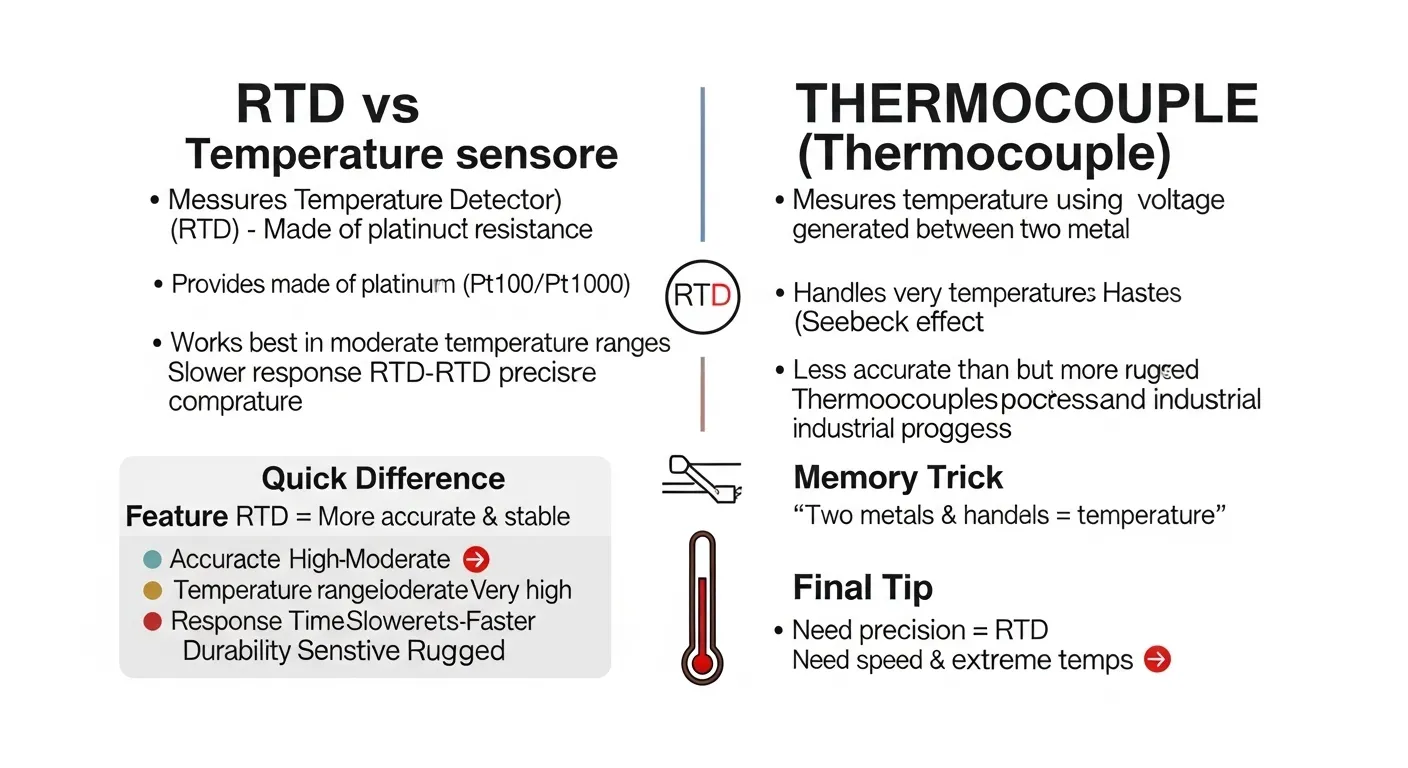
The difference between RTD and thermocouple is that an RTD measures temperature based on resistance changes in a metal (usually platinum), while a thermocouple measures temperature using voltage generated from two different metals joined together.
Many engineers and beginners get confused about the difference between RTD and thermocouple, especially when selecting temperature sensors for industrial or technical use.
If you’ve ever wondered what is RTD vs thermocouple, how they work, or which one is better, this guide will clearly explain the difference between RTD and thermocouple in a simple and practical way.
⚡ Quick Answer: Difference Between RTD and Thermocouple
- RTD: Uses resistance change for accurate temperature measurement
- Thermocouple: Uses voltage generation for wide temperature range
👉 Example: RTD is precise, thermocouple is more rugged and versatile.
📖 Definition of Difference Between RTD and Thermocouple
- RTD (Resistance Temperature Detector): A sensor that measures temperature by detecting changes in electrical resistance of a metal.
- Thermocouple: A sensor that measures temperature by generating voltage when two dissimilar metals are joined and exposed to heat.
🔊 Pronunciation (US & UK)
- RTD: UK /ˌɑː.tiːˈdiː/ | US /ˌɑːr.tiːˈdiː/
- Thermocouple: UK /ˈθɜː.məʊˌkʌp.əl/ | US /ˈθɝː.moʊˌkʌp.əl/
Now let’s break down their differences clearly.
📊 Comparison Table: RTD vs Thermocouple
| Feature | RTD | Thermocouple | Explanation |
| Principle | Resistance change | Voltage generation | Core difference |
| Accuracy | High | Moderate | Measurement precision |
| Temperature Range | Limited | Very wide | Operating range |
| Response Time | Slower | Faster | Speed |
| Cost | Higher | Lower | Price factor |
| Stability | Very stable | Less stable | Long-term use |
| Construction | Delicate | Rugged | Durability |
| Use | Precision systems | Harsh environments | Application |
🔍 KEY DIFFERENCES EXPLAINED BETWEEN RTD AND THERMOCOUPLE
1️⃣ Working Principle
RTD uses resistance, thermocouple uses voltage.
👉 Example: Different measurement methods
2️⃣ Accuracy
RTDs provide more precise readings than thermocouples.
👉 Example: Used in labs and precision systems
3️⃣ Temperature Range
Thermocouples can measure much higher temperatures.
👉 Example: Used in furnaces
4️⃣ Response Time
Thermocouples respond faster to temperature changes.
👉 Example: Better for rapid changes
5️⃣ Durability
Thermocouples are more rugged and handle harsh environments.
👉 Example: Industrial use
6️⃣ Cost
RTDs are usually more expensive than thermocouples.
👉 Example: Higher precision costs more
💡 What Is the Difference Between RTD and Thermocouple in Simple Words?
In simple words, RTD gives more accurate readings, while thermocouple works in extreme conditions and responds faster.
👉 Accuracy vs durability.
🧠 Why Do RTD or Thermocouples Exist?
They exist to meet different measurement needs:
- RTD for precision and stability
- Thermocouple for high temperature and rugged use
👉 Each serves a specific purpose.
🌍 Difference Between RTD and Thermocouple in Real Life
In real scenarios:
- RTDs are used in laboratories and controlled environments
- Thermocouples are used in industrial systems and high heat areas
👉 Choice depends on application.
⚖️ DIFFERENCE + SIMILARITY TABLE GENERATION
| Feature | RTD | Thermocouple | Similarity |
| Purpose | Measure temperature | Measure temperature | Same function |
| Type | Sensor | Sensor | Measurement devices |
| Use | Industrial/lab | Industrial | Temperature monitoring |
| Output | Electrical signal | Electrical signal | Electronic output |
| Application | Systems | Systems | Engineering use |
| Installation | Mounted sensors | Mounted sensors | Similar setup |
This table clearly shows the difference and similarity between difference between RTD and thermocouple for quick understanding.
❌ Common Mistakes with Difference Between RTD and Thermocouple
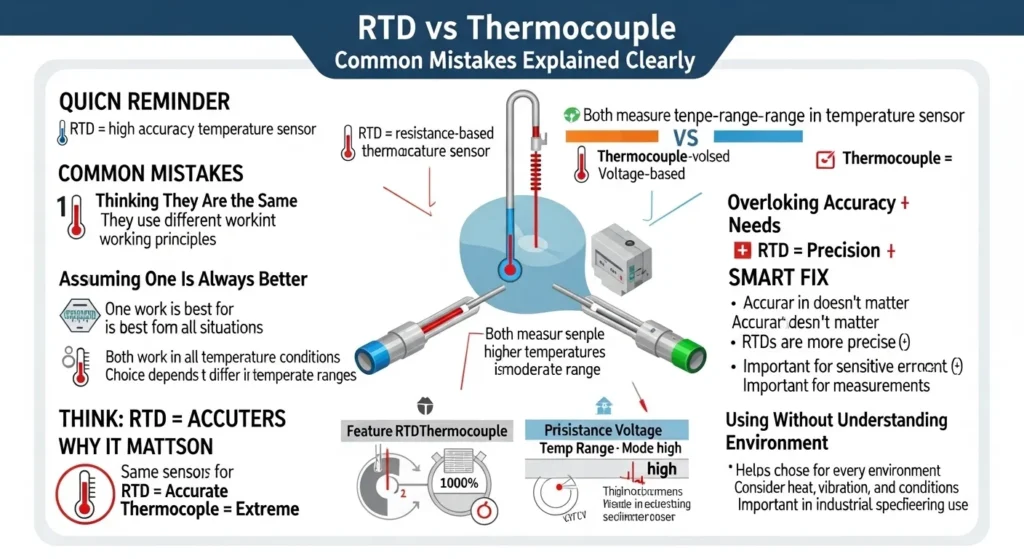
❌ Mistake 1: Thinking they work the same
✔ Fix: RTD uses resistance, thermocouple uses voltage
❌ Mistake 2: Choosing RTD for extreme heat
✔ Fix: Use thermocouple for high temperatures
❌ Mistake 3: Ignoring accuracy needs
✔ Fix: Use RTD for precision
❌ Mistake 4: Overlooking response time
✔ Fix: Use thermocouple for fast changes
🌍 Real Life Examples with Difference Between RTD and Thermocouple
1️⃣ Industrial Furnace
Thermocouple handles high heat
2️⃣ Laboratory Equipment
RTD provides accurate readings
3️⃣ Food Industry
RTD ensures precise temperature control
4️⃣ Manufacturing
Thermocouple used in harsh environments
🎯 WHEN TO USE EACH
Use RTD when:
✔ You need high accuracy
✔ Working in controlled environments
Use Thermocouple when:
✔ You need wide temperature range
✔ Working in harsh conditions
🤔 WHY PEOPLE GET CONFUSED IN DIFFERENCE BETWEEN RTD AND THERMOCOUPLE
- Both measure temperature
- Similar usage areas
- Technical complexity
- Lack of understanding
⚙️ How Engineering Systems Understand RTD vs Thermocouple
Engineering systems select sensors based on:
- Accuracy requirements
- Temperature range
- Environmental conditions
👉 This ensures reliable performance.
🧑💼 EXPERT INSIGHT
In real scenarios, choosing between RTD and thermocouple is not about which is better—it’s about suitability.
Most beginners focus only on cost or availability, but experienced engineers consider accuracy, environment, and response time. RTDs are ideal for precision control, while thermocouples excel in extreme conditions.
👉 Key insight:
RTD = precision, Thermocouple = versatility.
❓ FAQ:
❓ What is the difference between RTD and thermocouple?
RTD uses resistance, thermocouple uses voltage.
❓ Which is more accurate?
RTD is more accurate.
❓ Which works at higher temperatures?
Thermocouple handles higher temperatures.
❓ Which is faster?
Thermocouple responds faster.
❓ Are both used in industry?
Yes, based on application.
❓ Is RTD expensive?
Yes, compared to thermocouples.
❓ Can thermocouples be used in labs?
Yes, but RTDs are preferred for accuracy.
❓ Which is more durable?
Thermocouple is more rugged.
🏁 Conclusion
The difference between RTD and thermocouple lies in how they measure temperature and where they are used. RTDs offer high accuracy and stability, making them ideal for precise measurements, while thermocouples provide a wide temperature range, faster response, and better durability for harsh environments.
Understanding this difference helps you choose the right sensor for your needs. In simple terms, RTD is best for precision, while thermocouple is best for extreme conditions.
Once you understand this, selecting the right temperature sensor becomes much easier and more effective.
Discover More Articles:

Hi, I’m Nabeel Hassan. I love exploring interesting topics and explaining how different things compare with each other. Through my writing, I aim to provide clear, helpful, and easy to read explanations. I cover subjects related to learning, science, technology and general knowledge.