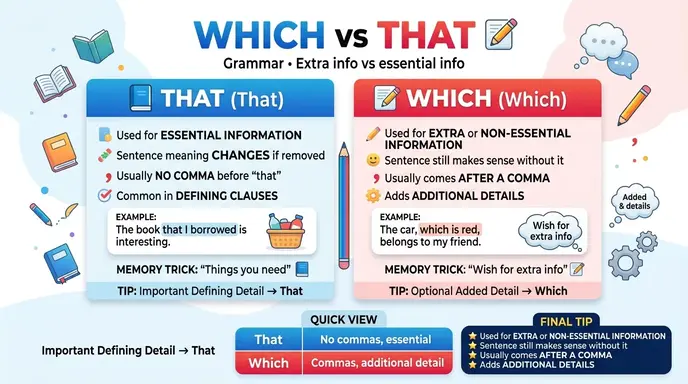
The difference between which and that is that “that” is usually used for essential information needed to identify something, while “which” is commonly used for extra information that is not essential to the sentence.
Many English learners get confused about the difference between which and that because both words can introduce clauses and refer to things, objects, or ideas. However, their grammar usage and punctuation rules are different.
If you’ve ever wondered what is which vs that, when to use commas, or how native speakers use these words, this guide will clearly explain the difference between which and that in simple and practical language.
⚡ Quick Answer: Difference Between That and Which
- That: Used for essential information without commas
- Which: Used for additional non essential information, usually with commas
👉 Example:
- “The book that I borrowed is missing.”
- “The book, which I borrowed yesterday, is missing.”
📖 Definition of Which and That
- That: A relative pronoun used to introduce essential clauses that identify the noun clearly.
- Which: A relative pronoun used to add extra information that is not necessary for the sentence meaning.
🔊 Pronunciation (US & UK)
- Which: UK /wɪtʃ/ | US /wɪtʃ/
- That: UK /ðæt/ | US /ðæt/
Now let’s understand their differences clearly.
📊 Which vs That Comparison Table
| Feature | Which | That |
| Clause Type | Non essential | Essential |
| Comma Usage | Usually uses commas | Usually no commas |
| Adds Extra Detail | Yes | No |
| Identifies Specific Noun | Sometimes | Commonly |
| Formal Writing | Common | Common |
| Restrictive Clause | Rarely | Yes |
| Nonrestrictive Clause | Yes | Rarely |
| Example | The car, which is red | The car that is red |
🔍 KEY DIFFERENCES EXPLAINED BETWEEN WHICH AND THAT
🧩 Essential vs Extra Information
“That” introduces information necessary to identify something, while “which” introduces extra details.
👉 Example:
“The phone that has a cracked screen is mine.”
(The cracked screen identifies the phone.)
✍️ Comma Rules
“Which” clauses are usually separated by commas because they add non essential information. “That” clauses usually do not use commas.
👉 Example:
“My laptop, which is new, works perfectly.”
📚 Restrictive and Nonrestrictive Clauses
“That” is commonly used in restrictive clauses, while “which” is commonly used in nonrestrictive clauses.
👉 Example:
“The movie that won the award was excellent.”
💬 Everyday English Usage
In casual speech, people sometimes mix “which” and “that,” but formal grammar rules separate them more clearly.
👉 Example:
Many writers follow stricter punctuation rules in formal writing.
🧠 Sentence Meaning Impact
Removing a “which” clause usually keeps the sentence understandable, but removing a “that” clause often changes the meaning.
👉 Example:
“The cake that contains nuts is for Sarah.”
Without the clause, the listener may not know which cake.
📖 Style Guide Differences
Some style guides strongly distinguish between “which” and “that,” while others allow more flexibility in informal English.
👉 Example:
American grammar guides often enforce the distinction more strictly.
🤔 What Is the Difference Between Which and That in Simple Words?
In simple words, “that” gives important identifying information, while “which” gives extra information that can usually be removed without changing the main meaning.
👉 That = necessary information
👉 Which = additional information
🧠 Why Do People Confuse Which and That?
Both words connect clauses to nouns, so they often appear similar.
“That” is commonly used for:
- Essential information
- Identifying objects
- Restrictive clauses
- No comma sentences
“Which” is commonly used for:
- Extra details
- Additional explanations
- Nonrestrictive clauses
- Comma separated phrases
👉 Comma usage is one of the biggest clues.
🌍 Difference Between Which or That in Real Life
In practical English:
- Formal writing often separates them carefully
- Casual conversation may mix them
- Editors usually check comma rules closely
👉 Grammar style affects usage.
⚖️ DIFFERENCE + SIMILARITY TABLE OF THAT VS WHICH
| Feature | Which | That | Similarity |
| Relative Pronoun | Yes | Yes | Grammar function |
| Connects Clauses | Yes | Yes | Sentence structure |
| Refers to Things | Yes | Yes | Noun reference |
| Used in English Writing | Yes | Yes | Common usage |
| Helps Describe Nouns | Yes | Yes | Clarification role |
| Appears in Sentences | Yes | Yes | Grammar support |
| Can Introduce Clauses | Yes | Yes | Clause connection |
| Important in Grammar | Yes | Yes | Writing accuracy |
This table clearly shows the difference and similarity between difference between which and that for quick understanding.
❌ Common Mistakes with Which or That
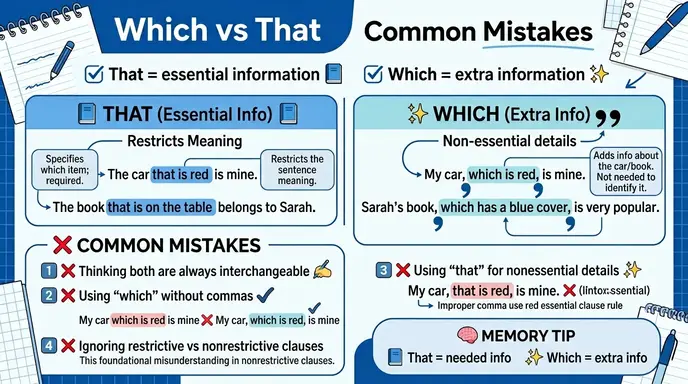
Using “Which” Without Commas for Extra Information
❌ My car which is blue needs washing.
✅ My car, which is blue, needs washing.
Extra information usually needs commas.
Using “That” with Nonessential Clauses
❌ My laptop, that is new, works perfectly.
✅ My laptop, which is new, works perfectly.
“That” usually introduces essential information.
Removing Essential Information
❌ The student won the prize.
✅ The student that studied hardest won the prize.
Essential detail matters.
Thinking Both Always Mean the Same
❌ Which and that are always interchangeable.
✅ Their grammatical roles often differ.
Context changes usage.
Ignoring Formal Grammar Rules
❌ Commas never matter with which and that.
✅ Punctuation helps separate clause types.
Grammar structure matters.
🏡 Real Life Examples with Which and That
📘 Essential Identification
“The jacket that belongs to Tom is missing.”
✨ Extra Information
“The jacket, which is expensive, is missing.”
🏫 Classroom Grammar
Teachers often explain restrictive and nonrestrictive clauses using which and that.
📰 Formal Writing
Editors commonly check correct which/that usage in professional writing.
🎯 WHEN TO USE EACH
Use That When:
✔ Giving essential information
✔ Identifying a specific noun
✔ Writing restrictive clauses
✔ Avoiding commas
Use Which When:
✔ Adding extra details
✔ Writing nonessential information
✔ Using comma separated clauses
✔ Expanding explanations
🤯 WHY PEOPLE GET CONFUSED IN THAT AND WHICH
- Both connect clauses
- Both refer to nouns
- Informal English sometimes mixes them
- Their meanings can overlap slightly
⚙️ How Grammar Experts Understand Which vs That
Grammar experts separate these words based on:
- Clause importance
- Comma usage
- Sentence meaning
- Restrictive versus nonrestrictive structure
👉 Essential information usually uses “that,” while extra information usually uses “which.”
🧑🏫 EXPERT INSIGHT
In real English writing, the difference between “which” and “that” mainly helps readers understand whether information is essential or optional. “That” narrows down exactly which person or thing is being discussed, while “which” simply adds extra descriptive detail.
One important insight many learners miss is that commas are a major clue. If the clause is surrounded by commas, “which” is usually the correct choice because the information is additional rather than necessary.
👉 Key insight:
“That” identifies essential information, while “which” adds optional extra information.
❓ FAQ:
❓ What is the difference between which and that?
“That” introduces essential information, while “which” introduces extra nonessential information.
❓ Does “which” usually need commas?
Yes, “which” clauses are usually separated by commas.
❓ Is “that” used without commas?
Usually yes, because it introduces essential clauses.
❓ Can “which” and “that” sometimes both work?
In casual English, sometimes yes, but formal grammar often distinguishes them.
❓ What is a restrictive clause?
A restrictive clause provides necessary identifying information.
❓ What is a nonrestrictive clause?
A nonrestrictive clause adds extra information that can be removed.
❓ Which is more common in formal grammar rules?
Both are common, but their roles are separated more carefully in formal writing.
❓ Why do writers care about this difference?
Correct usage improves clarity and sentence structure.
🏁 Conclusion
The difference between which and that mainly comes down to essential versus extra information. “That” is generally used for important identifying details without commas, while “which” is used for additional nonessential information and usually appears with commas.
Understanding this difference helps improve grammar accuracy, sentence clarity, and professional writing quality. In simple terms, “that” narrows meaning, while “which” adds extra explanation.
Once you understand how clause importance affects sentence structure, the difference between which and that becomes much easier to recognize.
Discover More Articles:

Hi, I’m Nabeel Hassan. I love exploring interesting topics and explaining how different things compare with each other. Through my writing, I aim to provide clear, helpful, and easy to read explanations. I cover subjects related to learning, science, technology and general knowledge.