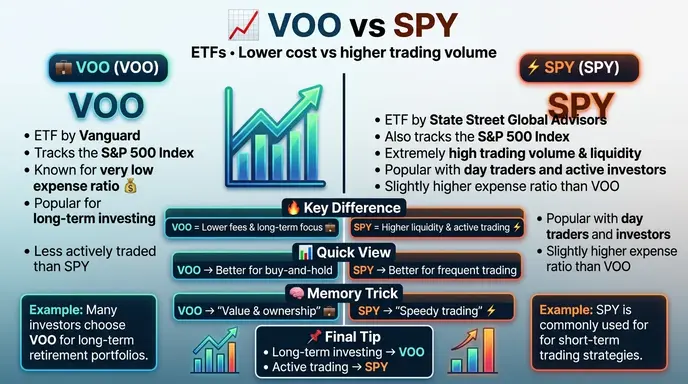
The difference between VOO and SPY is that both track the S&P 500 index, but VOO usually has lower fees and is designed for long term investing, while SPY is more popular for active trading because of its high liquidity and trading volume.
Many investors get confused about the difference between VOO and SPY because both ETFs contain many of the same large U.S. companies and often perform very similarly. However, their costs, structure, and trading use cases are different.
If you’ve ever wondered what is VOO vs SPY, which ETF is better for long term investing, or why traders prefer one over the other, this guide will clearly explain the difference between VOO and SPY in simple and practical language.
⚡ Quick Answer: Difference Between VOO or SPY
- VOO: Lower cost S&P 500 ETF commonly preferred for long term investing
- SPY: Highly liquid S&P 500 ETF commonly preferred for active trading
👉 Example: Long term retirement investors often choose VOO, while short term traders frequently use SPY.
📖 Definition of VOO and SPY
- VOO: An exchange traded fund (ETF) from Vanguard that tracks the S&P 500 index.
- SPY: An exchange traded fund (ETF) from State Street that also tracks the S&P 500 index.
🔊 Pronunciation (US & UK)
- VOO: Usually spoken as “voo” /vuː/
- SPY: Spoken as “spy” /spaɪ/
Now let’s understand their differences clearly.
📊 VOO vs SPY Comparison Table
| Feature | VOO | SPY |
| ETF Provider | Vanguard | State Street |
| Main Focus | Long term investing | Active trading |
| Expense Ratio | Lower | Slightly higher |
| Liquidity | High | Extremely high |
| Trading Volume | Very strong | Higher |
| Dividend Reinvestment | Investor friendly | Available but structured differently |
| Options Trading Popularity | Moderate | Very popular |
| Typical Investor | Long term investors | Traders and institutions |
🔍 KEY DIFFERENCES EXPLAINED BETWEEN VOO AND SPY
💰 Expense Ratio and Fees
VOO usually has lower management fees than SPY, making it attractive for long term investors.
👉 Example: Lower fees may help investors keep more returns over many years.
📈 Trading Volume and Liquidity
SPY is one of the most actively traded ETFs in the world, which makes it popular among day traders and institutions.
👉 Example: Traders often prefer SPY because buying and selling is extremely fast.
🏦 Fund Providers
VOO is managed by Vanguard, while SPY is managed by State Street.
👉 Example: Different investment companies operate the funds.
⏳ Long Term Investing vs Active Trading
VOO is commonly chosen for retirement accounts and long term holding. SPY is frequently used for short term market trading strategies.
👉 Example: Passive investors often prioritize lower fees.
📊 Portfolio Similarity
Both ETFs track the S&P 500 index, so they hold many of the same major U.S. companies.
👉 Example: Apple, Microsoft, and Amazon appear in both funds.
⚡ Options and Trading Flexibility
SPY has extremely active options trading markets, making it popular among professional traders.
👉 Example: Many options strategies focus on SPY because of high liquidity.
🤔 What Is the Difference Between SPY and VOO in Simple Words?
In simple words, VOO is usually preferred for lower cost long term investing, while SPY is often preferred for high volume active trading.
👉 VOO = long term investing focus
👉 SPY = active trading focus
🧠 Why Do Investors Compare VOO and SPY?
Both ETFs track the same S&P 500 index, so investors often compare costs and trading advantages.
Investors may choose VOO for:
- Lower fees
- Retirement investing
- Buy and hold strategies
- Long term wealth building
Investors may choose SPY for:
- Day trading
- Options trading
- Fast market execution
- Institutional trading activity
👉 Investment style usually determines the better choice.
🌍 Difference Between VOO and SPY in Real Life
In practical investing:
- Long term investors often focus on minimizing fees with VOO
- Active traders often prioritize liquidity and flexibility with SPY
- Performance between the two is usually very similar because both follow the same index
👉 Small differences matter more over long periods or high trading activity.
⚖️ DIFFERENCE + SIMILARITY TABLE
| Feature | VOO | SPY | Similarity |
| ETF Type | Yes | Yes | Exchange traded funds |
| Tracks S&P 500 | Yes | Yes | Same benchmark |
| Includes Large U.S. Companies | Yes | Yes | Similar holdings |
| Stock Market Investment | Yes | Yes | Equity exposure |
| Diversified Portfolio | Yes | Yes | Broad market access |
| Dividend Payments | Yes | Yes | Income potential |
| Trades on Exchanges | Yes | Yes | Market tradability |
| Popular Among Investors | Yes | Yes | Widely used ETFs |
This table clearly shows the difference and similarity between difference between VOO and SPY for quick understanding.
❌ Common Mistakes with VOO or SPY
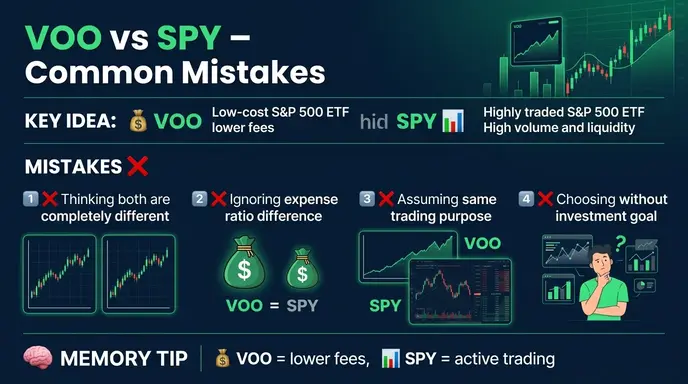
Thinking VOO and SPY Are Completely Different Investments
❌ VOO and SPY invest in different markets.
✅ Both mainly track the S&P 500 index.
Their holdings are very similar.
Ignoring Expense Ratios
❌ ETF fees do not matter long term.
✅ Lower fees can significantly affect returns over time.
Costs compound over years.
Assuming SPY Always Performs Better
❌ SPY always outperforms VOO.
✅ Performance is usually very close because both track the same index.
Structure differences matter more than returns.
Choosing Based Only on Popularity
❌ The most famous ETF is always best.
✅ Investment goals should guide ETF selection.
Strategy matters.
Confusing Trading and Investing Goals
❌ Active trading and long term investing require the same ETF priorities.
✅ Liquidity and fees matter differently depending on strategy.
Purpose changes the ideal choice.
🏡 Real Life Examples with VOO and SPY
🧓 Retirement Investing
Many retirement investors choose VOO for long term holding.
📱 Day Trading Activity
Active traders often use SPY because of high market liquidity.
💵 Passive Index Investing
Both ETFs are popular for broad market exposure.
📊 Options Trading
SPY is widely used for options strategies and market hedging.
🎯 WHEN TO USE EACH
Use VOO When:
✔ Investing long term
✔ Prioritizing lower fees
✔ Building retirement portfolios
✔ Following passive investing strategies
Use SPY When:
✔ Day trading actively
✔ Trading options frequently
✔ Needing maximum liquidity
✔ Managing institutional trading strategies
🤯 WHY PEOPLE GET CONFUSED IN VOO AND SPY
- Both track the S&P 500
- Both contain similar companies
- Performance often looks nearly identical
- Both are extremely popular ETFs
⚙️ How Investors Understand VOO vs SPY
Investors separate these ETFs based on:
- Expense ratios
- Trading liquidity
- Investment time horizon
- Trading strategy needs
👉 Long term investors often focus on costs, while traders focus on liquidity.
🧑💼 EXPERT INSIGHT
In real investing scenarios, the difference between VOO and SPY is usually less about investment returns and more about how investors use them. Since both track the S&P 500, their performance remains very similar most of the time. The biggest practical difference comes from fees and trading flexibility.
One important insight many beginners overlook is that small fee differences can become meaningful over decades of investing. Meanwhile, professional traders often care more about liquidity, options activity, and rapid trade execution, which explains SPY’s popularity in trading environments.
👉 Key insight:
VOO focuses more on low cost long term investing, while SPY focuses more on trading flexibility and liquidity.
❓ FAQ:
❓ What is the difference between VOO and SPY?
VOO has lower fees and is popular for long term investing, while SPY is more popular for active trading because of higher liquidity.
❓ Do VOO and SPY track the same index?
Yes, both track the S&P 500 index.
❓ Which ETF has lower fees?
VOO usually has a lower expense ratio.
❓ Why do traders prefer SPY?
SPY has extremely high trading volume and options activity.
❓ Which is better for retirement investing?
Many long term investors prefer VOO because of lower costs.
❓ Do VOO and SPY hold the same stocks?
They hold many of the same large U.S. companies.
❓ Is performance very different?
Usually no, because both follow the same index.
❓ Can beginners invest in either ETF?
Yes, both are commonly used by beginner and experienced investors.
🏁 Conclusion
The difference between VOO and SPY mainly comes down to fees, liquidity, and investing style. VOO is often preferred for low cost long term investing, while SPY is commonly favored for active trading and options activity because of its massive liquidity.
Understanding this difference helps investors choose the ETF that best matches their financial goals and strategy. In simple terms, VOO focuses on efficient long term investing, while SPY focuses on trading flexibility and market activity.
Once you understand how fees and trading needs affect investing decisions, choosing between VOO and SPY becomes much easier.
Discover More Articles:

Hi, I’m Nabeel Hassan. I love exploring interesting topics and explaining how different things compare with each other. Through my writing, I aim to provide clear, helpful, and easy to read explanations. I cover subjects related to learning, science, technology and general knowledge.