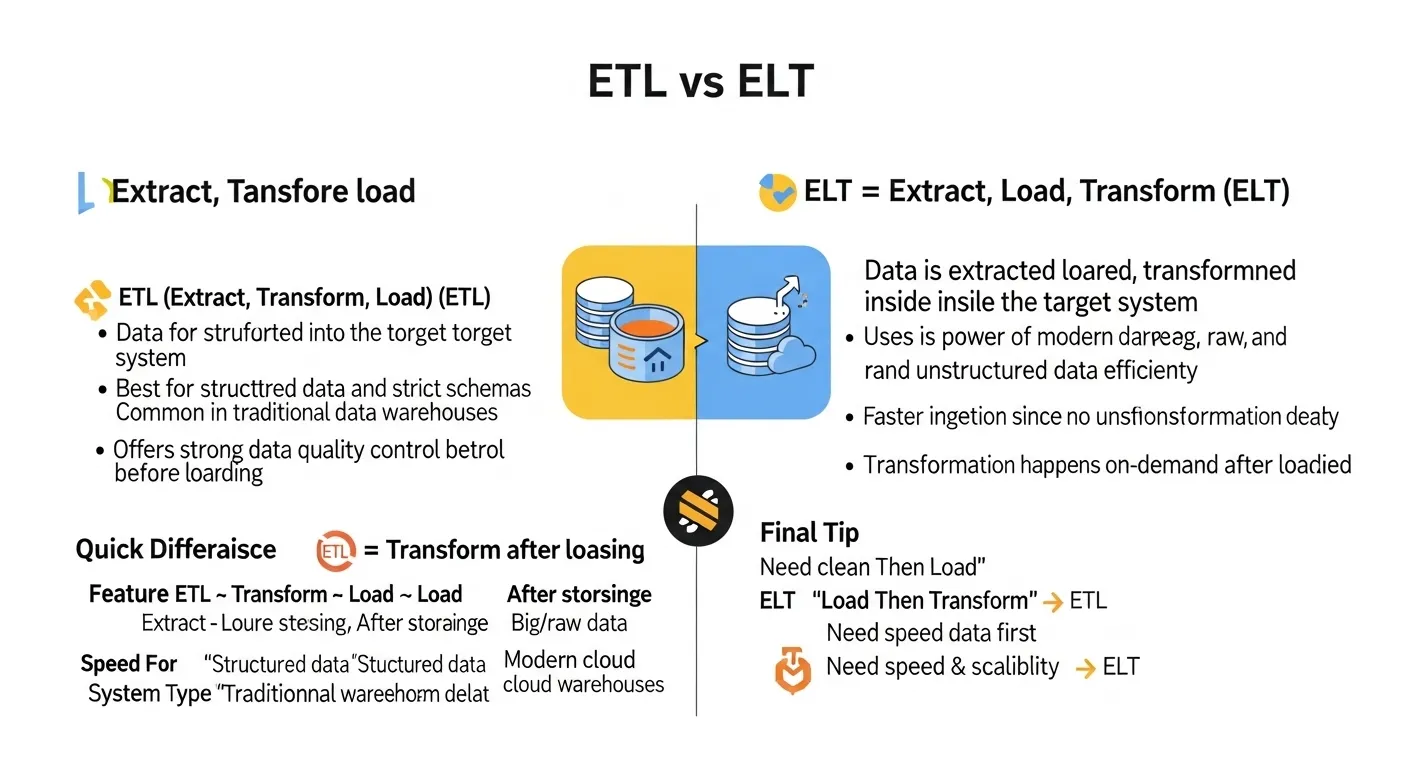
The difference between ETL and ELT is that ETL transforms data before loading it into a system, while ELT loads raw data first and then transforms it inside the system.
Many developers and data analysts get confused about the difference between ETL and ELT, especially when working with modern data pipelines and cloud platforms.
If you’ve ever wondered what is ETL vs ELT, how data flows in each method, or which one to use, this guide will clearly explain the difference between ETL and ELT in a simple and practical way.
⚡ Quick Answer: Difference Between ETL and ELT
- ETL: Extract → Transform → Load
- ELT: Extract → Load → Transform
👉 Example: ETL cleans data before storing, ELT stores first then processes it.
📖 Definition of Difference Between ETL and ELT
- ETL: A data integration process where data is extracted, transformed into a usable format, and then loaded into a database or warehouse.
- ELT: A data process where raw data is first loaded into a system and then transformed within that system.
🔊 Pronunciation (US & UK)
- ETL: UK /ˌiː.tiːˈel/ | US /ˌiː.tiːˈel/
- ELT: UK /ˌiː.elˈtiː/ | US /ˌiː.elˈtiː/
Now let’s break it down clearly.
📊 Comparison Table: ETL vs ELT
| Feature | ETL | ELT | Explanation |
| Process Order | Transform before load | Transform after load | Core difference |
| Data Storage | Cleaned data | Raw data | Data handling |
| Speed | Slower | Faster | Performance |
| Flexibility | Limited | High | Adaptability |
| System Type | Traditional systems | Cloud-based systems | Usage |
| Complexity | Higher upfront | Distributed | Workflow |
| Cost | Higher processing cost | Lower with cloud | Efficiency |
| Use Case | Structured data | Big data | Application |
🔍 KEY DIFFERENCES EXPLAINED BETWEEN ETL AND ELT
1️⃣ Process Flow
ETL transforms data first, ELT loads first.
👉 Example: Order of operations differs
2️⃣ Data Handling
ETL stores processed data, ELT stores raw data.
👉 Example: ELT keeps original data
3️⃣ Performance
ELT is faster due to modern systems.
👉 Example: Cloud processing power
4️⃣ Flexibility
ELT allows reprocessing anytime.
👉 Example: Raw data can be reused
5️⃣ Infrastructure
ETL works with traditional systems, ELT with cloud platforms.
👉 Example: Modern tools favor ELT
6️⃣ Scalability
ELT scales better with large datasets.
👉 Example: Big data environments
💡 What Is the Difference Between ETL and ELT in Simple Words?
In simple words, ETL processes data before storing it, while ELT stores data first and processes it later.
👉 Clean first vs store first.
🧠 Why Do ETL and ELT Exist?
They exist to solve different data processing needs:
- ETL for controlled, structured data environments
- ELT for large-scale, flexible data systems
👉 Both help manage data efficiently.
🌍 Difference Between ETL and ELT in Real Life
In real scenarios:
- ETL is used in older data warehouses
- ELT is used in modern cloud systems
👉 Choice depends on system architecture.
⚖️ DIFFERENCE + SIMILARITY TABLE GENERATION
| Feature | ETL | ELT | Similarity |
| Purpose | Data processing | Data processing | Same goal |
| Type | Pipeline | Pipeline | Data workflows |
| Use | Data integration | Data integration | System use |
| Output | Processed data | Processed data | Final result |
| Tools | Software tools | Software tools | Technology |
| Function | Transform data | Transform data | Data handling |
This table clearly shows the difference and similarity between difference between ETL and ELT for quick understanding.
Common Mistakes with Difference Between ETL and ELT
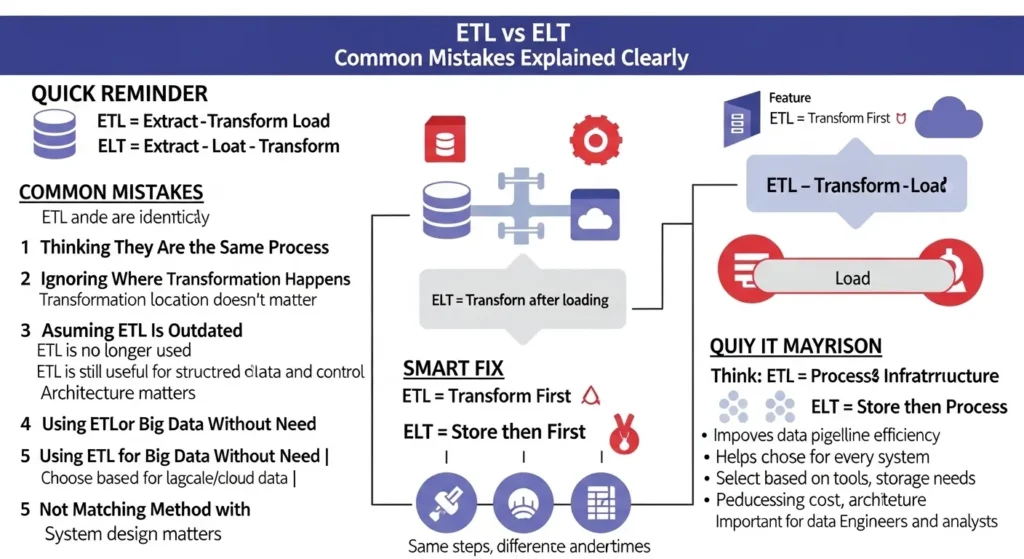
❌ Mistake 1: Thinking they are the same
✔ Fix: Order of steps is different
❌ Mistake 2: Using ETL for big data unnecessarily
✔ Fix: ELT is better for large datasets
❌ Mistake 3: Ignoring infrastructure
✔ Fix: Choose based on system type
❌ Mistake 4: Misunderstanding flexibility
✔ Fix: ELT allows more data reuse
🌍 Real Life Examples
1️⃣ Business Reports
ETL prepares clean data before analysis
2️⃣ Cloud Analytics
ELT loads raw data into cloud platforms
3️⃣ Data Warehousing
ETL used in traditional systems
4️⃣ Big Data Processing
ELT used in modern large-scale systems
🎯 WHEN TO USE EACH
Use ETL when:
✔ You need clean data before storage
✔ Working with structured systems
Use ELT when:
✔ You handle large datasets
✔ Using cloud-based platforms
🤔 WHY PEOPLE GET CONFUSED
- Similar names
- Same purpose (data processing)
- Overlapping tools
- Lack of technical clarity
⚙️ How Data Systems Understand ETL or ELT
Modern platforms like Google, Amazon, and Microsoft support ELT more due to cloud capabilities:
- ETL = traditional pipeline
- ELT = cloud-native pipeline
👉 This helps optimize performance and scalability.
🧑💼 EXPERT INSIGHT
In real scenarios, the shift from ETL to ELT reflects the evolution of data systems.
Most beginners focus only on the process order, but experienced data engineers consider storage power, scalability, and flexibility. ELT preferred in modern architectures because it allows storing raw data and transforming it multiple times as needed.
👉 Key insight:
ETL is controlled and structured, ELT is flexible and scalable.
❓ FAQ Section
❓ What is the difference between ETL and ELT?
ETL transforms data before loading, ELT transforms after loading.
❓ Which is faster, ETL or ELT?
ELT is generally faster.
❓ Which is better for big data?
ELT is better for large datasets.
❓ Is ETL outdated?
No, it is still used in many systems.
❓ Can ELT replace ETL?
In some cases, yes.
❓ Which is used in cloud systems?
ELT is commonly used.
❓ Do both process data?
Yes, both handle data transformation.
❓ Why is ELT popular?
Because of scalability and flexibility.
🏁 Conclusion
The difference between ETL and ELT lies in how and when data is transformed. ETL processes data before storing it, making it suitable for structured environments, while ELT stores raw data first and transforms it later, making it ideal for modern cloud-based systems.
Understanding this difference helps you choose the right data pipeline for your needs. In simple terms, ETL focuses on control and cleanliness, while ELT focuses on flexibility and scalability.
Once you understand this, managing data workflows becomes much more efficient and effective.
Discover More Articles:

Hi, I’m Nabeel Hassan. I love exploring interesting topics and explaining how different things compare with each other. Through my writing, I aim to provide clear, helpful, and easy to read explanations. I cover subjects related to learning, science, technology and general knowledge.