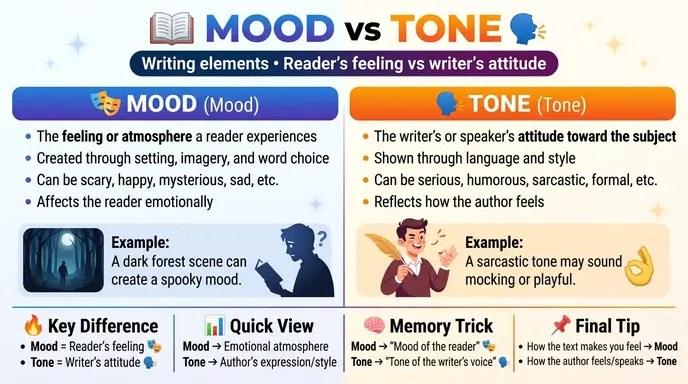
The difference between mood and tone is that tone reflects the writer’s or speaker’s attitude toward a subject, while mood describes the emotional feeling experienced by the reader or audience.
Many students and readers search for the difference between mood and tone because both relate to emotions in writing, literature, movies, speeches, and storytelling, yet they affect communication in different ways.
In simple words, tone comes from the author, while mood comes from the audience’s emotional response. Understanding the difference between mood and tone helps improve reading comprehension, literary analysis, creative writing, communication skills, and interpretation of stories or media.
💡 Quick Answer: Difference Between Mood or Tone
Tone is the writer’s attitude, while mood is the feeling created in the reader.
👉 Example:
A sarcastic tone may create an uncomfortable or humorous mood for readers.
📘 Definition of Mood and Tone
- Mood: The emotional atmosphere or feeling a reader experiences while reading or viewing content.
- Tone: The writer’s, speaker’s, or creator’s attitude toward the subject or audience.
🗣️ Pronunciation (US & UK)
- Mood
- US: /muːd/
- UK: /muːd/
- Tone
- US: /toʊn/
- UK: /təʊn/
These terms are commonly used in literature, poetry, storytelling, film analysis, communication studies, and classroom discussions.
📊 Comparison Table: Mood vs Tone
| Feature | Mood | Tone | Similarity |
| Main Meaning | Emotional feeling of the audience | Writer’s or speaker’s attitude | Both affect communication |
| Focus | Reader or viewer response | Author or speaker perspective | Both shape interpretation |
| Emotional Role | Creates atmosphere | Expresses attitude | Both influence storytelling |
| Source | Felt by audience | Created by creator | Both use language and style |
| Example | Suspenseful feeling | Serious or sarcastic attitude | Both appear in literature |
| Audience Effect | Influences emotions | Influences perception | Both affect understanding |
| Usage Area | Reading and emotional experience | Writing style and expression | Both used in literary analysis |
| Communication Purpose | Sets emotional environment | Shows opinion or feeling | Both support deeper meaning |
This table clearly shows the difference and similarity between mood and tone for quick understanding.
🧠 Key Differences Explained Between Tone and Mood
😊 Audience Feeling vs Writer Attitude
The biggest difference between mood and tone is perspective. Mood focuses on how readers feel, while tone focuses on how the writer feels.
👉 Example:
A horror story may use a fearful mood and a serious tone.
✍️ Source of Emotion
Tone comes from the writer’s language choices, while mood develops inside the reader.
📚 Literary Function
Tone helps reveal the creator’s attitude, while mood builds emotional atmosphere.
👉 Example:
A hopeful tone can create an uplifting mood.
🎭 Emotional Impact
Mood affects emotional experience directly, while tone guides interpretation.
🗣️ Communication Style
Tone may sound formal, angry, humorous, sarcastic, or optimistic.
🌌 Atmosphere Creation
Mood helps shape the emotional environment of stories, poems, films, and speeches.
🎬 Media and Storytelling Use
Movies, novels, music, and speeches all use tone and mood together to influence audiences.
🧠 Why Mood and Tone Get Confused
The difference between mood and tone becomes confusing because both involve emotions and emotional reactions. In many stories, the writer’s tone directly influences the reader’s mood, making them closely connected.
🌐 How Literature and Media Use Mood and Tone
Creative industries classify:
- Tone as the creator’s attitude or emotional voice
- Mood as the emotional atmosphere experienced by audiences
Writers, filmmakers, teachers, and communication experts analyze both concepts to understand storytelling impact and audience engagement.
Platforms like Netflix, Disney, and YouTube use mood and tone heavily in visual storytelling, scripts, music, and audience experience design.
📊 Difference + Similarity Table
| Feature | Mood | Tone | Similarity |
| Meaning | Reader’s emotional feeling | Writer’s emotional attitude | Both influence communication |
| Emotional Focus | Audience response | Creator perspective | Both affect storytelling |
| Main Purpose | Create atmosphere | Express attitude | Both shape interpretation |
| Example | Tense or peaceful feeling | Angry or cheerful expression | Both use emotional language |
| Source | Reader experience | Writer or speaker choice | Both appear in media and literature |
| Literary Role | Builds emotional setting | Reveals viewpoint | Both improve narrative depth |
| Reader Effect | Creates emotional reaction | Shapes understanding | Both influence audience engagement |
| Communication Area | Emotional atmosphere | Language style and attitude | Both support creative expression |
This table clearly shows the difference and similarity between mood and tone for quick understanding.
📖 Deep Explanation: How Tone Creates Mood
Tone and mood work together in communication:
- Writers choose specific words and style
- Tone reflects attitude or emotional voice
- Readers react emotionally to that tone
- Mood develops through the reader’s experience
👉 Example:
- A gloomy tone using dark descriptions may create a sad or mysterious mood.
- A playful tone may create a cheerful mood.
This connection is why tone and mood are often studied together in literature and media analysis.
⚠️ Common Mistakes with Difference Between Mood and Tone
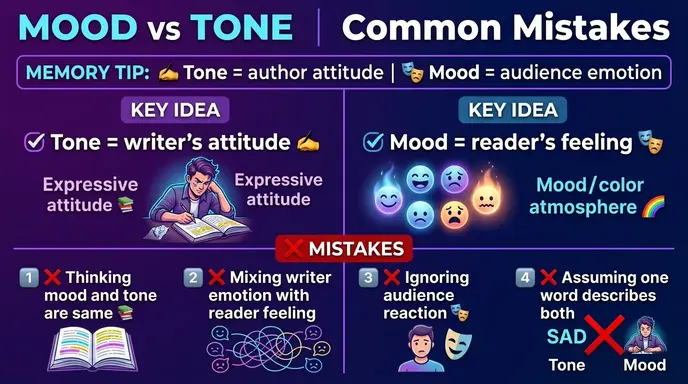
Thinking Mood and Tone Mean the Same Thing
❌ Mood and tone are identical literary terms.
✅ Tone is the creator’s attitude, while mood is the audience’s feeling.
Confusing Reader and Writer Roles
❌ Mood describes the author’s opinion.
✅ Mood describes the emotional experience of readers.
Ignoring Emotional Perspective
❌ Tone always represents audience emotions.
✅ Tone reflects the speaker’s or writer’s attitude.
Using Terms Incorrectly
❌ A suspenseful atmosphere is always tone.
✅ Suspenseful atmosphere usually relates to mood.
Believing Tone Only Exists in Literature
❌ Tone only appears in novels and poems.
✅ Tone also appears in speeches, movies, music, and conversations.
Assuming Mood Is Always Intentional
❌ Readers always feel the exact same mood.
✅ Different audiences may experience mood differently.
🧑💼 Real Life Examples with Mood and Tone
- Horror movies creating fearful mood
- Motivational speeches using inspiring tone
- Sad music creating emotional mood
- Sarcastic dialogue showing humorous tone
- Romantic novels creating warm mood
- News reports using serious tone
🎯 When to Focus on Mood or Tone
- Analyzing reader emotions → mood
- Studying author attitude → tone
- Understanding story atmosphere → mood
- Understanding writing style → tone
- Examining emotional impact → mood
- Interpreting communication intention → tone
🤔 Why People Get Confused in Mood and Tone
- Both relate to emotions
- Literature classes often teach them together
- Tone influences mood directly
- Emotional language overlaps in both concepts
- Many examples contain both simultaneously
🧠 How Communication Systems Understand Mood and Tone
Language and communication studies classify:
- Tone as emotional expression from the creator
- Mood as emotional reception from the audience
Modern storytelling systems analyze:
- Word choice
- Visual atmosphere
- Sound design
- Dialogue style
- Audience emotional response
This helps writers and creators build stronger emotional experiences.
🧠 Expert Insight
The difference between mood and tone is essential in literature, storytelling, and communication analysis. Tone represents the creator’s emotional attitude, while mood represents the emotional atmosphere experienced by the audience.
In practical reading and writing situations, identifying who is expressing emotion and who is feeling emotion is the fastest way to separate tone from mood correctly.
❓ FAQ:
1. What is the main difference between mood and tone?
Tone is the writer’s attitude, while mood is the feeling experienced by readers.
2. Can tone affect mood?
Yes, tone strongly influences the mood created in audiences.
3. Is mood created by the reader?
Yes, mood is the emotional response felt by the audience.
4. What are examples of tone?
Serious, sarcastic, cheerful, angry, and formal are common tones.
5. What are examples of mood?
Fearful, peaceful, tense, romantic, and joyful are common moods.
6. Are mood and tone used only in literature?
No, they also appear in movies, speeches, music, and communication.
7. Why do students confuse mood and tone?
Because both involve emotions and often appear together.
🧾 Conclusion
The difference between mood and tone comes from emotional perspective and communication role. Tone reflects the writer’s or speaker’s attitude toward a subject, while mood describes the emotional atmosphere experienced by readers or audiences.
Understanding the difference between mood and tone improves literary analysis, reading comprehension, writing skills, and communication interpretation. Once you connect tone with the creator’s attitude and mood with the audience’s emotional response, the distinction becomes much easier to understand in literature, media, and everyday communication.
Discover More Articles:

I’m Owen Parker, and I write articles that focus on explaining the differences between common concepts, tools, and ideas. I enjoy simplifying complex information and turning it into clear comparisons that anyone can understand. My work often covers science , education, technology, and everyday knowledge topics.