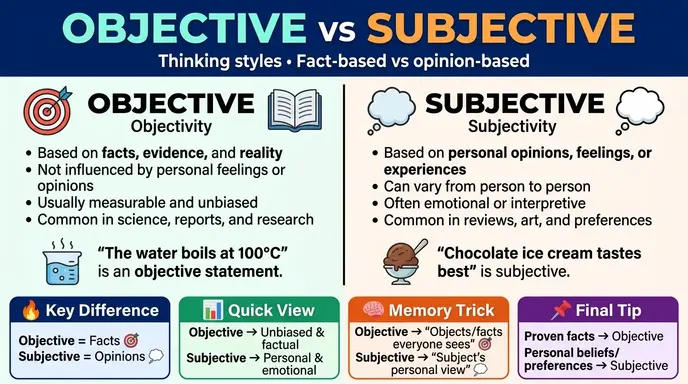
The difference between objective and subjective is that objective information is based on facts, evidence, and measurable reality, while subjective information is based on personal opinions, feelings, beliefs, or experiences.
Many students, writers, and professionals search for the difference between objective and subjective because these terms are widely used in education, journalism, science, communication, and daily conversations.
In simple words, objective statements can usually be proven true or false, while subjective statements depend on personal interpretation. Understanding the difference between objective and subjective helps people improve critical thinking, writing skills, decision-making, media analysis, and communication clarity.
💡 Quick Answer: Difference Between Objective or Subjective
Objective means fact-based and unbiased, while subjective means opinion-based and influenced by personal feelings.
👉 Example:
“The temperature is 30°C” is objective, while “the weather feels terrible” is subjective.
📘 Definition of Objective and Subjective
- Objective: Based on facts, evidence, or observable reality without personal bias.
- Subjective: Based on personal opinions, emotions, experiences, or interpretations.
🗣️ Pronunciation (US & UK)
- Objective
- US: /əbˈdʒek.tɪv/
- UK: /əbˈdʒek.tɪv/
- Subjective
- US: /səbˈdʒek.tɪv/
- UK: /səbˈdʒek.tɪv/
These terms are commonly used in education, science, psychology, journalism, debates, writing, and professional communication.
📊 Comparison Table: Objective vs Subjective
| Feature | Objective | Subjective | Similarity |
| Main Meaning | Based on facts and evidence | Based on opinions and feelings | Both describe viewpoints or information |
| Personal Bias | Minimal or absent | Strongly influenced by personal views | Both used in communication |
| Verification | Can often be proven | Cannot always be proven | Both affect interpretation |
| Emotional Influence | Usually neutral | Emotionally influenced | Both appear in writing and speech |
| Common Usage | Science, reporting, data | Reviews, opinions, emotions | Both used in discussions |
| Reliability Style | Measurable and factual | Personal and interpretive | Both can provide useful insights |
| Audience Impact | Focuses on accuracy | Focuses on personal experience | Both shape understanding |
| Example | “Water freezes at 0°C” | “Winter is depressing” | Both express information |
This table clearly shows the difference and similarity between objective and subjective for quick understanding.
🧠 Key Differences Explained Between Subjective and Objective
📌 Facts vs Opinions
The biggest difference between objective and subjective is that objective information relies on facts, while subjective information depends on personal feelings or opinions.
👉 Example:
“Earth orbits the sun” is objective, while “space is fascinating” is subjective.
🧠 Personal Influence
Subjective statements are shaped by emotions, beliefs, and experiences.
📊 Measurability
Objective information can usually be measured, tested, or verified.
👉 Example:
A scientific experiment uses objective observations instead of personal opinions.
🎭 Emotional Connection
Subjective language often expresses emotion or personal judgment.
📰 Communication Purpose
Objective communication focuses on accuracy, while subjective communication focuses on perspective or interpretation.
📚 Educational and Professional Use
Schools, journalism, and research often prefer objective analysis for reliability.
🎨 Creative Expression
Subjective thinking is common in art, reviews, storytelling, and personal experiences.
🧠 Why Objective and Subjective Get Confused
The difference between objective and subjective becomes confusing because many real-world situations contain both facts and opinions together. A person may describe objective details while also expressing subjective feelings in the same sentence.
🌐 How Communication Systems Use Objective and Subjective Information
Modern communication systems classify:
- Objective content as factual and evidence-based
- Subjective content as opinion-based or emotionally influenced
Platforms like Google, YouTube, and Meta analyze objective and subjective content differently in reviews, news discussions, recommendations, and audience engagement systems.
For example:
- News reporting often aims for objectivity
- Personal reviews and social posts are commonly subjective
📊 Difference + Similarity Table
| Feature | Objective | Subjective | Similarity |
| Meaning | Fact-based information | Opinion-based interpretation | Both communicate ideas |
| Emotional Influence | Neutral or limited | Emotionally influenced | Both affect understanding |
| Verification Ability | Testable or measurable | Personal and interpretive | Both may shape decisions |
| Common Usage | Research and reporting | Reviews and opinions | Both appear in media |
| Perspective | External reality focus | Personal viewpoint focus | Both involve communication |
| Reliability Type | Evidence-centered | Experience-centered | Both can be meaningful |
| Language Style | Precise and factual | Expressive and emotional | Both use descriptive language |
| Audience Reaction | Encourages analysis | Encourages emotional connection | Both influence perception |
This table clearly shows the difference and similarity between objective and subjective for quick understanding.
📖 Deep Explanation: Why Both Objective and Subjective Thinking Matter
Objective and subjective thinking both serve important purposes:
- Objective thinking improves accuracy and fairness
- Subjective thinking helps express emotions and experiences
- Communication often combines both approaches
👉 Example:
A movie critic may objectively discuss film length and camera quality while subjectively describing emotional impact.
In practical situations:
- Science relies heavily on objective evidence
- Art and personal storytelling often rely on subjective interpretation
Balanced communication often uses both effectively.
⚠️ Common Mistakes with Difference Between Objective and Subjective
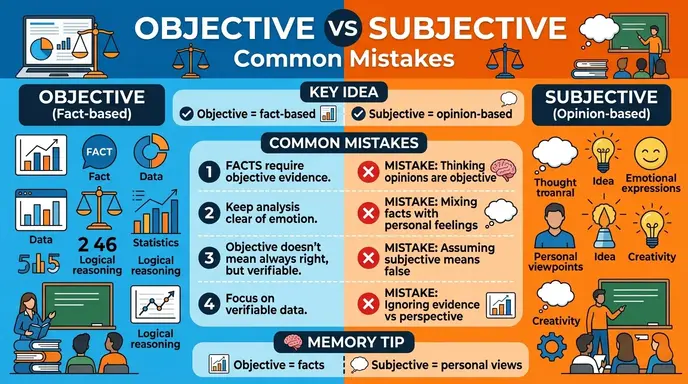
Thinking Objective Means Completely Perfect
❌ Objective information is always flawless.
✅ Objective information aims to reduce personal bias using facts and evidence.
Assuming Subjective Means False
❌ Subjective opinions are automatically incorrect.
✅ Subjective statements reflect personal perspectives and experiences.
Confusing Facts with Feelings
❌ Personal emotions always represent objective truth.
✅ Feelings are usually subjective interpretations.
Using Terms Incorrectly
❌ “Chocolate tastes better than vanilla” is objective.
✅ Taste preferences are subjective opinions.
Ignoring Context
❌ All communication must be objective.
✅ Different situations require different communication styles.
Believing Objectivity Removes All Human Influence
❌ Humans can always be perfectly objective.
✅ Complete objectivity can be difficult because people naturally have perspectives.
🧑💼 Real Life Examples with Objective and Subjective
- Scientific research using objective measurements
- Product reviews sharing subjective experiences
- Journalists reporting factual information
- Movie critics expressing personal opinions
- Teachers grading objective test questions
- Social media posts reflecting subjective emotions
🎯 When to Use Objective or Subjective Communication
- Reporting measurable facts → objective
- Sharing personal experiences → subjective
- Scientific discussions → objective
- Art and creative reviews → subjective
- Data analysis → objective
- Emotional storytelling → subjective
🤔 Why People Get Confused in Objective and Subjective
- Real conversations often mix facts and opinions
- Personal beliefs may feel factual to individuals
- Emotional language can sound convincing
- Media discussions may blend evidence and interpretation
- Everyday communication rarely stays completely objective or subjective
🧠 How Information Systems Understand Objective and Subjective Content
Modern information systems analyze:
- Factual accuracy
- Emotional language
- Opinion markers
- Sentiment patterns
- Evidence references
This helps platforms and communication tools separate factual reporting from opinion-based discussion.
🧠 Expert Insight
The difference between objective and subjective is essential for critical thinking, communication, and information analysis. Objective thinking focuses on evidence and measurable facts, while subjective thinking reflects human emotion, interpretation, and personal experience.
In practical communication, understanding whether a statement is fact-based or opinion-based helps people evaluate information more accurately and avoid misunderstandings.
❓ FAQ: Difference Between Subjective or Objective
1. What is the main difference between objective and subjective?
Objective information is fact-based, while subjective information is opinion-based.
2. Can subjective opinions be useful?
Yes, subjective opinions help express experiences and emotions.
3. Is science usually objective?
Yes, science aims to rely on measurable evidence and objective analysis.
4. Are emotions subjective?
Yes, emotions are usually personal and subjective.
5. Can writing include both objective and subjective elements?
Yes, many forms of communication combine facts and opinions.
6. Why is objective thinking important?
It improves fairness, accuracy, and evidence-based understanding.
7. Why do people confuse objective and subjective?
Because facts and personal interpretations often appear together in communication.
🧾 Conclusion
The difference between objective and subjective comes from facts versus personal interpretation. Objective information focuses on evidence, measurable reality, and reduced bias, while subjective information reflects opinions, emotions, beliefs, and individual experiences.
Understanding the difference between objective and subjective improves communication, critical thinking, media literacy, and decision-making. Once you connect objective with facts and subjective with personal perspective, the distinction becomes much easier to recognize in education, media, science, and everyday life.
Discover More Articles:

Hi, I’m Nabeel Hassan. I love exploring interesting topics and explaining how different things compare with each other. Through my writing, I aim to provide clear, helpful, and easy to read explanations. I cover subjects related to learning, science, technology and general knowledge.