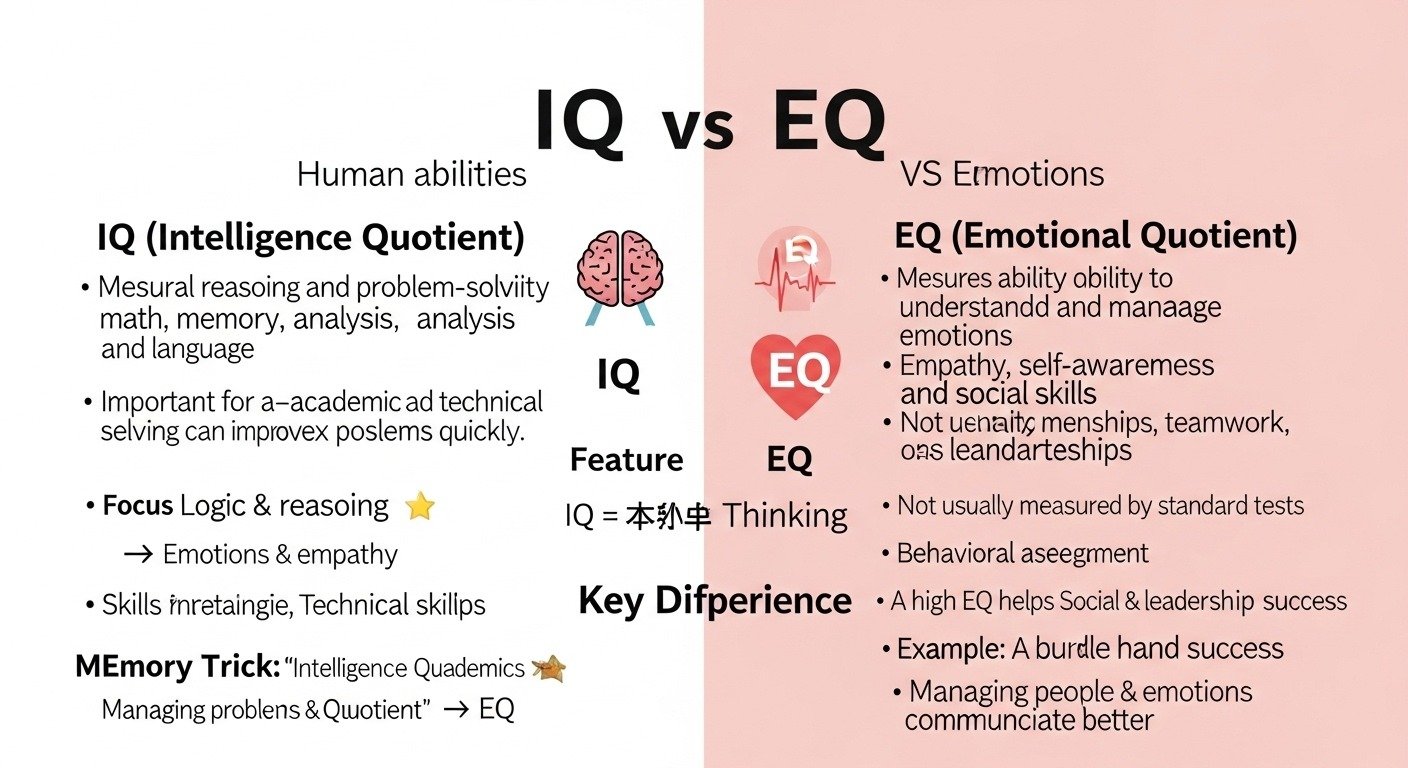
The difference between IQ and EQ is mainly about the type of intelligence they measure.
IQ (Intelligence Quotient) focuses on logical reasoning, problem-solving, and academic ability, while
EQ (Emotional Quotient) focuses on understanding and managing emotions both your own and others’.
Understanding the difference between IQ and EQ helps in personal growth, career success, and relationships. In simple terms, IQ is about thinking smart, while EQ is about feeling and relating smart.
🧠 Key Difference Between the Both
The main difference lies in thinking vs emotions.
- IQ: Logical and analytical intelligence
- EQ: Emotional and social intelligence
Examples:
- IQ helps solve math problems.
- EQ helps handle relationships.
🌟 Why Is Their Difference Important?
Understanding the difference between IQ and EQ is important because success in life depends on both mental ability and emotional skills. While IQ may help in academics and technical work, EQ plays a key role in communication, leadership, and teamwork. Knowing the difference between IQ and EQ helps balance intelligence with emotional awareness.
🔊 Pronunciation (US & UK)
| Term | US Pronunciation | UK Pronunciation |
| IQ | /ˌaɪˈkjuː/ | /ˌaɪˈkjuː/ |
| EQ | /ˌiːˈkjuː/ | /ˌiːˈkjuː/ |
➡️ Now let’s explore the detailed difference between IQ and EQ step by step.
🌐 Difference Between IQ and EQ
1️⃣ Definition
IQ measures cognitive abilities like reasoning and memory.
EQ measures emotional awareness and control.
Examples:
- IQ tests intelligence level.
- EQ measures emotional skills.
2️⃣ Focus Area
IQ focuses on logic and problem-solving.
EQ focuses on emotions and relationships.
Examples:
- IQ helps in analysis.
- EQ helps in communication.
3️⃣ Skills Involved
IQ includes math, reasoning, and language skills.
EQ includes empathy, self-control, and social skills.
Examples:
- IQ solves puzzles.
- EQ resolves conflicts.
4️⃣ Measurement
IQ is measured through standardized tests.
EQ is measured through behavioral assessments.
Examples:
- IQ score (e.g., 100, 120).
- EQ level based on emotional responses.
5️⃣ Importance in Life
IQ is important for academic success.
EQ is important for social and professional success.
Examples:
- IQ helps pass exams.
- EQ helps build relationships.
6️⃣ Stability
IQ is relatively stable over time.
EQ can be improved with practice.
Examples:
- IQ changes slowly.
- EQ can grow with experience.
7️⃣ Workplace Role
IQ helps in technical and analytical jobs.
EQ helps in leadership and teamwork.
Examples:
- IQ used in engineering tasks.
- EQ used in management roles.
8️⃣ Decision Making
IQ supports logical decisions.
EQ supports emotional and balanced decisions.
Examples:
- IQ analyzes facts.
- EQ considers feelings.
9️⃣ Communication
IQ focuses less on communication style.
EQ improves communication and understanding.
Examples:
- IQ explains ideas.
- EQ connects with people.
🔟 Success Factor
IQ contributes to knowledge and skills.
EQ contributes to long-term success and happiness.
Examples:
- IQ builds expertise.
- EQ builds relationships.
🧠 Nature and Behaviour of Both Iq and Eq
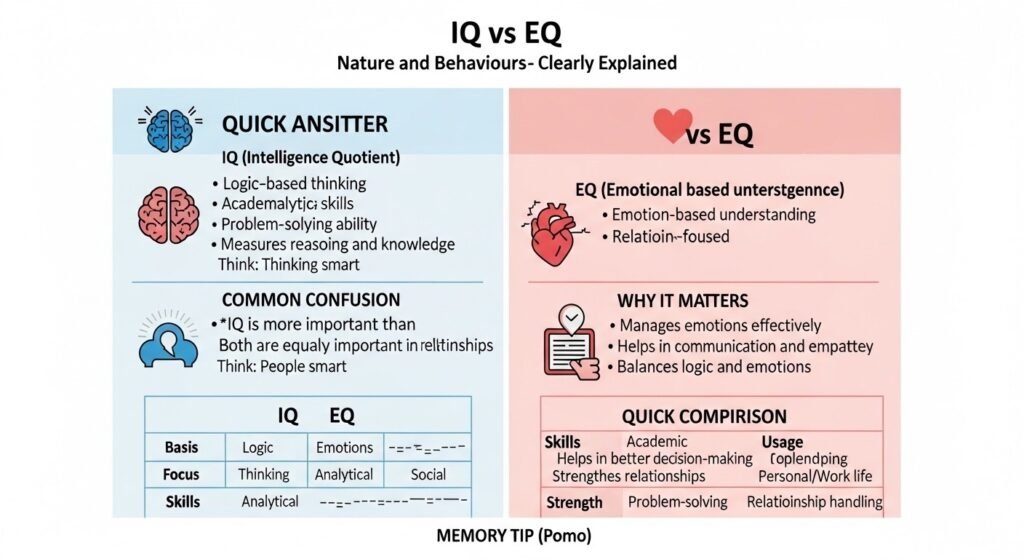
IQ
- Logic-based
- Analytical
- Academic-focused
EQ
- Emotion-based
- Social
- Relationship-focused
📊 Comparison Chart
🧠 Difference Between IQ and EQ
| Feature | IQ 🧠 | EQ ❤️ |
| Meaning | Intelligence Quotient | Emotional Quotient |
| Focus | Logic & reasoning | Emotions & relationships |
| Skills | Math, memory, analysis | Empathy, communication |
| Measurement | Standard tests | Behavioral assessment |
| Stability | Stable | Can improve |
| Role | Academic success | Social success |
| Workplace | Technical roles | Leadership roles |
| Decision Type | Logical | Emotional + logical |
| Communication | Less focus | Strong focus |
| Outcome | Knowledge | Relationships & success |
⚖️ Which Is Better in What Situation?
IQ
Best for problem-solving, academics, and technical tasks.
EQ
Best for leadership, teamwork, and personal relationships.
🎭 Use in Metaphors and Similes
Metaphor example:
- IQ is the engine of a car, while EQ is the steering wheel.
Simile example:
- IQ is like solving a puzzle, while EQ is like understanding people.
💬 Connotative Meaning
| Term | Connotation | Example |
| IQ | Intelligence, logic | He has a high IQ. |
| EQ | Empathy, awareness | She has strong EQ. |
🗣️ Expressions
- High IQ score
- Emotional intelligence (EQ)
- Balance IQ and EQ
📚 Psychological Context
IQ and EQ are widely studied in psychology, education, and workplace development to understand human intelligence and behavior.
❔ Frequently Asked Questions
1. What is the main difference between IQ and EQ?
IQ measures intelligence, while EQ measures emotional skills.
2. Which is more important?
Both are important for success.
3. Can EQ be improved?
Yes, with practice and experience.
4. Is IQ fixed?
It is relatively stable but can develop slightly.
5. Do successful people need both?
Yes, balance of both is ideal.
🌍 Importance in Daily Life
Understanding the difference between IQ and EQ helps improve learning, communication, relationships, and career growth.
✍️ Final Words
The difference between IQ and EQ lies in thinking versus feeling. IQ helps you understand and solve problems, while EQ helps you connect with people and manage emotions. Both are essential for a balanced life.
🏁 Conclusion
Knowing the difference between IQ and EQ helps you grow both intellectually and emotionally. While IQ builds knowledge, EQ builds relationships and success. Together, they create a complete form of intelligence.
Discover More Articles:

I’m Owen Parker, and I write articles that focus on explaining the differences between common concepts, tools, and ideas. I enjoy simplifying complex information and turning it into clear comparisons that anyone can understand. My work often covers science , education, technology, and everyday knowledge topics.