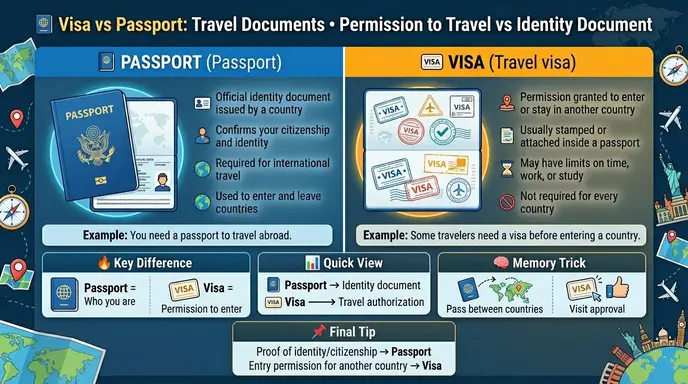
The difference between visa and passport is that a passport is an official identity and travel document issued by a country, while a visa is official permission allowing someone to enter, stay, or travel within another country for a specific purpose and time.
Many travelers search for the difference between visa and passport because both are required for international travel, yet they serve completely different functions.
In simple words, a passport proves who you are and where you are from, while a visa gives permission to visit another country. Understanding the difference between visa and passport helps travelers avoid confusion during international trips, immigration checks, student applications, business travel, and tourism planning.
💡 Quick Answer: Difference Between Visa or Passport
A passport identifies the traveler and nationality, while a visa grants permission to enter another country.
👉 Example: A person may use a Pakistani passport for identity and then receive a visa to visit the United Kingdom.
📘 Definition of Visa and Passport
- Passport: A government-issued travel document that confirms a person’s identity and nationality.
- Visa: An official authorization placed in or linked to a passport allowing entry into another country for a specific purpose.
🗣️ Pronunciation (US & UK)
- Visa
- US: /ˈviː.zə/
- UK: /ˈviː.zə/
- Passport
- US: /ˈpæs.pɔːrt/
- UK: /ˈpɑːs.pɔːt/
These terms are commonly used in immigration, airports, tourism, international business, education, and global travel systems.
📊 Comparison Table: Visa vs Passport
| Feature | Visa | Passport | Similarity |
| Main Purpose | Permission to enter another country | Identification and nationality proof | Both used for international travel |
| Issued By | Foreign country government | Traveler’s home country government | Both are official documents |
| Validity Scope | Specific country or region | Worldwide identity document | Both have expiration dates |
| Main Function | Entry authorization | Identity verification | Both checked during immigration |
| Requirement | Depends on destination country | Required for most international travel | Both support border control |
| Appearance | Stamp, sticker, or digital approval | Booklet or electronic document | Both contain personal details |
| Usage Duration | Temporary stay permission | Long-term identity document | Both must remain valid |
| Travel Role | Controls entry conditions | Enables international travel | Both important for overseas trips |
This table clearly shows the difference and similarity between visa and passport for quick understanding.
🧠 Key Differences Explained Between Passport and Visa
🌍 Identity vs Permission
The biggest difference between visa and passport is purpose. A passport identifies the traveler, while a visa provides entry permission.
👉 Example: Immigration officers first check a traveler’s passport identity and then verify visa approval.
🏛️ Issuing Authority
Passports are issued by the traveler’s own country, while visas are issued by the destination country.
✈️ Travel Requirement
A passport is usually necessary for almost all international travel, while visa requirements depend on destination rules.
👉 Example: Some countries allow visa-free travel for certain passports.
⏳ Validity Period
Passports often remain valid for several years, while visas may only allow short-term stays.
📑 Document Format
Passports are physical booklets or electronic travel documents, while visas may appear as stamps, stickers, or digital approvals.
🛂 Immigration Role
Border officers use passports to confirm identity and visas to confirm travel authorization.
🎓 Travel Purpose
Visas may be issued for tourism, study, work, business, or immigration purposes.
🧠 Why Visa and Passport Exist Separately
The difference between visa and passport exists because countries need separate systems for identity verification and border permission. Passports establish nationality and identity, while visas help governments control entry, security, and travel duration.
🌐 How International Travel Systems Use Visa and Passport
Global immigration systems classify:
- Passports as identity and nationality documents
- Visas as travel authorization approvals
Organizations like International Air Transport Association and border agencies worldwide use passport and visa systems to manage international travel security and immigration procedures.
Countries also use digital systems connected with airlines and airports to verify:
- Passport validity
- Visa status
- Travel eligibility
- Entry restrictions
📊 Difference + Similarity Table
| Feature | Visa | Passport | Similarity |
| Meaning | Entry permission document | National identity travel document | Both used internationally |
| Issued By | Destination country | Home country government | Both require official approval |
| Purpose | Controls entry and stay | Confirms identity and nationality | Both checked at borders |
| Validity | Usually short-term | Usually long-term | Both have expiration periods |
| Appearance | Sticker, stamp, or electronic approval | Travel booklet or e-passport | Both contain traveler information |
| Travel Importance | Needed for certain destinations | Needed for international travel | Both support immigration control |
| Usage | Specific country visits | Worldwide identity verification | Both required during many trips |
| Security Role | Entry management | Identity authentication | Both improve border security |
This table clearly shows the difference and similarity between visa and passport for quick understanding.
🛫 Deep Explanation: Why Travelers Often Need Both
International travel usually involves:
- Identity verification
- Nationality confirmation
- Entry permission checks
- Security screening
- Travel purpose approval
👉 Example:
A student traveling abroad may need:
- A passport from their home country
- A student visa from the destination country
Without a valid passport, a traveler cannot normally leave or enter countries. Without a required visa, entry may be denied even with a valid passport.
⚠️ Common Mistakes with Difference Between Passport or Visa
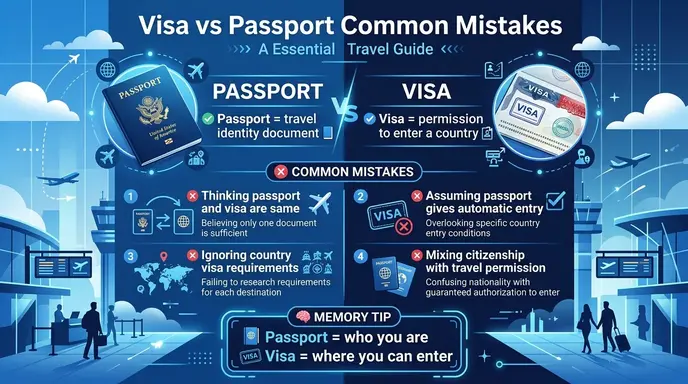
Thinking Visa and Passport Are the Same Document
❌ A visa and passport are identical travel documents.
✅ A passport proves identity, while a visa grants entry permission.
Assuming Every Country Requires a Visa
❌ All international travel always requires visas.
✅ Some countries allow visa-free travel for certain passports.
Ignoring Expiration Dates
❌ Expired travel documents still work internationally.
✅ Passports and visas must remain valid for travel.
Using Terms Incorrectly
❌ A passport is permission to enter another country.
✅ A visa provides entry authorization.
Believing a Visa Guarantees Entry
❌ Having a visa guarantees automatic border entry.
✅ Immigration officers still make final entry decisions.
Forgetting Passport Validity Rules
❌ Any passport expiration date is acceptable for travel.
✅ Many countries require several months of passport validity remaining.
🧑💼 Real Life Examples with Visa and Passport
- Tourists using passports for international vacations
- Students applying for study visas abroad
- Business travelers receiving work visas
- Immigration officers checking passports at airports
- Families renewing passports before travel
- Travelers applying for tourist visas online
🎯 When You Need a Visa or Passport
- International identity verification → passport
- Permission to enter another country → visa
- Overseas study → passport and student visa
- International tourism → passport and sometimes visa
- Business travel → passport and business visa
- Long-term relocation → passport and immigration visa
🤔 Why People Get Confused in Visa and Passport
- Both are used during international travel
- Airports and immigration check both together
- Travel agencies often mention them at the same time
- New travelers may not understand document roles
- Some countries combine digital visa systems with passport scanning
🧠 How Immigration Systems Understand Visa and Passport
Immigration systems classify:
- Passports as traveler identity documents
- Visas as entry authorization approvals
Modern border systems analyze:
- Nationality
- Visa eligibility
- Travel purpose
- Security clearance
- Stay duration
This helps countries manage immigration, tourism, security, and border control effectively.
🧠 Expert Insight
The difference between visa and passport is essential in global travel and immigration systems. A passport acts as your international identity document, while a visa determines whether another country allows you to enter for a specific reason and period.
In practical travel planning, checking passport validity and visa requirements early can prevent delays, denied boarding, or immigration problems.
❓ FAQ:
1. What is the main difference between visa and passport?
A passport proves identity and nationality, while a visa grants entry permission into another country.
2. Can someone travel internationally without a passport?
Most international travel requires a valid passport.
3. Do all countries require visas?
No, some countries allow visa-free travel depending on nationality.
4. Who issues passports?
Passports are issued by a person’s home country government.
5. Who issues visas?
Visas are issued by the destination country.
6. Can a visa expire before a passport?
Yes, visas often have shorter validity periods.
7. Does having a visa guarantee entry?
No, immigration officers still make final decisions at the border.
🧾 Conclusion
The difference between visa and passport comes from purpose, issuing authority, and travel function. A passport identifies the traveler and confirms nationality, while a visa provides legal permission to enter another country for tourism, study, work, or other approved activities.
Understanding the difference between visa and passport helps travelers prepare correctly for international trips, immigration procedures, and global mobility requirements. Once you connect passports with identity and visas with travel permission, the distinction becomes much easier to understand in modern international travel systems.
Discover More Articles:

I’m Owen Parker, and I write articles that focus on explaining the differences between common concepts, tools, and ideas. I enjoy simplifying complex information and turning it into clear comparisons that anyone can understand. My work often covers science , education, technology, and everyday knowledge topics.