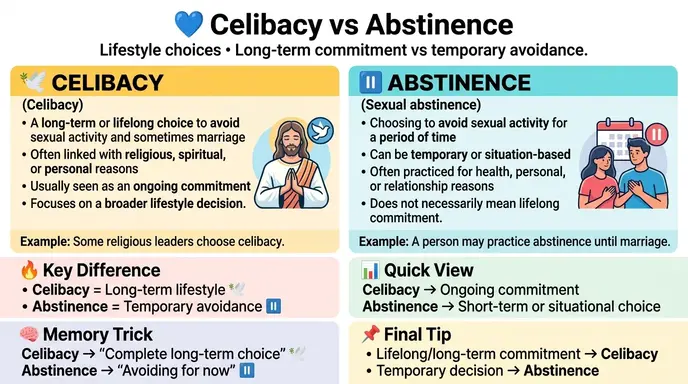
The difference between celibacy and abstinence is that celibacy is usually a long-term or lifestyle-based choice to avoid marriage or sexual relationships, while abstinence typically means temporarily choosing not to engage in sexual activity for personal, medical, religious, or social reasons.
Many people search for the difference between celibacy and abstinence because both involve avoiding sexual activity, yet their purpose, duration, and personal meaning can differ significantly.
In simple words, celibacy is often connected to a long-term commitment or spiritual lifestyle, while abstinence may be temporary and situation-based. Understanding the difference between celibacy and abstinence helps clarify discussions related to relationships, religion, health education, personal values, and lifestyle decisions.
💡 Quick Answer: Difference Between Celibacy or Abstinence
Celibacy is generally a long-term commitment to avoid sexual relationships, while abstinence is usually a temporary choice to avoid sexual activity.
👉 Example: A religious monk may practice celibacy for life, while a person may practice abstinence until marriage.
📘 Definition of Celibacy and Abstinence
- Celibacy: A long-term or lifelong commitment to avoid marriage and sexual relationships, often for religious, spiritual, or personal reasons.
- Abstinence: Choosing not to engage in sexual activity for a certain period or situation.
🗣️ Pronunciation (US & UK)
- Celibacy
- US: /ˈsel.ə.bə.si/
- UK: /ˈsel.ɪ.bə.si/
- Abstinence
- US: /ˈæb.stə.nəns/
- UK: /ˈæb.stɪ.nəns/
These terms are commonly used in relationship discussions, religious teachings, health education, psychology, and social behavior studies.
📊 Comparison Table: Celibacy vs Abstinence
| Feature | Celibacy | Abstinence | Similarity |
| Main Meaning | Long-term avoidance of sexual relationships | Temporary avoidance of sexual activity | Both involve avoiding sexual activity |
| Time Period | Often lifelong or long-term | Usually temporary | Both are personal choices |
| Common Purpose | Spiritual, religious, or lifestyle commitment | Health, personal, cultural, or relationship reasons | Both may reflect personal values |
| Marriage Connection | Sometimes includes avoiding marriage | Does not necessarily avoid marriage | Both may involve self-control |
| Flexibility | Usually more permanent | Often situation-based | Both depend on personal decisions |
| Religious Association | Strongly linked in many traditions | Sometimes linked to beliefs | Both may appear in religious contexts |
| Personal Lifestyle | Often identity-based | Often goal-based | Both involve behavioral choices |
| Social Context | Associated with religious roles or lifestyles | Common in education and relationships | Both discussed in health and society |
This table clearly shows the difference and similarity between celibacy and abstinence for quick understanding.
🧠 Key Differences Explained Between Abstinence and Celibacy
⏳ Long-Term vs Temporary Choice
The biggest difference between celibacy and abstinence is duration. Celibacy is often long-term, while abstinence is usually temporary.
👉 Example: Someone may practice abstinence during dating, but celibacy may continue for many years or even life.
🧘 Lifestyle and Identity
Celibacy is frequently connected to a lifestyle or spiritual identity.
❤️ Relationship Context
A person practicing abstinence may still pursue romantic relationships or marriage later.
👉 Example: Many couples choose abstinence before marriage without choosing lifelong celibacy.
⛪ Religious Influence
Celibacy has strong historical ties to religious traditions and spiritual dedication.
🩺 Health and Education Usage
Abstinence is commonly discussed in health education and relationship guidance.
🎯 Purpose and Motivation
Celibacy often reflects deep personal or spiritual commitment, while abstinence may relate to timing, health, or personal boundaries.
🔄 Flexibility of Choice
Abstinence can begin or end depending on circumstances, while celibacy is often viewed as a more permanent commitment.
🧠 Why Celibacy and Abstinence Get Confused
The difference between celibacy and abstinence becomes confusing because both involve avoiding sexual activity. Many people use the words interchangeably in everyday conversation, even though their meaning and intent can differ.
🌐 How Society and Education Systems Use Abstinence or Celibacy
Social and educational discussions classify:
- Celibacy as a long-term lifestyle or spiritual commitment
- Abstinence as a behavioral or personal decision
Organizations involved in public health and relationship education discuss abstinence frequently in educational settings, while celibacy is often discussed in religious, historical, or spiritual contexts.
Institutions like World Health Organization and educational health programs may discuss abstinence within relationship education and personal health conversations.
📊 Difference + Similarity Table
| Feature | Celibacy | Abstinence | Similarity |
| Meaning | Long-term avoidance of sexual relationships | Temporary avoidance of sexual activity | Both involve sexual restraint |
| Duration | Often permanent or long-term | Often short-term or situational | Both depend on personal decisions |
| Common Motivation | Spiritual or lifestyle commitment | Personal, health, or relationship reasons | Both may reflect values and beliefs |
| Marriage Aspect | May include avoiding marriage | Does not necessarily affect marriage plans | Both involve self-discipline |
| Social Context | Religious or spiritual discussions | Health and relationship discussions | Both appear in social conversations |
| Flexibility | Less flexible commitment | More flexible choice | Both are voluntary decisions |
| Educational Usage | Less common in school health programs | Common in relationship education | Both discussed in behavioral topics |
| Lifestyle Role | Often identity-based | Usually goal-based | Both involve personal boundaries |
This table clearly shows the difference and similarity between celibacy and abstinence for quick understanding.
🧩 Deep Explanation: Why Intent Matters So Much
The meaning behind the choice often separates celibacy from abstinence:
- Celibacy usually reflects long-term commitment
- Abstinence often reflects temporary goals or circumstances
- Motivation shapes how each term is understood socially and personally
👉 Example:
- A religious leader practicing lifelong sexual restraint may describe it as celibacy
- A student avoiding sexual activity until marriage may describe it as abstinence
The behavior may appear similar, but the long-term intention and lifestyle meaning are different.
⚠️ Common Mistakes with Difference Between Celibacy and Abstinence
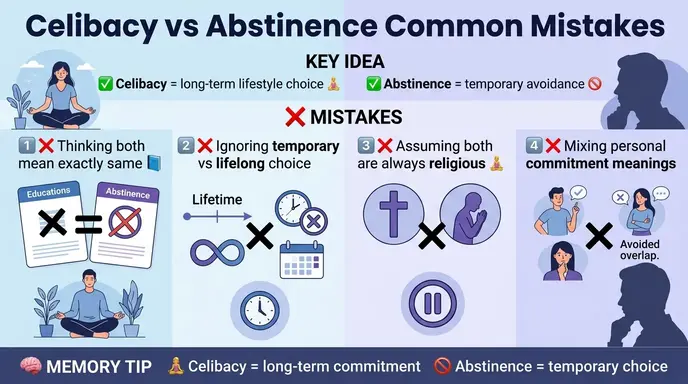
Thinking Celibacy and Abstinence Mean Exactly the Same Thing
❌ Celibacy and abstinence are identical concepts.
✅ Celibacy is usually long-term, while abstinence is often temporary.
Assuming Abstinence Always Means Lifelong Commitment
❌ Abstinence always lasts forever.
✅ Abstinence may only apply during certain periods or situations.
Ignoring Lifestyle Context
❌ Celibacy only refers to temporary relationship decisions.
✅ Celibacy is often connected to lifestyle or spiritual commitment.
Using Terms Incorrectly
❌ A temporary pause in relationships is always celibacy.
✅ Temporary choices are more commonly called abstinence.
Believing Both Terms Are Only Religious
❌ Only religious people practice celibacy or abstinence.
✅ People choose them for many personal, cultural, or health reasons.
Confusing Personal Goals
❌ Abstinence and celibacy always involve the same motivations.
✅ Their goals and meanings may differ greatly.
🧑💼 Real Life Examples with Celibacy and Abstinence
- Religious monks practicing lifelong celibacy
- Couples choosing abstinence before marriage
- Athletes temporarily practicing abstinence for personal discipline
- Spiritual leaders following celibate lifestyles
- Teen relationship education discussing abstinence
- Individuals choosing abstinence for emotional or personal reasons
🎯 When People Choose Celibacy or Abstinence
- Spiritual commitment → celibacy
- Temporary personal boundaries → abstinence
- Religious dedication → celibacy
- Relationship timing decisions → abstinence
- Long-term lifestyle choice → celibacy
- Health or educational goals → abstinence
🤔 Why People Get Confused in Celibacy and Abstinence
- Both involve avoiding sexual activity
- Everyday conversation often mixes the terms
- Media discussions simplify definitions
- Cultural interpretations vary
- Personal motivations are not always visible externally
🧠 How Behavioral and Social Systems Understand Celibacy and Abstinence
Behavioral studies generally classify:
- Celibacy as a long-term identity or lifestyle practice
- Abstinence as a temporary behavioral choice
Researchers may examine:
- Motivation
- Religious influence
- Relationship goals
- Emotional and social context
This helps better understand how people make personal lifestyle decisions.
🧠 Expert Insight
The difference between celibacy and abstinence mainly comes from long-term intention, lifestyle meaning, and personal motivation. Celibacy is often associated with lasting spiritual or lifestyle commitment, while abstinence usually relates to temporary personal, health, or relationship choices.
In practical discussions, understanding the intention behind the decision is often more important than focusing only on the behavior itself.
❓ FAQ:
1. What is the main difference between celibacy and abstinence?
Celibacy is generally long-term, while abstinence is often temporary.
2. Is celibacy always religious?
No, some people choose celibacy for personal or lifestyle reasons.
3. Can abstinence be temporary?
Yes, abstinence is commonly temporary or situation-based.
4. Does celibacy always mean avoiding marriage?
In many traditional definitions, yes, though usage may vary.
5. Are both voluntary choices?
Yes, both are personal decisions.
6. Why do people confuse celibacy and abstinence?
Because both involve avoiding sexual activity.
7. Can someone practice abstinence without being celibate?
Yes, many people practice temporary abstinence without lifelong celibacy.
🧾 Conclusion
The difference between celibacy and abstinence comes from duration, purpose, and personal meaning. Celibacy is often a long-term or lifelong commitment connected to spiritual, personal, or lifestyle beliefs, while abstinence is generally a temporary choice to avoid sexual activity for specific reasons or situations.
Understanding the difference between celibacy and abstinence helps clarify relationship discussions, educational topics, and personal lifestyle choices. Once you connect celibacy with long-term commitment and abstinence with temporary choice, the distinction becomes much easier to understand in social, cultural, and personal contexts.
Discover More Articles:

Hi, I’m Nabeel Hassan. I love exploring interesting topics and explaining how different things compare with each other. Through my writing, I aim to provide clear, helpful, and easy to read explanations. I cover subjects related to learning, science, technology and general knowledge.