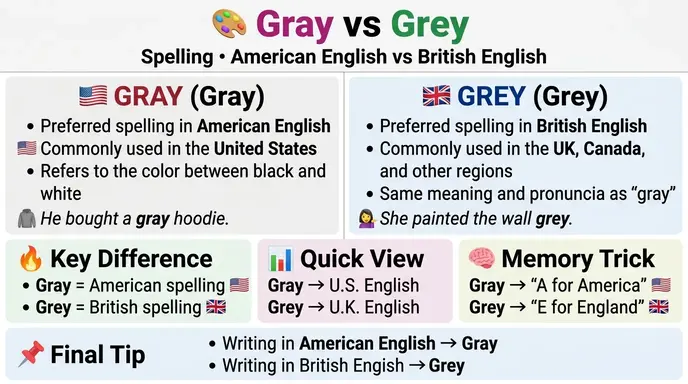
The difference between gray and grey is that both words mean the same color, but “gray” is more commonly used in American English, while “grey” is more common in British English and other regions influenced by British spelling.
Many writers, students, and English learners search for the difference between gray and grey because the spellings look different even though they refer to the same color and meaning.
In simple words, the distinction is mainly regional rather than grammatical. Understanding the difference between gray and grey helps improve spelling accuracy, writing consistency, language learning, and communication in different English speaking regions.
💡 Quick Answer: Difference Between Gray or Grey
Gray and grey refer to the same color, but “gray” is mainly American English, while “grey” is mainly British English.
👉 Example:
An American company may write “gray sweater,” while a British writer may write “grey jumper.”
📘 Definition of Gray and Grey
- Gray: The American English spelling of the color between black and white.
- Grey: The British English spelling of the same color between black and white.
🗣️ Pronunciation (US & UK)
- Gray
- US: /ɡreɪ/
- UK: /ɡreɪ/
- Grey
- US: /ɡreɪ/
- UK: /ɡreɪ/
Both spellings are pronounced exactly the same in spoken English.
📊 Comparison Table: Gray vs Grey
| Feature | Gray | Grey | Similarity |
| Main Usage Region | American English | British English | Both describe the same color |
| Meaning | Color between black and white | Color between black and white | Both have identical meaning |
| Pronunciation | Same pronunciation | Same pronunciation | Both sound identical |
| Spelling Style | American spelling preference | British spelling preference | Both are correct spellings |
| Common Usage | United States publications | UK, Canada, Australia publications | Both appear in English writing |
| Dictionary Acceptance | Accepted globally | Accepted globally | Both are standard English |
| Grammar Role | Noun and adjective | Noun and adjective | Both function similarly |
| Communication Impact | Regional writing style | Regional writing style | Both are easily understood |
This table clearly shows the difference and similarity between gray and grey for quick understanding.
🧠 Key Differences Explained Between Grey and Gray
🌍 Regional Spelling Difference
The biggest difference between gray and grey is regional preference. Americans usually prefer “gray,” while British English speakers commonly use “grey.”
👉 Example:
Most American textbooks use “gray,” while British newspapers often use “grey.”
📚 Meaning Remains the Same
Both spellings describe the exact same color.
✍️ Writing Style Consistency
Writers usually choose one spelling style and stay consistent throughout their writing.
👉 Example:
An American blog may consistently use “gray,” while a UK magazine uses “grey.”
🗣️ Pronunciation Is Identical
There is no pronunciation difference between gray and grey.
🌐 Global English Influence
Different countries follow different English spelling traditions.
🎨 Usage in Design and Branding
Some companies or brands choose one spelling based on audience location.
📖 Educational Usage
Schools often teach spelling preferences based on regional English standards.
🧠 Why Gray and Grey Get Confused
The difference between gray and grey becomes confusing because both spellings are correct and widely accepted. English learners often see both versions online, in books, movies, packaging, and social media.
🌐 How Language Systems Use Gray and Grey
Modern language systems classify:
- “Gray” as the preferred American English spelling
- “Grey” as the preferred British English spelling
Platforms like Google, Microsoft, and Grammarly often recognize both spellings but may suggest one depending on language settings and regional writing style.
For example:
- US English settings may suggest “gray”
- UK English settings may suggest “grey”
📊 Difference + Similarity Table
| Feature | Gray | Grey | Similarity |
| Meaning | American spelling of the color | British spelling of the color | Both describe the same shade |
| Regional Preference | Common in the United States | Common in the UK and Commonwealth countries | Both accepted in English |
| Pronunciation | Pronounced “gray” | Pronounced “gray” | Both sound identical |
| Writing Style | American English style | British English style | Both are grammatically correct |
| Dictionary Recognition | Standard spelling | Standard spelling | Both appear in dictionaries |
| Educational Usage | Taught in US schools | Taught in UK schools | Both taught in English learning |
| Reader Understanding | Easily understood globally | Easily understood globally | Both communicate the same meaning |
| Communication Purpose | Describes color | Describes color | Both function identically |
This table clearly shows the difference and similarity between gray and grey for quick understanding.
🎨 Deep Explanation: Why English Has Two Spellings
English spelling evolved differently across regions:
- American English simplified some spellings
- British English preserved older spelling traditions
- Both styles became accepted globally
👉 Example:
- “Color” vs “colour”
- “Favorite” vs “favourite”
- “Gray” vs “grey”
The meaning never changed, but regional writing conventions created different spelling preferences over time.
⚠️ Common Mistakes with Difference Between Gray and Grey
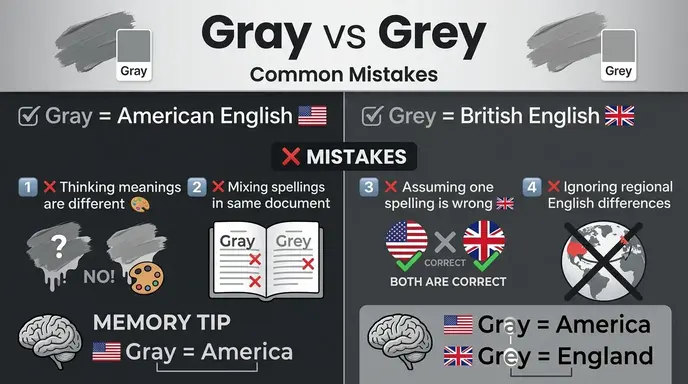
Thinking One Spelling Is Wrong
❌ “Grey” is an incorrect spelling.
✅ Both gray and grey are correct depending on region.
Ignoring Regional Style
❌ American English normally prefers “grey.”
✅ American English usually prefers “gray.”
Using Mixed Spellings in One Article
❌ The report uses gray and grey randomly.
✅ Writers usually keep one spelling style consistently.
Confusing Pronunciation
❌ Gray and grey are pronounced differently.
✅ Both spellings have the same pronunciation.
Assuming Meaning Changes
❌ Gray and grey represent different colors.
✅ Both words describe the same color.
Ignoring Language Settings
❌ Spellcheck always marks one spelling wrong universally.
✅ Language settings often affect spelling suggestions.
🧑💼 Real Life Examples with Gray and Grey
- American websites using “gray”
- British fashion magazines using “grey”
- Design software recognizing both spellings
- School textbooks teaching regional spelling styles
- Global brands adapting spelling for audiences
- Writers adjusting spelling based on target readers
🎯 When to Use Gray or Grey
- Writing for American audiences → gray
- Writing for British audiences → grey
- Following US English style guides → gray
- Following UK English conventions → grey
- International communication → either may work
- Consistent branding and writing → choose one style and stay consistent
🤔 Why People Get Confused in Gray and Grey
- Both spellings are correct
- Both are widely used online
- Pronunciation is identical
- English has regional spelling differences
- Spellcheck tools may suggest different versions
🧠 How Language and Writing Systems Understand Gray and Grey
Modern writing systems analyze:
- Regional language settings
- Audience location
- Writing consistency
- Dictionary standards
- English style preferences
This helps editing systems recommend the appropriate spelling style for different audiences.
🧠 Expert Insight
The difference between gray and grey is primarily regional rather than grammatical or semantic. “Gray” dominates American English, while “grey” is more common in British English and related language systems.
In practical writing situations, consistency matters more than choosing one universally “correct” spelling because both versions are widely accepted and understood globally.
❓ FAQ: Difference Between Grey or Gray
1. What is the main difference between gray and grey?
Gray is mainly American English, while grey is mainly British English.
2. Do gray and grey mean different colors?
No, both describe the same color.
3. Which spelling is correct?
Both spellings are correct depending on regional English style.
4. Is pronunciation different?
No, both are pronounced the same way.
5. Which spelling is used in the United States?
American English usually prefers “gray.”
6. Which spelling is common in Britain?
British English commonly uses “grey.”
7. Why do spellcheck tools suggest different spellings?
Suggestions often depend on language or regional settings.
🧾 Conclusion
The difference between gray and grey comes from regional English spelling preferences rather than meaning or pronunciation. “Gray” is mainly used in American English, while “grey” is more common in British English and many Commonwealth countries.
Understanding the difference between gray and grey helps improve writing consistency, spelling accuracy, and communication across different English speaking audiences. Once you connect “gray” with American English and “grey” with British English, the distinction becomes easy to remember in everyday writing and communication.
Discover More Articles:

I’m Owen Parker, and I write articles that focus on explaining the differences between common concepts, tools, and ideas. I enjoy simplifying complex information and turning it into clear comparisons that anyone can understand. My work often covers science , education, technology, and everyday knowledge topics.