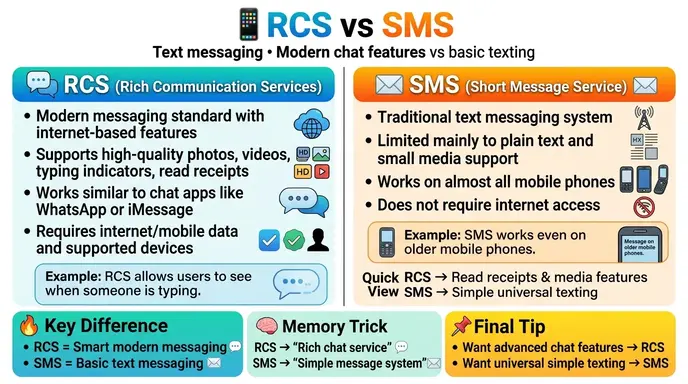
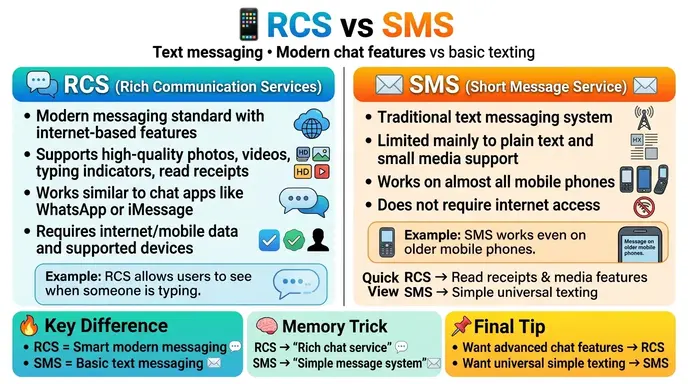
The difference between RCS and SMS is that SMS is the traditional text messaging system that works through cellular networks with basic text support, while RCS is a modern messaging standard that supports features like typing indicators, high quality media sharing, read receipts, and internet based messaging.
Many smartphone users search for the difference between RCS and SMS because messaging apps and mobile devices now support both technologies, yet they offer very different communication experiences.
In simple words, SMS is older and simpler, while RCS works more like modern chat applications. Understanding the difference between RCS and SMS helps users choose better messaging options, understand phone settings, and improve communication across Android devices and mobile networks.
💡 Quick Answer: Difference Between RCS oir SMS
SMS is a basic cellular text messaging system, while RCS is an advanced internet based messaging standard with modern chat features.
👉 Example:
SMS can send plain text messages, while RCS can show typing indicators and send high quality photos.
📘 Definition of RCS and SMS
- RCS (Rich Communication Services): A modern messaging protocol that adds advanced chat features like media sharing, read receipts, and typing indicators.
- SMS (Short Message Service): A traditional text messaging system that sends short text messages through mobile carrier networks.
🗣️ Pronunciation (US & UK)
- RCS
- US: /ˌɑːr.siːˈes/
- UK: /ˌɑː.siːˈes/
- SMS
- US: /ˌes.emˈes/
- UK: /ˌes.emˈes/
These terms are commonly used in smartphones, Android messaging systems, mobile carriers, texting apps, and communication technology discussions.
📊 Comparison Table: RCS vs SMS
| Feature | RCS | SMS | Similarity |
| Main Technology | Internet based messaging standard | Cellular text messaging system | Both send messages |
| Media Quality | High quality images and videos | Limited media support | Both support communication |
| Typing Indicators | Available | Not available | Both work on mobile devices |
| Read Receipts | Supported | Usually unavailable | Both used for texting |
| Character Limit | Larger message support | Limited text length | Both can send text |
| Internet Requirement | Usually requires internet or data | Works through carrier network | Both depend on mobile systems |
| Group Chat Features | Advanced group messaging | Basic group texting | Both allow conversations |
| Messaging Experience | Modern chat style communication | Simple traditional texting | Both connect users |
This table clearly shows the difference and similarity between RCS and SMS for quick understanding.
🧠 Key Differences Explained Between SMS and RCS
📱 Traditional vs Modern Messaging
The biggest difference between RCS and SMS is technology style. SMS is a traditional texting system, while RCS provides modern chat features similar to messaging apps.
👉 Example:
RCS conversations can show when someone is typing, while SMS cannot.
🌐 Internet Connectivity
RCS usually works through mobile data or Wi Fi internet connections.
🖼️ Media Sharing Quality
RCS supports better image and video quality than SMS.
👉 Example:
Photos sent through SMS may appear compressed, while RCS often keeps higher quality.
👥 Group Messaging Features
RCS offers improved group chat experiences with richer communication tools.
📩 Read Receipts
RCS can show when messages are delivered and read.
⚡ Messaging Experience
RCS feels similar to modern messaging apps with interactive communication features.
📶 Compatibility
SMS works on nearly all mobile phones, while RCS support depends on devices, carriers, and apps.
🧠 Why RCS and SMS Exist Together
The difference between RCS and SMS exists because SMS was created decades earlier for basic texting, while RCS was developed later to modernize mobile communication with internet powered features.
SMS remains widely supported because:
- It works without internet
- Almost all phones support it
- Mobile networks worldwide use it
RCS was introduced to compete with modern chat platforms and improve smartphone messaging experiences.
🌐 How Mobile Systems Use RCS and SMS
Mobile systems classify:
- SMS as traditional carrier based texting
- RCS as advanced messaging communication
Companies like Google, Samsung, and Apple play important roles in mobile messaging systems and communication technology development.
Apps like Google Messages support RCS features including:
- Typing indicators
- Read receipts
- High quality media sharing
- Enhanced group chats
📊 Difference + Similarity Table
| Feature | RCS | SMS | Similarity |
| Meaning | Advanced messaging standard | Basic text messaging service | Both support communication |
| Connection Type | Internet or data based | Cellular network based | Both send mobile messages |
| Media Support | High quality media sharing | Limited media quality | Both allow photo messaging |
| Chat Features | Read receipts and typing indicators | Basic text only features | Both used on smartphones |
| Messaging Style | Modern chat experience | Traditional texting experience | Both connect users instantly |
| Group Chat Quality | Advanced group conversations | Basic group messaging | Both support multiple recipients |
| Compatibility | Depends on carrier and app support | Works almost everywhere | Both used globally |
| User Experience | Interactive and feature rich | Simple and lightweight | Both enable mobile communication |
This table clearly shows the difference and similarity between RCS and SMS for quick understanding.
💬 Deep Explanation: Why RCS Feels More Like Chat Apps
RCS improves traditional texting by adding features commonly found in messaging apps:
- Typing indicators
- Read receipts
- Better media sharing
- Larger message support
- Enhanced group conversations
👉 Example:
A user sending vacation photos through RCS can share clearer images and receive delivery confirmations.
SMS, however, remains important because:
- It works on basic phones
- Internet is not always required
- Global compatibility remains extremely high
This balance is why both systems still exist together on smartphones today.
⚠️ Common Mistakes with Difference Between RCS and SMS
Thinking RCS and SMS Are Identical
❌ RCS and SMS use the same technology.
✅ RCS includes advanced internet based messaging features.
Assuming SMS Requires Internet
❌ SMS only works with Wi Fi or mobile data.
✅ SMS mainly works through cellular carrier networks.
Ignoring Compatibility Differences
❌ Every phone automatically supports RCS features.
✅ RCS availability depends on apps, carriers, and devices.
Using Terms Incorrectly
❌ SMS supports typing indicators and read receipts.
✅ Those are commonly associated with RCS.
Believing RCS Completely Replaced SMS
❌ SMS no longer exists on smartphones.
✅ SMS remains widely used worldwide.
Confusing Messaging Apps with Messaging Standards
❌ RCS is the same as a standalone chat application.
✅ RCS is a messaging standard used inside supported apps.
🧑💼 Real Life Examples with RCS and SMS
- SMS used for banking verification codes
- RCS group chats on Android phones
- SMS communication in areas with weak internet
- RCS sending high quality photos
- Businesses using SMS alerts for customers
- Smartphones switching between RCS and SMS automatically
🎯 When to Use RCS or SMS
- Advanced messaging features → RCS
- Basic universal texting → SMS
- High quality media sharing → RCS
- Messaging without internet → SMS
- Modern group conversations → RCS
- Compatibility with older phones → SMS
🤔 Why People Get Confused in RCS and SMS
- Both appear inside the same messaging apps
- Users may not notice which system is active
- Modern phones switch automatically between them
- Both send text messages
- Messaging technology terms can sound technical
🧠 How Mobile Communication Systems Understand RCS and SMS
Communication systems analyze:
- Device compatibility
- Carrier support
- Internet connectivity
- Messaging features
- Media handling capability
Smartphones often automatically choose between RCS and SMS depending on network availability and recipient support.
🧠 Expert Insight
The difference between RCS and SMS mainly comes from technology capability and user experience. SMS remains the universal standard for basic texting, while RCS modernizes messaging with richer communication features similar to chat applications.
In practical smartphone use, RCS improves messaging quality and interaction, but SMS still remains essential because of its global compatibility and reliability across devices and networks.
❓ FAQ: Difference Between SMS vs RCS
1. What is the main difference between RCS and SMS?
RCS supports advanced messaging features, while SMS provides basic text messaging.
2. Does RCS require internet access?
Yes, RCS usually works through mobile data or Wi Fi.
3. Can SMS work without internet?
Yes, SMS works through cellular carrier networks.
4. Does RCS support read receipts?
Yes, RCS commonly includes read receipts and typing indicators.
5. Why is SMS still widely used?
Because it works on almost all phones and networks worldwide.
6. Is RCS available on all devices?
No, support depends on carriers, phones, and messaging apps.
7. Can phones switch between RCS and SMS automatically?
Yes, many modern messaging apps switch automatically when needed.
🧾 Conclusion
The difference between RCS and SMS comes from messaging technology, features, and communication style. SMS is the traditional text messaging system designed for basic mobile communication, while RCS offers a modern chat experience with internet powered features like read receipts, typing indicators, and high quality media sharing.
Understanding the difference between RCS and SMS helps smartphone users choose better messaging options, improve communication experiences, and understand how modern mobile messaging systems work.
Once you connect SMS with traditional texting and RCS with advanced chat functionality, the distinction becomes much easier to understand in modern smartphone communication.
Discover More Articles:

I’m Owen Parker, and I write articles that focus on explaining the differences between common concepts, tools, and ideas. I enjoy simplifying complex information and turning it into clear comparisons that anyone can understand. My work often covers science , education, technology, and everyday knowledge topics.