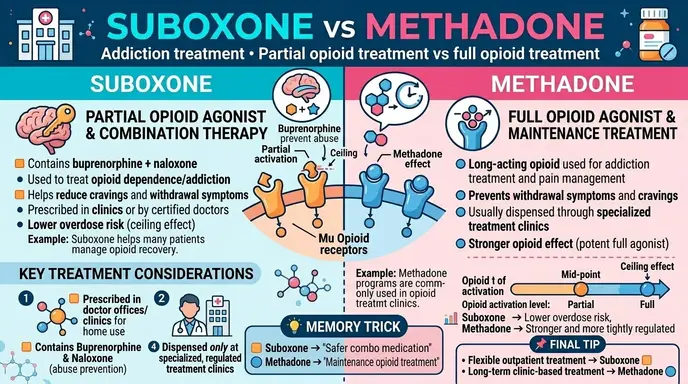
The difference between Suboxone and methadone is that Suboxone contains buprenorphine and naloxone to help reduce opioid cravings with a lower overdose risk, while methadone is a full opioid agonist used to manage withdrawal symptoms and opioid dependence through controlled treatment programs.
Many patients and families search for the difference between Suboxone and methadone because both medications are used in opioid use disorder treatment, yet they work differently in the body and follow different treatment approaches.
In simple words, both medications help people recover from opioid dependence, but they differ in strength, regulation, overdose risk, and how treatment is supervised. Understanding the difference between Suboxone and methadone helps people better understand medication-assisted treatment and recovery support systems.
💡 Quick Answer: Difference Between Suboxone and Methadone
Suboxone uses buprenorphine and naloxone to reduce cravings with partial opioid effects, while methadone is a full opioid agonist used in supervised opioid treatment programs.
👉 Example:
A patient in a clinic-based treatment program may receive methadone daily, while another patient may use prescribed Suboxone as part of outpatient recovery treatment.
📘 Definition of Suboxone and Methadone
- Suboxone: A prescription medication containing buprenorphine and naloxone used to help treat opioid dependence and reduce cravings.
- Methadone: A long-acting opioid medication used in medically supervised treatment for opioid dependence and withdrawal management.
🗣️ Pronunciation (US & UK)
- Suboxone
- US: /səˈbɑːk.soʊn/
- UK: /səˈbɒk.səʊn/
- Methadone
- US: /ˈmeθ.ə.doʊn/
- UK: /ˈmeθ.ə.dəʊn/
These medications are commonly discussed in addiction medicine, recovery treatment, mental health care, and substance use disorder management.
📊 Comparison Table: Suboxone vs Methadone
| Feature | Suboxone | Methadone | Similarity |
| Main Ingredient | Buprenorphine and naloxone | Methadone hydrochloride | Both treat opioid dependence |
| Medication Type | Partial opioid agonist | Full opioid agonist | Both reduce withdrawal symptoms |
| Overdose Risk | Generally lower | Higher risk if misused | Both require medical supervision |
| Treatment Setting | Often outpatient prescription | Commonly clinic-based programs | Both support recovery treatment |
| Craving Control | Helps reduce cravings | Helps reduce cravings | Both used in medication-assisted treatment |
| Abuse Prevention | Naloxone discourages misuse | Strict clinic supervision common | Both monitored medically |
| Access Method | Prescription from qualified providers | Specialized treatment clinics | Both require healthcare guidance |
| Treatment Goal | Support opioid recovery | Support opioid recovery | Both improve treatment stability |
This table clearly shows the difference and similarity between Suboxone and methadone for quick understanding.
🧠 Key Differences Explained Between Suboxone and Methadone
💊 Medication Composition
The biggest difference between Suboxone and methadone is the active ingredients. Suboxone contains buprenorphine and naloxone, while methadone contains methadone itself as the active opioid medication.
👉 Example:
Naloxone in Suboxone helps discourage misuse through injection.
⚖️ Opioid Effect Strength
Methadone is a full opioid agonist, while buprenorphine in Suboxone is a partial opioid agonist.
🏥 Treatment Environment
Methadone treatment is commonly managed through specialized clinics, while Suboxone may be prescribed in outpatient healthcare settings.
🚨 Overdose Risk
Methadone may carry higher overdose risk if misused improperly.
👉 Example:
Healthcare professionals monitor methadone dosing carefully.
⏳ Duration and Stability
Both medications are long-acting and designed to stabilize withdrawal symptoms and cravings.
🔒 Abuse Prevention Features
Suboxone includes naloxone to reduce misuse potential.
🩺 Recovery Support
Both medications are often combined with:
- Counseling
- Behavioral therapy
- Recovery support programs
- Mental health care
🧠 Why Suboxone and Methadone Get Confused
The difference between Suboxone and methadone becomes confusing because both:
- Treat opioid dependence
- Reduce withdrawal symptoms
- Help control cravings
- Require medical supervision
Many people also hear both medications discussed together in addiction treatment settings.
🌐 How Healthcare Systems Use Suboxone and Methadone
Healthcare systems classify:
- Suboxone as a buprenorphine-based treatment medication
- Methadone as a long-acting opioid treatment medication
Organizations like Substance Abuse and Mental Health Services Administration and World Health Organization discuss:
- Medication-assisted treatment
- Opioid recovery programs
- Harm reduction approaches
- Withdrawal management
- Recovery support systems
Modern healthcare systems also monitor treatment safety, prescription access, and recovery progress.
📊 Difference + Similarity Table
| Feature | Suboxone | Methadone | Similarity |
| Meaning | Buprenorphine-based recovery medication | Long-acting opioid treatment medication | Both treat opioid dependence |
| Opioid Activity | Partial opioid agonist | Full opioid agonist | Both reduce cravings |
| Main Usage | Outpatient treatment support | Structured clinic treatment | Both support recovery |
| Overdose Risk | Generally lower risk | Higher misuse risk possible | Both require monitoring |
| Abuse Prevention | Contains naloxone | Strict supervision common | Both involve controlled treatment |
| Access Type | Prescription medication | Specialized clinic programs | Both require healthcare providers |
| Treatment Purpose | Withdrawal and craving support | Withdrawal and stabilization support | Both assist recovery management |
| Medical Oversight | Ongoing provider supervision | Intensive treatment supervision | Both require professional care |
This table clearly shows the difference and similarity between Suboxone and methadone for quick understanding.
🩺 Deep Explanation: Why Medication-Assisted Treatment Matters
Medication-assisted treatment helps support recovery by:
- Reducing opioid cravings
- Lowering withdrawal discomfort
- Improving treatment stability
- Supporting long-term recovery goals
👉 Example:
Patients may better maintain work, family routines, and counseling participation when withdrawal symptoms are managed effectively.
Suboxone and methadone both support recovery, but treatment plans differ depending on:
- Medical history
- Severity of opioid dependence
- Recovery environment
- Healthcare access
- Individual treatment response
⚠️ Common Mistakes with Difference Between Suboxone and Methadone
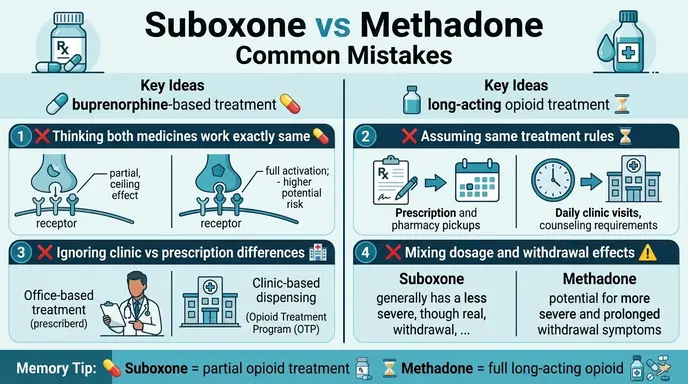
Thinking Suboxone and Methadone Are Identical
❌ Suboxone and methadone are the exact same medication.
✅ They contain different active ingredients and work differently.
Using Terms Incorrectly
❌ Suboxone is simply another brand name for methadone.
✅ They are separate medications.
Assuming Recovery Medication Means Instant Recovery
❌ Medication alone automatically solves opioid dependence.
✅ Recovery often includes counseling and support programs.
Ignoring Overdose Risks
❌ Methadone misuse carries no serious risk.
✅ Improper methadone use can be dangerous.
Believing One Medication Fits Everyone
❌ Every patient should use the same treatment medication.
✅ Treatment depends on medical and recovery needs.
🧑⚕️ Real Life Examples with Suboxone and Methadone
- Outpatient opioid recovery treatment with Suboxone
- Methadone clinic recovery programs
- Counseling combined with medication-assisted treatment
- Withdrawal symptom management during recovery
- Long-term recovery support planning
- Healthcare supervision during addiction treatment
🎯 When Healthcare Providers May Use Suboxone or Methadone
- Structured clinic-based treatment → methadone commonly used
- Outpatient prescription treatment → Suboxone commonly used
- Long term opioid recovery → either may be considered
- Craving and withdrawal management → both used medically
- Harm reduction approaches → both support recovery systems
- Recovery monitoring and counseling → both integrated with care
🤔 Why People Get Confused in Suboxone and Methadone
- Both treat opioid dependence
- Both reduce withdrawal symptoms
- Both used in recovery programs
- Similar treatment discussions online
- Both belong to medication-assisted treatment approaches
🧠 How Healthcare Systems Understand Suboxone and Methadone Treatment
Healthcare systems analyze:
- Opioid dependence severity
- Withdrawal symptoms
- Medication safety
- Treatment stability
- Recovery support needs
- Long-term treatment planning
This helps healthcare professionals develop individualized recovery plans.
🧠 Expert Insight
The difference between Suboxone and methadone mainly comes from medication structure, opioid receptor activity, and treatment delivery systems. Suboxone uses buprenorphine and naloxone with partial opioid effects, while methadone is a full opioid agonist often managed through specialized clinics.
In practical addiction medicine, healthcare providers focus on patient safety, treatment stability, counseling support, and individualized recovery planning rather than assuming one medication is universally better.
❓ FAQ: Difference Between Suboxone and Methadone
1. What is the main difference between Suboxone and methadone?
Suboxone contains buprenorphine and naloxone, while methadone is a full opioid agonist medication.
2. Are both used for opioid dependence?
Yes, both support opioid recovery treatment.
3. Is methadone stronger than Suboxone?
Methadone is a full opioid agonist, while Suboxone uses partial opioid activity.
4. Why does Suboxone contain naloxone?
Naloxone helps discourage misuse.
5. Are methadone treatments commonly clinic-based?
Yes, methadone often managed through specialized treatment programs.
6. Can both reduce cravings and withdrawal symptoms?
Yes, both medications designed to help manage withdrawal and cravings.
7. Why do people compare Suboxone and methadone?
Because both commonly used in medication-assisted treatment for opioid dependence.
🧾 Conclusion
The difference between Suboxone and methadone comes from active ingredients, opioid receptor activity, overdose risk, and treatment structure. Suboxone uses buprenorphine and naloxone to support recovery with partial opioid effects, while methadone is a full opioid agonist used in structured treatment programs.
Understanding the difference between Suboxone and methadone helps people better understand medication-assisted treatment and recovery support systems. Once you connect Suboxone with buprenorphine-based outpatient treatment and methadone with supervised opioid treatment programs, the distinction becomes much easier to understand in addiction medicine.
Discover More Articles:

Hi, I’m Nabeel Hassan. I love exploring interesting topics and explaining how different things compare with each other. Through my writing, I aim to provide clear, helpful, and easy to read explanations. I cover subjects related to learning, science, technology and general knowledge.