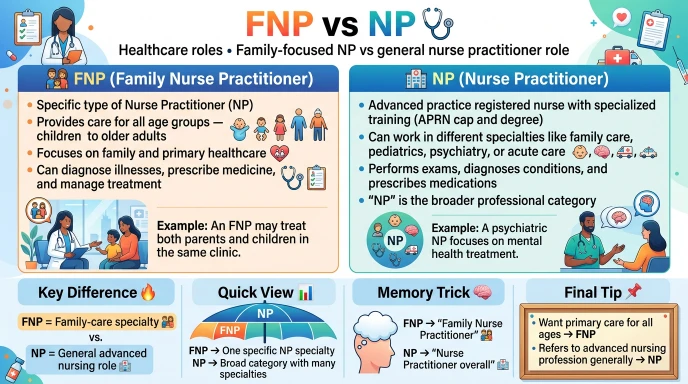
The difference between FNP and NP is that an FNP (Family Nurse Practitioner) is a specific type of nurse practitioner trained to provide healthcare for patients of all ages, while NP (Nurse Practitioner) is a broader category that includes several specialized advanced nursing roles.
Many nursing students and healthcare professionals search for the difference between FNP and NP because the titles sound similar and are often used interchangeably in hospitals, clinics, and healthcare discussions.
In simple words, every FNP is an NP, but not every NP is an FNP. Understanding the difference between FNP and NP helps students, patients, and healthcare workers better understand advanced nursing careers, specialties, and patient care responsibilities.
💡 Quick Answer: Difference Between FNP or NP
An NP is a general advanced nursing role, while an FNP is a nurse practitioner specializing in family and primary healthcare across all age groups.
👉 Example:
A psychiatric NP may focus on mental health care, while an FNP may treat children, adults, and older patients in family practice settings.
📘 Definition of FNP and NP
- FNP (Family Nurse Practitioner): A nurse practitioner specializing in primary and family healthcare for patients across all age groups.
- NP (Nurse Practitioner): An advanced practice registered nurse trained to diagnose, treat, and manage patient care in specific healthcare specialties.
🗣️ Pronunciation (US & UK)
- FNP
- US: /ˌef.enˈpiː/
- UK: /ˌef.enˈpiː/
- NP
- US: /ˌenˈpiː/
- UK: /ˌenˈpiː/
These terms are commonly discussed in nursing education, advanced healthcare practice, medical clinics, hospitals, and patient care systems.
📊 Comparison Table: FNP vs NP
| Feature | FNP | NP | Similarity |
| Meaning | Family Nurse Practitioner | Nurse Practitioner | Both are advanced nursing roles |
| Scope | Family and primary care | Multiple specialties possible | Both provide patient care |
| Patient Age Range | All ages | Depends on specialty | Both diagnose and treat conditions |
| Specialty Focus | Family healthcare | Broader healthcare categories | Both require advanced education |
| Career Category | Specific NP specialty | General nursing category | Both are advanced practice nurses |
| Workplaces | Clinics, family practices | Hospitals, clinics, specialty centers | Both work in healthcare settings |
| Training Focus | Family medicine and prevention | Specialty dependent training | Both need clinical experience |
| Licensing | NP license with family specialization | Advanced nursing licensure | Both follow healthcare regulations |
This table clearly shows the difference and similarity between FNP and NP for quick understanding.
🧠 Key Differences Explained Between FNP vs NP
🩺 General Role vs Specialty
The biggest difference between FNP and NP is that NP is a broad category, while FNP is one specialized type of nurse practitioner.
👉 Example:
An FNP focuses on family medicine, while another NP may specialize in pediatrics or psychiatry.
👨👩👧 Patient Population
FNPs commonly treat:
- Children
- Teenagers
- Adults
- Older adults
Other NP specialties may focus only on certain age groups or medical areas.
🧠 Specialty Training
FNP programs emphasize:
- Family medicine
- Preventive care
- Routine checkups
- Long term patient care
🏥 Healthcare Environment
FNPs often work in:
- Family clinics
- Primary care centers
- Community healthcare offices
Other NPs may work in specialized hospital departments.
📚 Career Flexibility
NP roles include many specialties such as:
- Psychiatric NP
- Pediatric NP
- Acute Care NP
- Women’s Health NP
- Family Nurse Practitioner
🧬 Scope of Practice
Both FNPs and NPs may:
- Diagnose illnesses
- Order tests
- Prescribe medications
- Manage treatment plans
However, practice rules vary by region and healthcare regulations.
❤️ Long Term Care Focus
FNPs often build ongoing relationships with families and patients over time.
🧠 Why FNP and NP Get Confused
The difference between FNP and NP becomes confusing because:
- Both are advanced nursing roles
- FNP is included under the NP category
- Similar job duties overlap
- Hospitals may shorten titles informally
- Patients often hear only “nurse practitioner”
This causes many people to assume all nurse practitioners are FNPs.
🌐 How Healthcare Systems Use NP and FNP Roles
Healthcare systems classify:
- NP as an advanced nursing practice category
- FNP as a family focused nurse practitioner specialty
Organizations like American Association of Nurse Practitioners and American Nurses Association discuss:
- Advanced nursing education
- Clinical practice standards
- Family healthcare
- Preventive medicine
- Patient centered care
Modern healthcare systems also rely heavily on nurse practitioners to improve healthcare access and primary care availability.
📊 Difference + Similarity Table
| Feature | FNP | NP | Similarity |
| Meaning | Family focused nurse practitioner | General advanced nursing role | Both provide healthcare services |
| Main Focus | Family and primary care | Specialty based patient care | Both diagnose and treat patients |
| Specialty Type | Specific NP specialization | Broad nursing category | Both require graduate education |
| Patient Range | All age groups | Depends on specialty area | Both support patient health |
| Workplace | Family clinics and primary care | Hospitals and specialty clinics | Both work in healthcare systems |
| Education Style | Family medicine training | Specialty focused programs | Both need advanced nursing study |
| Clinical Role | Preventive and ongoing care | Variable based on specialty | Both manage patient treatment |
| Healthcare Purpose | Family centered care | Advanced nursing practice | Both improve healthcare access |
This table clearly shows the difference and similarity between FNP and NP for quick understanding.
🩺 Deep Explanation: Why FNPs Are Important in Modern Healthcare
Family Nurse Practitioners help healthcare systems by:
- Providing primary care services
- Supporting preventive healthcare
- Managing chronic conditions
- Improving healthcare access in communities
👉 Example:
In many clinics, FNPs help manage routine checkups, diabetes care, vaccinations, and family health monitoring.
Healthcare systems increasingly rely on nurse practitioners because:
- Physician shortages continue in many areas
- Preventive care demand is growing
- Community healthcare access remains important
This makes FNPs highly valuable in modern healthcare environments.
⚠️ Common Mistakes with Difference Between FNP and NP
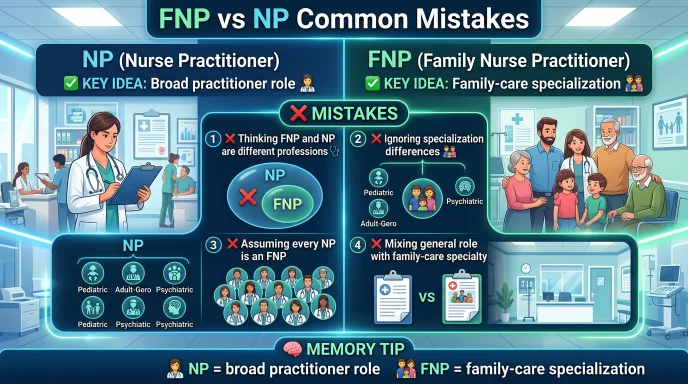
Thinking FNP and NP Mean Exactly the Same Thing
❌ FNP and NP are completely identical titles.
✅ FNP is one specialty within the broader NP category.
Ignoring Specialty Differences
❌ Every NP works in family medicine.
✅ NPs may specialize in psychiatry, pediatrics, acute care, and more.
Using Terms Incorrectly
❌ All nurse practitioners are Family Nurse Practitioners.
✅ Some NPs focus on completely different specialties.
Assuming FNPs Only Treat Adults
❌ FNPs only provide adult healthcare.
✅ FNPs commonly treat patients of all ages.
Ignoring Healthcare Settings
❌ Every NP works in the same type of clinic.
✅ Work environments vary depending on specialty.
Believing NPs Are Registered Nurses Only
❌ NPs have the same role as standard registered nurses.
✅ NPs receive advanced clinical education and training.
🧑⚕️ Real Life Examples with FNP and NP
- Family healthcare clinics staffed by FNPs
- Pediatric NPs treating children
- Psychiatric NPs supporting mental health patients
- Primary care visits managed by nurse practitioners
- Community healthcare centers using FNP services
- Chronic disease management through advanced nursing care
🎯 When FNP or Other NP Specialties Are Used
- Family healthcare needs → FNP commonly used
- Mental health treatment → psychiatric NP often used
- Child focused healthcare → pediatric NP specialization
- Hospital critical care → acute care NP roles
- Preventive healthcare → FNPs frequently involved
- Community clinics → FNPs widely used
🤔 Why People Get Confused in FNP and NP
- Similar job responsibilities
- Overlapping healthcare duties
- FNP is part of NP category
- Patients hear simplified nursing titles
- Healthcare systems use abbreviations frequently
🧠 How Healthcare Systems Understand NP or FNP Roles
Healthcare systems analyze:
- Patient population needs
- Specialty training
- Clinical scope
- Licensing regulations
- Healthcare access demands
- Preventive care requirements
This helps hospitals and clinics assign advanced nursing professionals effectively.
🧠 Expert Insight
The difference between FNP and NP mainly comes from specialization. NP is the broader advanced nursing category, while FNP is a specialized nurse practitioner role focused on family and primary healthcare across all age groups.
In practical healthcare systems, FNPs play a major role in preventive care, chronic disease management, and community health support. Understanding this distinction helps patients and nursing students better understand modern advanced nursing careers.
❓ FAQ: Difference Between FNP and NP
1. What is the main difference between FNP and NP?
An NP is a broad advanced nursing role, while an FNP specializes in family healthcare.
2. Is every FNP an NP?
Yes, every Family Nurse Practitioner is a Nurse Practitioner.
3. Can NPs have different specialties?
Yes, NPs may specialize in psychiatry, pediatrics, acute care, and more.
4. Do FNPs treat children and adults?
Yes, FNPs commonly treat patients of all ages.
5. Are FNPs allowed to prescribe medications?
In many regions, yes, depending on healthcare regulations.
6. Why do people confuse FNP and NP?
Because FNP is part of the broader NP category.
7. Where do FNPs usually work?
They commonly work in family clinics and primary care settings.
🧾 Conclusion
The difference between FNP and NP comes from specialization and scope of practice. NP is a broad category of advanced nursing professionals, while FNP refers specifically to Family Nurse Practitioners trained to provide primary and family healthcare across all age groups.
Understanding the difference between FNP and NP helps nursing students, patients, and healthcare workers better understand modern advanced nursing roles. Once you connect NP with the overall advanced nursing category and FNP with family focused healthcare specialization, the distinction becomes much easier to recognize in real healthcare environments.
Discover More Articles:

Hi, I’m Nabeel Hassan. I love exploring interesting topics and explaining how different things compare with each other. Through my writing, I aim to provide clear, helpful, and easy to read explanations. I cover subjects related to learning, science, technology and general knowledge.