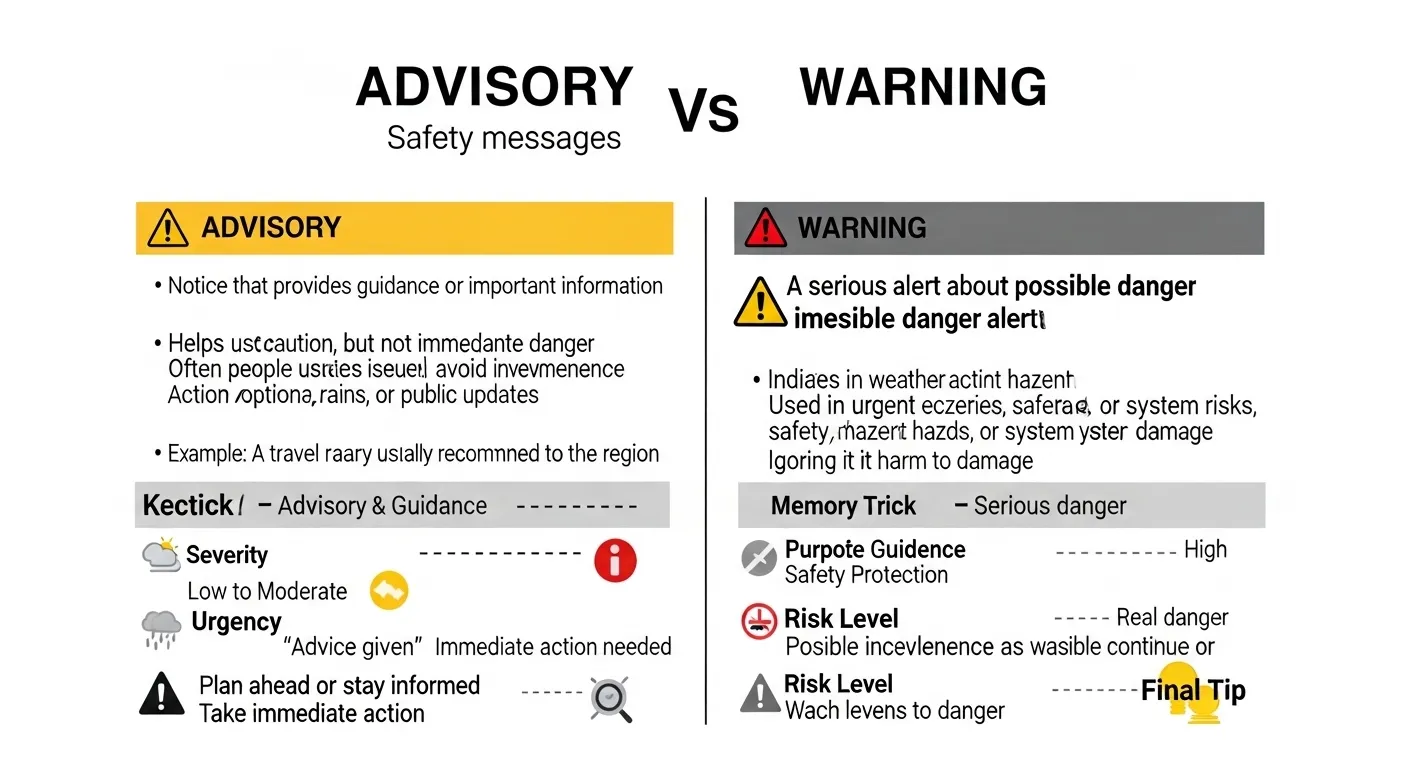
The difference between advisory and warning is mainly about the level of risk and urgency. Both are official messages used by weather services, governments, and safety organizations to inform people about possible hazards.
An advisory is a notice that conditions may cause inconvenience or minor risk, while a warning indicates dangerous conditions that require immediate action.
Understanding the difference between advisory and warning helps people stay safe and respond correctly during emergencies.
⚠️ Key Difference Between the Both
The main difference lies in severity and action required.
- Advisory: Be aware, take caution
- Warning: Take immediate action, danger is expected
Examples:
- Advisory → Travel may be difficult
- Warning → Travel is dangerous and not recommended
🌦️ Why Is Their Difference Important?
Understanding the difference between advisory and warning is important for safety, travel planning, and emergency response. People often ignore advisories but must act seriously on warnings. Knowing the difference between advisory and warning can prevent accidents, injuries, and property damage.
🔊 Pronunciation (US & UK)
| Term | US Pronunciation | UK Pronunciation |
| Advisory | /ədˈvaɪ.zər.i/ | /ədˈvaɪ.zər.i/ |
| Warning | /ˈwɔːr.nɪŋ/ | /ˈwɔː.nɪŋ/ |
➡️ Now let’s explore the detailed difference between advisory and warning step by step.
🌐 Difference Between Advisory and Warning
1️⃣ Level of Risk
Advisory indicates low to moderate risk.
Warning indicates high or severe risk.
Examples:
- Advisory: Light snow possible
- Warning: Heavy blizzard expected
2️⃣ Urgency
Advisory is less urgent.
Warning requires immediate attention.
Examples:
- Advisory: Drive carefully
- Warning: Do not travel
3️⃣ Action Required
Advisory suggests caution.
Warning demands action or avoidance.
Examples:
- Advisory: Be cautious while driving
- Warning: Evacuate area if instructed
4️⃣ Severity of Conditions
Advisory = mild conditions
Warning = dangerous conditions
Examples:
- Advisory: Fog may reduce visibility
- Warning: Dense fog causing zero visibility
5️⃣ Impact on Daily Life
Advisory may cause inconvenience.
Warning may cause disruption or danger.
Examples:
- Advisory: Minor delays possible
- Warning: Roads may close
6️⃣ Authority Use
Advisory is issued for awareness.
Warning is issued for safety protection.
Examples:
- Advisory: Weather update notice
- Warning: Emergency alert
7️⃣ Public Response
Advisory → Stay informed
Warning → Take immediate action
Examples:
- Advisory: Plan carefully
- Warning: Act immediately
8️⃣ Duration of Impact
Advisory may last longer but is less severe.
Warning is often short-term but intense.
Examples:
- Advisory: Heat advisory for a day
- Warning: Storm warning for hours
9️⃣ Emotional Tone
Advisory feels calm and informative.
Warning feels serious and urgent.
Examples:
- Advisory: Stay aware
- Warning: Stay safe immediately
🔟 Examples in Real Life
Advisory
- Heat advisory
- Travel advisory
- Fog advisory
Warning
- Tornado warning
- Flood warning
- Storm warning
🧠 Nature and Behaviour of Both Advisory and Warning
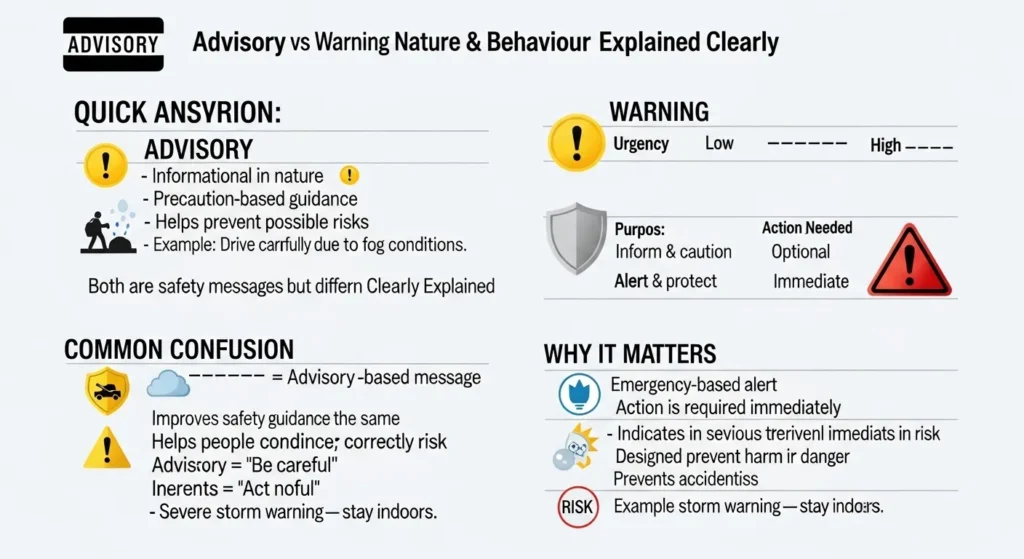
Advisory
- Informational
- Low urgency
- Precaution-based
Warning
- Emergency-based
- High urgency
- Action-required
📊 Comparison Chart
⚠️ Difference Between Advisory and Warning
| Feature | Advisory ⚠️ | Warning 🚨 |
| Risk Level | Low to moderate | High to severe |
| Urgency | Low | High |
| Action Needed | Caution | Immediate action |
| Severity | Mild | Dangerous |
| Purpose | Inform | Protect |
| Public Response | Be aware | Act immediately |
| Impact | Inconvenience | Safety threat |
| Tone | Calm | Serious |
| Example | Heat advisory | Storm warning |
| Outcome | Stay cautious | Stay safe/evacuate |
⚖️ Which Is More Serious?
A warning is always more serious than an advisory because it indicates immediate danger and requires action. An advisory is mainly for awareness and preparation.
🎭 Use in Metaphors and Similes
Metaphor example:
- An advisory is a gentle tap on the shoulder, while a warning is a loud alarm.
Simile example:
- An advisory is like a weather tip, while a warning is like a fire alarm.
💬 Connotative Meaning
| Term | Connotation | Example |
| Advisory | Caution, awareness | It felt like a soft advisory. |
| Warning | Danger, urgency | It sounded like a serious warning. |
🗣️ Expressions
- Issue an advisory
- Raise a warning
- Travel advisory in effect
- Severe weather warning
📚 Real-World Usage
- Meteorology (weather alerts)
- Government safety alerts
- Travel and aviation notices
- Disaster management systems
❔ Frequently Asked Questions
1. Which is more serious, advisory or warning?
Warning is more serious.
2. What does an advisory mean?
It means be cautious.
3. What does a warning mean?
It means immediate danger is expected.
4. Should I ignore advisories?
No, but they are less urgent than warnings.
5. Do warnings require action?
Yes, immediate action is often required.
🌍 Importance in Daily Life
Understanding the difference between advisory and warning helps people make safer decisions during weather events, travel, and emergencies.
✍️ Final Words
The difference between advisory and warning is based on severity and urgency. An advisory is a cautionary notice, while a warning signals danger and requires immediate action. Both are important for safety and awareness.
🏁 Conclusion
Knowing the difference between advisory and warning helps you respond correctly in risky situations. Advisories keep you informed, while warnings protect you from immediate danger. Understanding both ensures better safety and preparedness.
Discover More Articles:

Hi, I’m Nabeel Hassan. I love exploring interesting topics and explaining how different things compare with each other. Through my writing, I aim to provide clear, helpful, and easy to read explanations. I cover subjects related to learning, science, technology and general knowledge.