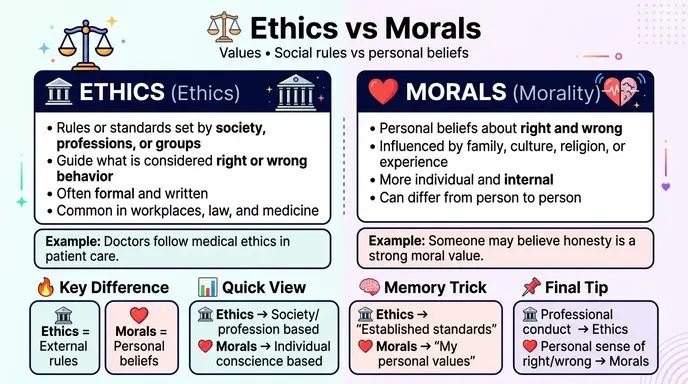
The difference between ethics and morals is that morals are personal beliefs about right and wrong, while ethics are external rules or standards followed by groups, professions, or societies.
Many people search for the difference between ethics and morals because the two terms are closely connected and often used interchangeably in conversations, workplaces, education, and philosophy. However, they are not exactly the same.
In simple words, morals come from personal values, while ethics come from social or professional guidelines. Understanding the difference between ethics and morals helps people make better decisions in personal life, business, education, healthcare, law, and professional environments.
💡 Quick Answer: Difference Between Ethics or Morals
Morals are individual beliefs about right and wrong, while ethics are organized standards or rules accepted by a community or profession.
👉 Example: A person may morally believe lying is wrong, while a company follows ethical rules about honesty in business communication.
📘 Definition of Ethics and Morals
- Ethics: Rules, principles, or standards created by groups, professions, or societies to guide behavior.
- Morals: Personal beliefs and values that help individuals decide what is right or wrong.
🗣️ Pronunciation (US & UK)
- Ethics
- US: /ˈeθ.ɪks/
- UK: /ˈeθ.ɪks/
- Morals
- US: /ˈmɔːr.əlz/
- UK: /ˈmɒr.əlz/
These terms are commonly used in philosophy, education, law, business, healthcare, and social discussions.
📊 Comparison Table: Ethics vs Morals
| Feature | Ethics | Morals | Similarity |
| Meaning | External standards or rules | Personal beliefs about right and wrong | Both guide human behavior |
| Source | Society, profession, or organization | Individual values and upbringing | Both influence decisions |
| Flexibility | May change by profession or culture | Usually deeply personal | Both relate to right and wrong |
| Focus | Group behavior standards | Personal conscience | Both affect actions |
| Example | Medical ethics in hospitals | Personal belief against stealing | Both encourage responsible behavior |
| Enforcement | Often officially enforced | Self-controlled | Both shape social conduct |
| Application | Workplace and professional settings | Daily personal life | Both influence choices |
| Nature | Structured guidelines | Internal principles | Both connected to values |
This table clearly shows the difference and similarity between ethics and morals for quick understanding.
🧠 Key Differences Explained Between Morals and Ethics
⚖️ Personal vs Social Standards
Morals are personal beliefs, while ethics are rules accepted by groups or professions.
👉 Example: A person may personally believe gambling is wrong, while a workplace ethical code may not address it.
🏢 Professional Application
Ethics are commonly used in professions such as medicine, law, education, and business.
🧠 Source of Beliefs
Morals usually develop through family, religion, culture, and personal experiences. Ethics are often created by organizations or societies.
📚 Flexibility Difference
Ethical rules can change depending on industry standards or laws, while morals are often deeply personal and harder to change.
👥 Individual vs Group Focus
Morals focus on personal conscience, while ethics focus on acceptable group behavior.
📜 Enforcement Style
Ethics may have official consequences if broken, while morals depend mostly on personal guilt or responsibility.
🌍 Cultural Influence
Ethics and morals can both vary across cultures, but ethics often adapt faster to social and professional changes.
🧠 Why Ethics and Morals Exist
The difference between ethics and morals exists because societies need both personal values and organized standards. Morals help individuals make personal choices, while ethics create order and trust in workplaces, institutions, and communities.
🌐 How Ethics and Morals Work in Modern Society
Ethics are important in:
- Healthcare systems
- Legal professions
- Business organizations
- Technology companies
- Educational institutions
Morals influence:
- Personal relationships
- Family decisions
- Religious beliefs
- Individual behavior
- Social responsibility
Companies like Google and Microsoft use ethical guidelines for privacy, workplace conduct, and professional responsibility.
📊 Difference + Similarity Table
| Feature | Ethics | Morals | Similarity |
| Meaning | Social or professional rules | Personal beliefs about right and wrong | Both guide behavior |
| Main Source | Organizations and society | Individual conscience | Both shape decisions |
| Main Focus | Group standards | Personal values | Both connected to responsibility |
| Flexibility | Can change with rules and systems | Usually more stable personally | Both affected by culture |
| Application Area | Workplaces and institutions | Daily personal life | Both influence actions |
| Enforcement | Official policies or codes | Self-discipline and conscience | Both encourage fairness |
| Decision Style | Based on accepted standards | Based on personal beliefs | Both help solve moral questions |
| Purpose | Maintain social and professional order | Maintain personal integrity | Both support human relationships |
This table clearly shows the difference and similarity between ethics and morals for quick understanding.
🔍 Deep Explanation: How Ethics and Morals Affect Daily Decisions
In real life, ethics and morals often work together:
- Morals shape personal beliefs
- Ethics shape professional behavior
👉 Example:
A doctor may morally care about helping patients, while medical ethics guide professional treatment standards.
This difference becomes important in:
- Business decisions
- Healthcare choices
- Technology privacy policies
- Legal systems
- Educational environments
Sometimes ethics and morals agree, but sometimes conflicts happen between personal beliefs and professional rules.
⚠️ Common Mistakes with Difference Between Ethics and Morals
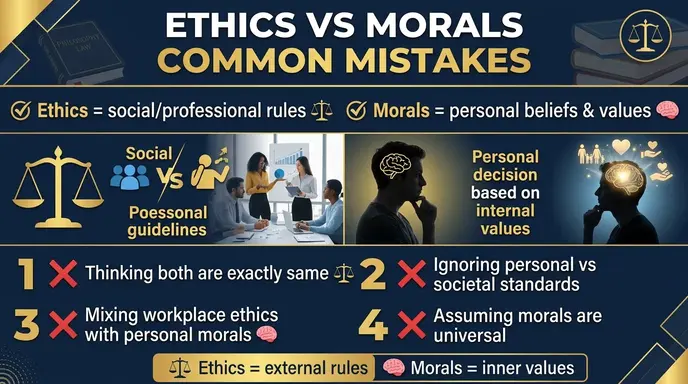
Thinking Ethics and Morals Mean Exactly the Same
❌ Ethics and morals are completely identical concepts.
✅ Morals are personal beliefs, while ethics are external standards.
Assuming Ethics Are Only About Laws
❌ Ethics only refers to legal rules.
✅ Ethics includes professional and social principles beyond laws.
Ignoring Personal Values
❌ Morals come only from workplace rules.
✅ Morals usually develop from personal beliefs and upbringing.
Confusing Professional Rules with Personal Beliefs
❌ Company ethics and personal morals are always identical.
✅ Ethical codes and personal morals can sometimes differ.
Using the Terms Incorrectly
❌ My personal morals are part of my office ethics policy.
✅ Personal morals and workplace ethics are related but different.
Believing Ethics Never Change
❌ Ethical standards remain the same forever.
✅ Ethical rules can change as societies and industries evolve.
🧑💼 Real Life Examples with Ethics and Morals
- A journalist follows ethical reporting standards
- A person morally believes helping others is important
- Doctors follow medical ethics during patient care
- Employees follow workplace ethical guidelines
- Individuals make moral choices in personal relationships
- Businesses create ethical codes for fair practices
🎯 When to Use Ethics or Morals
- Personal beliefs and values → morals
- Professional standards and policies → ethics
- Workplace behavior rules → ethics
- Individual conscience decisions → morals
- Organizational conduct systems → ethics
- Personal right-and-wrong judgments → morals
🤔 Why People Get Confused in Ethics and Morals
- Both relate to right and wrong
- Both guide behavior and decisions
- They are often used interchangeably in conversation
- Philosophy discussions connect both concepts closely
- Ethical and moral values sometimes overlap
🧠 How Educational and Professional Systems Understand Ethics and Morals
Educational and professional systems classify:
- Ethics as structured standards for groups and professions
- Morals as personal principles and beliefs
This distinction helps organizations create fair systems while allowing individuals to maintain personal values and integrity.
🧠 Expert Insight
The difference between ethics and morals is important in both personal and professional life. Morals help individuals decide what they personally believe is right, while ethics help societies and organizations maintain fairness, trust, and responsibility.
In practical situations, understanding both concepts helps people balance personal values with professional expectations and social responsibilities.
❓ FAQ:
1. What is the main difference between ethics and morals?
Morals are personal beliefs, while ethics are external standards or rules.
2. Can ethics and morals conflict?
Yes, professional ethics and personal morals can sometimes differ.
3. Are ethics based on society?
Yes, ethics often come from groups, professions, or social systems.
4. Do morals come from personal beliefs?
Yes, morals are usually shaped by upbringing, culture, and experiences.
5. Why are ethics important in workplaces?
They help maintain fairness, trust, and professional behavior.
6. Are morals the same in every culture?
No, moral beliefs can vary between cultures and individuals.
7. Can ethical rules change over time?
Yes, ethical standards may evolve with society and industries.
🧾 Conclusion
The difference between ethics and morals comes down to external standards versus personal beliefs. Ethics are organized rules or principles followed by professions, organizations, or societies, while morals are individual beliefs about right and wrong shaped by personal values and experiences.
Understanding the difference between ethics and morals helps people navigate personal choices, professional behavior, social responsibility, and decision-making more effectively. Once you connect morals with personal conscience and ethics with social or professional standards, the distinction becomes much easier to understand in daily life.
Discover More Articles:

I’m Owen Parker, and I write articles that focus on explaining the differences between common concepts, tools, and ideas. I enjoy simplifying complex information and turning it into clear comparisons that anyone can understand. My work often covers science , education, technology, and everyday knowledge topics.