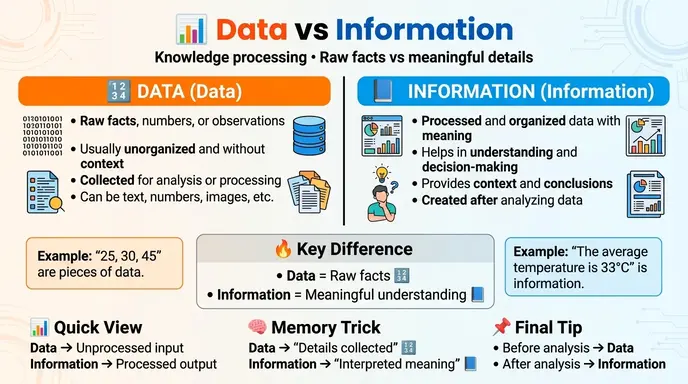
The difference between data and information is that data refers to raw facts and figures, while information is processed data that becomes meaningful and useful.
Many students, office workers, and technology users search for the difference between data and information because both terms are commonly used in computers, business systems, research, and digital communication. Although closely connected, they are not identical.
In simple words, data is the unorganized input, while information is the organized output people can understand easily. Understanding the difference between data and information helps explain how databases, reports, artificial intelligence, analytics systems, and digital platforms work in real life.
💡 Quick Answer: Difference Between Data or Information
Data consists of raw facts, while information is organized data that provides meaning and understanding.
👉 Example: A spreadsheet filled with numbers is data, but a monthly sales report explaining those numbers is information.
📘 Definition of Data and Information
- Data: Raw facts, numbers, symbols, or observations collected without detailed interpretation.
- Information: Processed and organized data that provides context, meaning, and useful understanding.
🗣️ Pronunciation (US & UK)
- Data
- US: /ˈdeɪ.t̬ə/
- UK: /ˈdeɪ.tə/
- Information
- US: /ˌɪn.fɚˈmeɪ.ʃən/
- UK: /ˌɪn.fəˈmeɪ.ʃən/
These terms widely used in business, education, computer science, artificial intelligence, databases, and digital communication systems.
📊 Comparison Table: Data vs Information
| Feature | Data | Information | Similarity |
| Meaning | Raw facts and figures | Processed meaningful results | Both relate to knowledge handling |
| Structure | Unorganized | Organized and structured | Both used in digital systems |
| Purpose | Used as input | Used for understanding and decisions | Both important in technology |
| Context | Usually lacks meaning | Contains clear interpretation | Both can be stored electronically |
| Example | Student marks list | Final performance report | Both used in education |
| Processing | Needs analysis | Already analyzed | Both connected in computing |
| Human Understanding | Difficult without context | Easier to understand | Both help communication |
| Usage | Collection stage | Reporting and decision stage | Both part of information systems |
This table clearly shows the difference and similarity between data and information for quick understanding.
🧠 Key Differences Explained Between Information and Data
📥 Raw Facts vs Meaningful Results
Data consists of raw facts without organization, while information presents those facts in a meaningful way.
👉 Example: Random customer purchase numbers are data, while a sales summary showing buying trends is information.
📊 Processing Difference
Data requires processing and analysis before becoming useful information.
🧩 Context and Meaning
Information contains context and interpretation, while raw data alone may not explain anything clearly.
👉 Example: “450” alone is data, but “450 products sold this week” is information.
💻 Role in Technology
Computer systems collect data continuously and convert it into information users can understand and use.
📈 Decision-Making Use
Businesses and organizations use information for planning and decisions, while data mainly serves as input material.
⚡ Digital Importance
Modern technologies depend heavily on converting large amounts of data into valuable information.
🧠 Why Data and Information Exist
The difference between data and information exists because raw facts alone are not always useful. Businesses, schools, governments, and technology systems need organized interpretation to understand patterns, solve problems, and make decisions.
🌐 How Modern Systems Use Data and Information
Digital systems collect enormous amounts of data daily:
- Websites track user activity
- Apps collect usage patterns
- Banks store transaction records
- Hospitals manage patient records
Companies like Google, Meta, and Microsoft process massive amounts of data and transform it into useful information for analytics, recommendations, and user experiences.
📊 Difference + Similarity Table
| Feature | Data | Information | Similarity |
| Meaning | Raw collected facts | Organized meaningful output | Both relate to communication |
| Main Role | Input material | Useful interpretation | Both support digital systems |
| Structure | Unorganized details | Structured content | Both stored electronically |
| Human Use | Harder to understand directly | Easier to interpret | Both help learning and analysis |
| Processing Stage | Before analysis | After analysis | Both connected in computing |
| Business Usage | Records and statistics | Reports and insights | Both used in organizations |
| Technology Usage | Database storage | Dashboards and reports | Both handled by software systems |
| Example | Attendance numbers | Attendance performance summary | Both used in schools and offices |
This table clearly shows the difference and similarity between data and information for quick understanding.
🔍 Deep Explanation: How Data Becomes Information
In real systems, data goes through several stages before becoming information:
- Collection
- Organization
- Processing
- Interpretation
- Presentation
👉 Example:
- Daily temperature readings = data
- Weekly climate report = information
This process is used in:
- Banking systems
- Social media platforms
- Artificial intelligence tools
- Business reporting systems
- Educational databases
Without processing, data remains difficult to understand.
⚠️ Common Mistakes with Difference Between Data and Information
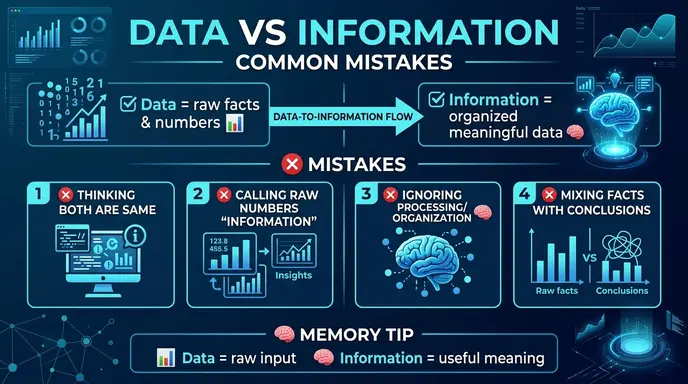
Thinking Data and Information Are the Same
❌ Data and information mean exactly the same thing.
✅ Data is raw facts, while information is processed and meaningful.
Assuming Raw Data Is Always Useful
❌ Raw data automatically helps decision-making.
✅ Data often requires organization and analysis first.
Ignoring Context
❌ Information does not need interpretation or explanation.
✅ Information becomes valuable because context is added.
Confusing Collection with Reporting
❌ Collecting data is identical to creating information.
✅ Information is created after processing and analyzing data.
Using the Terms Incorrectly
❌ A completed business report is raw data.
✅ A completed business report is information.
Believing Computers Only Store Information
❌ Computer systems mainly store information directly.
✅ Most systems first collect and store raw data.
🧑💼 Real Life Examples with Data and Information
- Exam scores entered into software are data
- Final grade analysis reports are information
- Website visitor numbers are data
- User behavior insights are information
- Medical readings are data
- Health diagnosis summaries are information
- Sales entries are data
- Business growth reports are information
🎯 When to Use Data or Information
- Raw statistics and numbers → data
- Organized summaries and reports → information
- Database records → data
- Decision-making and analysis → information
- Survey responses → data
- Survey conclusions → information
🤔 Why People Get Confused in Data and Information
- Both terms are used together frequently
- Technology discussions often combine them
- Information is directly created from data
- Many people use the words interchangeably in daily conversation
- Digital systems process both continuously
🧠 How Computer Systems Understand Data and User Intent
Modern computer systems classify:
- Data as raw input values
- Information as processed meaningful output
Artificial intelligence systems analyze data patterns to create information that supports recommendations, predictions, reporting, and decision-making. This process is important in:
- Search engines
- Business analytics
- Social media platforms
- Educational software
- Financial systems
🧠 Expert Insight
The difference between data and information is one of the most important concepts in technology and digital communication. Data has limited value unless it is processed into useful information people can understand and apply.
In practical business and technology environments, organizations collect huge amounts of data every second, but real value comes from transforming that data into insights that improve decisions, planning, and user experiences.
❓ FAQ:
1. What is the main difference between data and information?
Data is raw facts, while information is meaningful processed data.
2. Can information exist without data?
No, information created from data.
3. Which comes first, data or information?
Data comes first.
4. Why is information more useful?
Because it provides context and understanding.
5. Is data always meaningful immediately?
No, it usually needs processing and interpretation.
6. How do computers use data and information?
Computers collect data and process it into understandable information.
7. What is a simple example of data and information?
A list of numbers is data, while a report explaining those numbers is information.
🧾 Conclusion
The difference between data and information comes down to raw facts versus meaningful understanding. Data includes unorganized facts, numbers, or observations, while information is created when that data is processed, analyzed, and organized into a useful form.
Understanding the difference between data and information helps students, professionals, and technology users understand how databases, reports, artificial intelligence systems, and digital platforms operate. Once you connect data with raw input and information with meaningful output, the concept becomes much easier to understand and apply in education, business, and daily life.
Discover More Articles:

Hi, I’m Nabeel Hassan. I love exploring interesting topics and explaining how different things compare with each other. Through my writing, I aim to provide clear, helpful, and easy to read explanations. I cover subjects related to learning, science, technology and general knowledge.