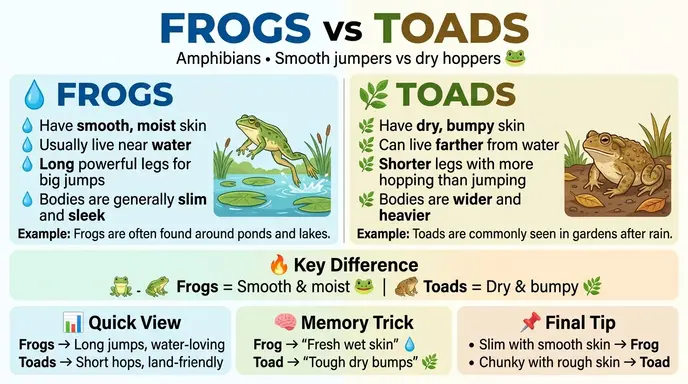
The difference between frogs and toads is that frogs usually have smooth, moist skin and long legs for jumping, while toads typically have dry, bumpy skin and shorter legs for walking or short hops.
Many people search for the difference between frogs and toads because both are amphibians that look similar at first glance. However, they differ in appearance, habitat, behavior, and body structure.
In simple words, frogs are more adapted for swimming and jumping, while toads are better suited for land environments. Understanding the difference between frogs and toads helps nature lovers, students, and animal enthusiasts identify them correctly in gardens, forests, ponds, and wetlands.
💡 Quick Answer: Difference Between Frogs or Toads
Frogs have smooth skin and long jumping legs, while toads have rough skin and shorter legs designed more for walking and hopping.
👉 Example: A green frog near a pond usually jumps far into water, while a brown toad in a garden often moves slowly with short hops.
📘 Definition of Frogs and Toads
- Frog: A smooth-skinned amphibian that usually lives near water and has long powerful legs for jumping.
- Toad: A rough-skinned amphibian that spends more time on land and typically has shorter legs.
🗣️ Pronunciation (US & UK)
- Frog
- US: /frɔːɡ/
- UK: /frɒɡ/
- Toad
- US: /toʊd/
- UK: /təʊd/
These animal terms are commonly used in biology, wildlife studies, children’s education, and environmental science.
📊 Comparison Table: Frogs vs Toads
| Feature | Frogs | Toads | Similarity |
| Skin Texture | Smooth and moist | Dry and bumpy | Both are amphibians |
| Legs | Long and strong | Shorter and thicker | Both use legs for movement |
| Movement | Long jumps | Short hops or walking | Both can hop |
| Habitat | Mostly near water | Mostly on land | Both need moisture to survive |
| Body Shape | Slim and athletic | Rounder and heavier | Both have similar body structure |
| Eggs | Laid in clusters | Laid in long chains | Both lay eggs in water |
| Skin Moisture | Wet appearance | Dry appearance | Both absorb water through skin |
| Defense | Fast jumping escape | Toxic skin glands in some species | Both avoid predators differently |
This table clearly shows the difference and similarity between frogs and toads for quick understanding.
🧠 Key Differences Between Frogs and Toads
🐸 Skin Texture
Frogs have smooth and moist skin, while toads have dry, rough, and bumpy skin.
👉 Example: Frogs often look shiny near ponds, while toads appear rougher in gardens or forests.
🦵 Leg Structure
Frogs usually have long legs built for powerful jumps. Toads have shorter legs designed for walking or small hops.
🌊 Habitat Preference
Frogs spend more time near water, while toads can survive farther away from water sources.
👉 Example: Frogs are common near lakes and ponds, while toads are often found in backyards and soil.
🎨 Body Appearance
Frogs are generally slimmer and smoother. Toads are often heavier and wider.
🥚 Egg Patterns
Frogs lay eggs in grouped clusters, while toads usually lay eggs in long chains.
⚡ Defense Mechanisms
Some toads release toxins from skin glands to protect themselves from predators, while frogs mainly rely on speed and camouflage.
🌿 Movement Style
Frogs leap long distances, while toads move with slower hops.
🧠 Why Toads and Frogs Exist in Different Forms
The difference between frogs and toads developed because amphibians adapted to different environments over time. Frogs evolved for wetter habitats and swimming, while toads adapted better to drier land conditions.
🏷️ How Nature Classifies Frogs and Toads
Biology classifies:
- Frogs as amphibians with smooth skin and strong jumping ability
- Toads as amphibians with rougher skin and land adaptation
Although they are different, both belong to the amphibian group and share many biological traits.
📊 Difference + Similarity Table
| Feature | Frogs | Toads | Similarity |
| Meaning | Smooth-skinned amphibian | Rough-skinned amphibian | Both belong to amphibians |
| Skin Type | Moist and smooth | Dry and bumpy | Both absorb moisture through skin |
| Habitat | Near ponds and wetlands | Gardens and dry land areas | Both need water for reproduction |
| Movement | Long-distance jumping | Short hopping or walking | Both use hopping movement |
| Body Shape | Slim body | Wider and heavier body | Both have four legs |
| Egg Style | Egg clusters | Long egg chains | Both lay eggs in water |
| Defense Style | Camouflage and speed | Skin toxins in some species | Both avoid predators |
| Lifestyle | More aquatic | More land-based | Both live in natural ecosystems |
This table clearly shows the difference and similarity between frogs and toads for quick understanding.
⚠️ Common Mistakes with Difference Between Frogs and Toads
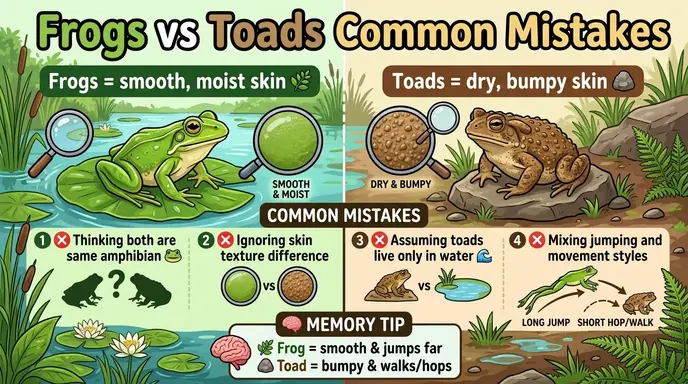
Thinking Frogs and Toads Are Completely Different Animals
❌ Frogs and toads belong to unrelated animal groups.
✅ Both frogs and toads are amphibians.
Assuming All Toads Cause Warts
❌ Touching a toad gives humans warts.
✅ Toads do not cause warts, although some release mild toxins.
Confusing Skin Texture
❌ Frogs always have dry rough skin.
✅ Frogs usually have smooth and moist skin.
Ignoring Habitat Differences
❌ Toads live only in water like frogs.
✅ Toads spend more time on land than frogs.
Using Movement Terms Incorrectly
❌ Toads make giant jumps like frogs.
✅ Toads usually move with shorter hops.
Believing All Frogs Are Green
❌ Every frog species is bright green.
✅ Frogs can appear in many colors and patterns.
🧑💼 Real Life Examples with Frogs and Toads
- Frogs are commonly seen near ponds during rainy seasons
- Toads often appear in gardens at night
- Frogs jump quickly into water when threatened
- Toads hide under rocks and soil during daytime
- Wildlife documentaries often compare frogs and toads for educational purposes
🎯 When to Identify a Frog or Toad
- Smooth wet skin → likely a frog
- Dry bumpy skin → likely a toad
- Long jumping movement → frog
- Short hopping movement → toad
- Found near water → often frog
- Found in gardens or dry soil → often toad
🤔 Why People Get Confused
- Both are amphibians
- Similar body shape and appearance
- Both live near moist environments
- Children’s books often use the terms interchangeably
- Many species share similar colors and sizes
🧠 How Science Understands Frogs and Toads
Biologists classify frogs and toads based on:
- Skin texture
- Body structure
- Habitat adaptation
- Reproductive behavior
- Evolutionary traits
This helps researchers study ecosystems, biodiversity, and amphibian conservation.
🧠 Expert Insight
The difference between frogs and toads mainly comes from habitat adaptation and body structure. Frogs evolved for swimming and jumping in wetter environments, while toads adapted for more land-based survival.
In real nature observation, skin texture and leg length are usually the easiest ways to identify whether an amphibian is a frog or a toad.
❓ FAQ:
1. Are frogs and toads the same?
No, but both are amphibians.
2. Which has smoother skin?
Frogs usually have smoother skin.
3. Do toads live in water?
Toads need water for breeding but spend more time on land.
4. Which jumps farther?
Frogs usually jump farther because of longer legs.
5. Can touching a toad cause warts?
No, that is a common myth.
6. Are frogs always green?
No, frogs come in many colors.
7. Why are toads bumpier than frogs?
Their rough skin helps them adapt better to land environments.
🧾 Conclusion
The difference between frogs and toads comes from their skin texture, habitat, movement, and body structure. Frogs usually have smooth moist skin and long legs designed for swimming and jumping, while toads have dry bumpy skin and shorter legs suited for life on land.
Understanding the difference between frogs and toads helps people identify amphibians more accurately in nature, education, and wildlife observation. Once you connect frogs with water and jumping and toads with rough skin and land movement, the distinction becomes much easier to remember.
Discover More Articles:

Hi, I’m Nabeel Hassan. I love exploring interesting topics and explaining how different things compare with each other. Through my writing, I aim to provide clear, helpful, and easy to read explanations. I cover subjects related to learning, science, technology and general knowledge.