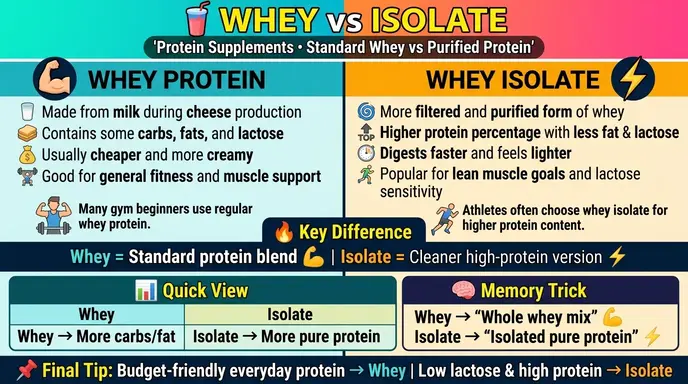
The difference between whey and isolate is that whey protein contains more carbohydrates, fats, and lactose, while whey isolate is a more filtered form with higher protein content and lower lactose and fat levels.
Many fitness beginners search for the difference between whey and isolate because both are popular protein supplements used for muscle recovery, workout support, and daily nutrition. However, they differ in processing, purity, digestion, and nutritional value.
In simple words, whey protein is the broader protein product, while whey isolate is a cleaner and more refined version. Understanding the difference between whey and isolate helps people choose the right supplement based on fitness goals, digestion, diet preferences, and budget.
💡 Quick Answer: Difference Between Whey and Isolate
Whey protein contains more natural milk components, while whey isolate is processed further to provide higher protein and lower lactose, fat, and carbs.
👉 Example: Standard whey may contain around 70–80% protein, while whey isolate usually contains 90% or more protein.
📘 Definition of Whey and Isolate
- Whey Protein: A milk-derived protein supplement containing protein along with small amounts of fats, carbohydrates, and lactose.
- Whey Isolate: A highly filtered whey protein with most fats, lactose, and carbs removed for higher protein purity.
🗣️ Pronunciation (US & UK)
- Whey
- US: /weɪ/
- UK: /weɪ/
- Isolate
- US: /ˈaɪ.sə.leɪt/
- UK: /ˈaɪ.sə.leɪt/
These terms are commonly used in fitness, bodybuilding, nutrition, sports supplements, and gym discussions.
📊 Comparison Table: Whey vs Isolate
| Feature | Whey Protein | Whey Isolate | Similarity |
| Protein Content | Around 70–80% protein | Usually 90% or more protein | Both provide muscle-supporting protein |
| Lactose Level | Contains more lactose | Very low lactose | Both come from milk |
| Fat Content | Slightly higher fat | Very low fat | Both used in fitness nutrition |
| Processing | Less filtered | More heavily filtered | Both made from whey |
| Digestion | Good for most users | Easier for lactose-sensitive users | Both digest relatively fast |
| Price | Usually more affordable | Usually more expensive | Both sold as supplements |
| Muscle Recovery | Supports recovery | Supports recovery with leaner nutrition | Both popular after workouts |
| Common Users | General fitness users | Athletes and strict diet users | Both used for protein intake |
This table clearly shows the difference and similarity between whey and isolate for quick understanding.
🧠 Key Differences Between Whey or Isolate
🥛 Protein Purity
The biggest difference between whey and isolate is protein concentration. Whey isolate contains a higher percentage of pure protein.
👉 Example: Whey isolate usually contains less sugar and fat compared to regular whey protein.
⚙️ Processing Method
Whey isolate goes through additional filtration to remove extra lactose, fats, and carbohydrates.
🍽️ Lactose Content
Regular whey contains more lactose, while isolate contains very little lactose.
👉 Example: People sensitive to dairy often tolerate whey isolate better.
💪 Fitness Goals
Whey protein is suitable for general fitness and muscle gain, while isolate is often preferred for lean muscle building and calorie-controlled diets.
💰 Price Difference
Whey isolate is usually more expensive because of extra processing and higher purity.
⚡ Digestion Speed
Both digest quickly, but isolate may absorb slightly faster because it contains fewer additional nutrients.
🏋️ Nutritional Profile
Whey protein provides a balanced nutritional profile, while isolate focuses more on maximum protein with minimal extras.
🧠 Why Whey and Isolate Exist
The difference between whey and isolate exists because fitness users have different nutritional needs. Some people want affordable daily protein, while others prefer higher protein purity, lower lactose, and fewer calories.
🏷️ How Fitness Brands Use Whey and Isolate
Supplement brands market:
- Whey protein → balanced and affordable protein option
- Whey isolate → premium lean protein supplement
- Isolate products are often promoted for cutting phases and advanced fitness goals
Fitness communities and gym trainers also recommend products differently based on diet plans and body goals.
📊 Difference + Similarity Table
| Feature | Whey Protein | Whey Isolate | Similarity |
| Meaning | Standard whey protein supplement | Filtered high-purity whey protein | Both come from milk protein |
| Protein Level | Moderate to high protein | Very high protein concentration | Both support muscle recovery |
| Lactose Amount | Higher lactose | Very low lactose | Both dairy-based supplements |
| Fat and Carbs | Contains slightly more | Contains very little | Both used in sports nutrition |
| Processing | Less processed | More refined filtration | Both produced from whey |
| Fitness Use | General muscle support | Lean muscle and calorie control | Both used after workouts |
| Cost | More affordable | More premium pricing | Both sold in supplement markets |
| Digestion | Good for most users | Easier for sensitive digestion | Both absorb quickly |
This table clearly shows the difference and similarity between whey and isolate for quick understanding.
⚠️ Common Mistakes with Difference Between Whey and Isolate
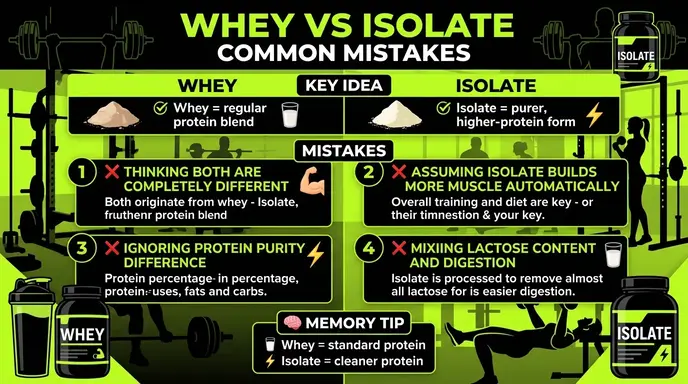
Thinking Whey and Isolate Are Completely Different Proteins
❌ Whey and isolate come from different protein sources.
✅ Whey isolate is a filtered form of whey protein.
Assuming Isolate Always Builds More Muscle
❌ Whey isolate automatically creates bigger muscles than whey.
✅ Muscle growth depends on total nutrition, training, and protein intake.
Ignoring Lactose Sensitivity
❌ Regular whey is always suitable for lactose-sensitive users.
✅ Some people digest isolate better because it contains less lactose.
Believing More Expensive Means Necessary
❌ Everyone must buy isolate for fitness success.
✅ Regular whey works well for many fitness goals and budgets.
Confusing Protein Percentage
❌ Whey and isolate contain the exact same protein concentration.
✅ Isolate usually contains higher protein purity.
Using Supplements Incorrectly
❌ Protein supplements replace all whole foods.
✅ Supplements support nutrition but should not fully replace balanced meals.
🧑💼 Real Life Examples with Isolate and Whey
- Gym beginners often start with regular whey protein
- Athletes during cutting phases may prefer isolate
- Lactose-sensitive users choose isolate for easier digestion
- Bodybuilders use both products depending on training goals
- Fitness meal plans include whey shakes after workouts
🎯 When to Choose Whey or Isolate
- Affordable daily protein → whey
- Lower lactose option → isolate
- Lean muscle and low calories → isolate
- General muscle recovery → whey
- Budget-friendly supplement → whey
- Strict diet or cutting phase → isolate
🤔 Why People Get Confused
- Both are protein supplements
- Packaging and flavors look similar
- Fitness marketing uses complex terms
- Both support muscle recovery
- Many people assume isolate is completely different from whey
🧠 How Nutrition Systems Understand This Topic
Nutrition and fitness industries classify:
- Whey protein as a general milk protein supplement
- Whey isolate as a purified whey protein form
This classification helps trainers, athletes, and consumers select products based on dietary and performance goals.
🧠 Expert Insight
The difference between whey and isolate mainly comes down to filtration, protein purity, and nutritional profile. Whey protein works well for most fitness users, while isolate is often preferred for leaner nutrition and lower lactose intake.
In practical fitness use, the best choice depends on personal goals, digestion, calorie needs, and budget rather than marketing claims alone.
❓ FAQ:
1. Is whey isolate better than regular whey?
It depends on fitness goals and dietary needs.
2. Does isolate contain more protein?
Yes, isolate usually has higher protein concentration.
3. Is whey isolate lactose-free?
It contains very low lactose but may not be completely lactose-free.
4. Which is better for muscle gain?
Both can support muscle growth effectively.
5. Why is whey isolate more expensive?
Because it requires extra filtration and processing.
6. Can beginners use whey isolate?
Yes, beginners can use either whey or isolate.
7. Which digests faster?
Isolate may absorb slightly faster due to lower fat and lactose content.
🧾 Conclusion
The difference between whey and isolate comes from processing, protein purity, lactose content, and nutritional composition. Whey protein contains more natural milk nutrients, while whey isolate is a more refined version with higher protein and lower fat, carbs, and lactose.
Understanding the difference between whey and isolate helps fitness users choose supplements that match their workout goals, digestion needs, and budget. Once you understand that whey isolate is simply a cleaner form of whey protein, selecting the right option becomes much easier for daily nutrition and muscle recovery.
Discover More Articles:

I’m Owen Parker, and I write articles that focus on explaining the differences between common concepts, tools, and ideas. I enjoy simplifying complex information and turning it into clear comparisons that anyone can understand. My work often covers science , education, technology, and everyday knowledge topics.