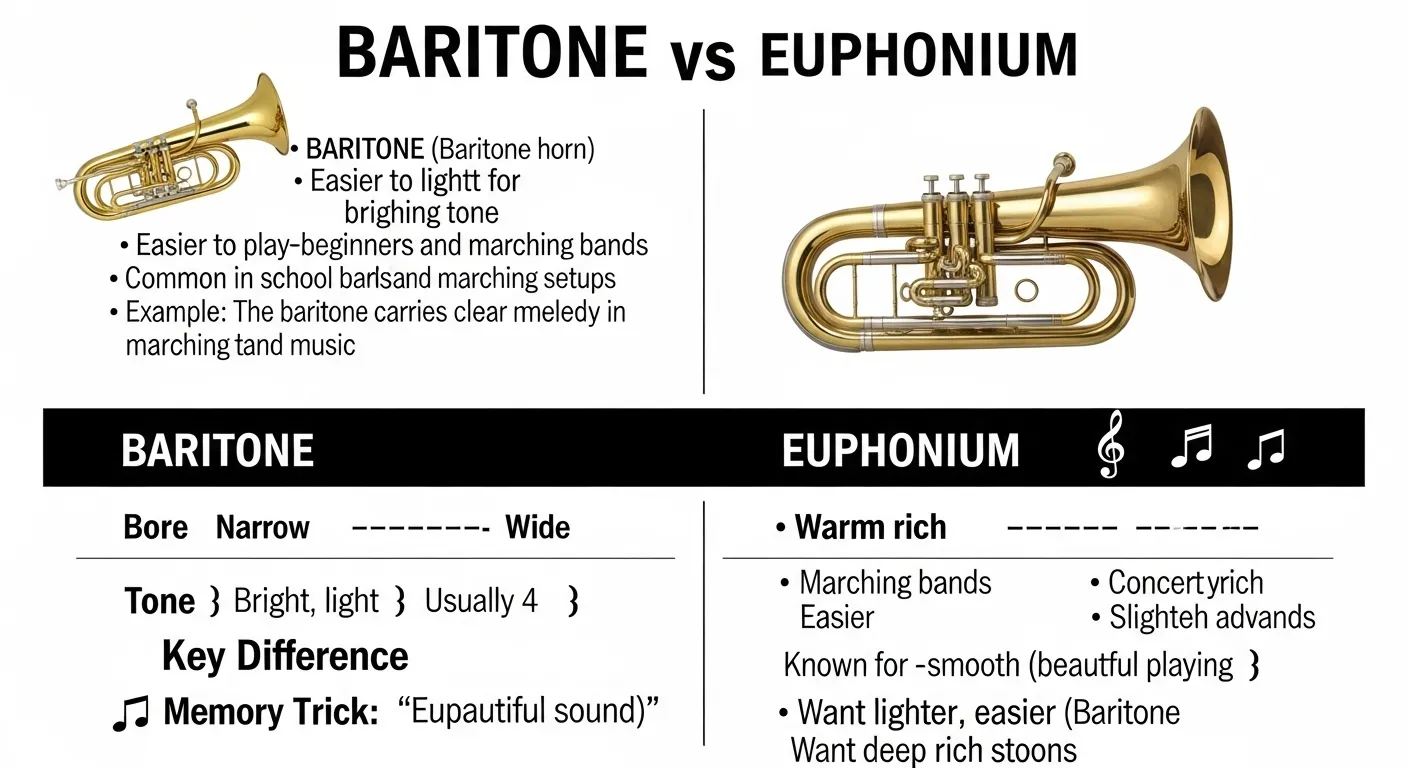
The difference between baritone and euphonium is that the baritone has a lighter tone and more direct sound, while the euphonium has a richer, deeper, and more mellow tone.
Many musicians and beginners get confused about the difference between baritone and euphonium because both instruments look similar and belong to the same brass family.
If you’ve ever wondered what is a baritone vs euphonium, how they sound, or which one to choose, this guide will clearly explain the difference between baritone and euphonium in a simple and practical way.
⚡ Quick Answer: Difference Between Baritone and Euphonium
- Baritone: Lighter, more focused sound with smaller tubing
- Euphonium: Deeper, warmer sound with wider tubing
👉 Example: Baritone sounds bright, euphonium sounds smooth and rich.
📖 Definition of Difference Between Baritone and Euphonium
- Baritone: A brass instrument with narrower tubing, producing a clear and direct tone.
- Euphonium: A brass instrument with wider tubing, producing a warm, full, and mellow tone.
🔊 Pronunciation (US & UK)
- Baritone: UK /ˈbær.ɪ.təʊn/ | US /ˈber.ə.toʊn/
- Euphonium: UK /juːˈfəʊ.ni.əm/ | US /juːˈfoʊ.ni.əm/
Now let’s explore their differences in detail.
📊 Comparison Table: Baritone vs Euphonium
| Feature | Baritone | Euphonium | Explanation |
| Sound | Bright, light | Warm, rich | Core difference |
| Tubing | Narrow | Wide | Design difference |
| Tone Quality | Direct | Smooth | Sound texture |
| Size | Slightly smaller | Slightly larger | Physical build |
| Weight | Lighter | Heavier | Handling |
| Use | Marching bands | Concert bands | Performance context |
| Air Flow | Faster | Slower, fuller | Playing style |
| Range | Similar | Similar | Musical range |
🔍 KEY DIFFERENCES EXPLAINED BETWEEN BARITONE AND EUPHONIUM
1️⃣ Sound Quality
Baritone produces a brighter tone, while euphonium produces a richer tone.
👉 Example: Euphonium sounds more “full” in music
2️⃣ Tubing Shape
Baritone has narrower tubing, euphonium has conical wider tubing.
👉 Example: This affects sound depth
3️⃣ Musical Role
Baritone often supports melody, euphonium often carries expressive lines.
👉 Example: Euphonium used for solos
4️⃣ Weight and Feel
Euphonium is heavier and feels more solid.
👉 Example: Baritone is easier to carry
5️⃣ Air Requirement
Euphonium needs more air for fuller sound.
👉 Example: Requires stronger breath control
6️⃣ Usage Context
Baritone is common in marching bands, euphonium in concert bands.
👉 Example: Different performance settings
💡 What Is the Difference Between Baritone and Euphonium in Simple Words?
In simple words, a baritone sounds lighter and sharper, while a euphonium sounds deeper and smoother.
👉 Same family, different sound feel.
🧠 Why Do Baritone and Euphonium Exist?
They exist to create different sound textures in music:
- Baritone adds clarity and brightness
- Euphonium adds depth and warmth
👉 Together, they enrich musical arrangements.
🌍 Difference Between Baritone and Euphonium in Real Life
In real scenarios:
- Baritone is used in marching performances
- Euphonium is used in orchestras and bands
👉 Each instrument has a specific role.
⚖️ DIFFERENCE + SIMILARITY TABLE
| Feature | Baritone | Euphonium | Similarity |
| Type | Brass instrument | Brass instrument | Same family |
| Playing Method | Blown air | Blown air | Same technique |
| Range | Mid-low | Mid-low | Similar pitch range |
| Use | Music bands | Music bands | Musical use |
| Material | Metal | Metal | Same construction |
| Valves | 3–4 valves | 3–4 valves | Similar design |
This table clearly shows the difference and similarity between difference between baritone and euphonium for quick understanding.
❌ Common Mistakes with Difference Between Baritone and Euphonium
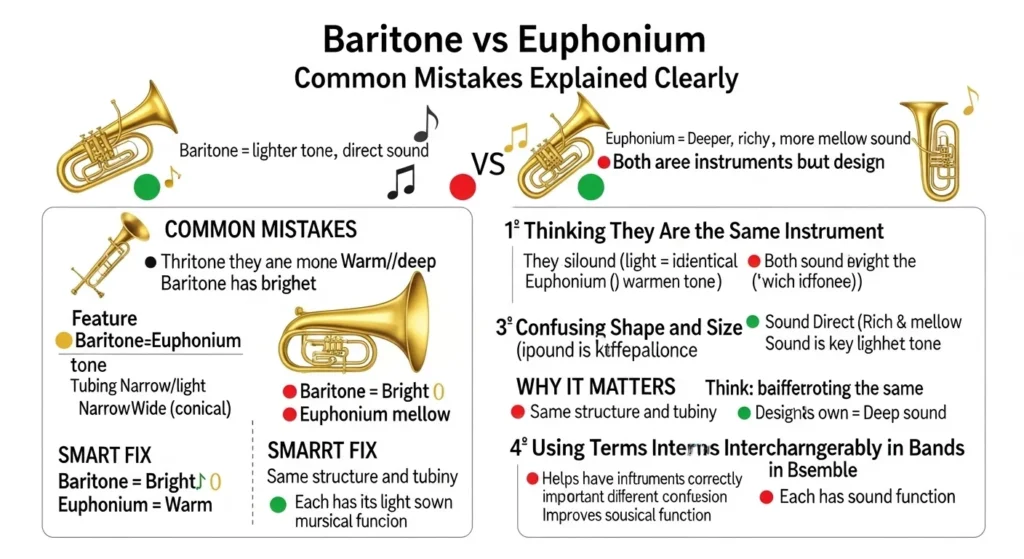
❌ Mistake 1: Thinking they are the same instrument
✔ Fix: They differ in sound and design
❌ Mistake 2: Ignoring tubing differences
✔ Fix: Tube shape affects tone
❌ Mistake 3: Using them interchangeably in music
✔ Fix: Each has a unique role
❌ Mistake 4: Assuming size defines sound only
✔ Fix: Design matters more than size
🌍 Real Life Examples with Difference Between Baritone and Euphonium
1️⃣ School Bands
Students may start with baritone
2️⃣ Concert Performances
Euphonium used for rich sound
3️⃣ Marching Bands
Baritone easier to carry and play
4️⃣ Solo Performances
Euphonium preferred for expressive solos
🎯 WHEN TO USE EACH
Use baritone when:
✔ You want a lighter sound
✔ Playing in marching settings
Use euphonium when:
✔ You want a rich tone
✔ Playing in concert settings
🤔 WHY PEOPLE GET CONFUSED IN DIFFERENCE BETWEEN BARITONE AND EUPHONIUM
- Similar appearance
- Same instrument family
- Overlapping usage
- Lack of musical knowledge
⚙️ How Music Systems Understand Baritone vs Euphonium
Music theory and orchestration treat them differently:
- Baritone = brighter tone role
- Euphonium = warmer tone role
👉 This helps composers balance sound.
🧑💼 EXPERT INSIGHT
In real scenarios, the difference between baritone and euphonium is all about sound character.
Most beginners focus on appearance, but experienced musicians choose based on tone quality and musical role. Euphonium is often preferred for expressive playing, while baritone supports clarity in ensembles.
👉 Key insight:
Baritone adds brightness, euphonium adds richness.
❓ FAQ
❓ What is the difference between baritone and euphonium?
Baritone has a lighter tone, euphonium has a deeper tone.
❓ Are they the same instrument?
No, they differ in design and sound.
❓ Which is easier to play?
Baritone is often easier for beginners.
❓ Which sounds better?
Depends on musical preference.
❓ Are both used in bands?
Yes, in different roles.
❓ Do they have the same range?
They have similar pitch ranges.
❓ Which is heavier?
Euphonium is heavier.
❓ Why do they look similar?
They belong to the same brass family.
🏁 Conclusion
The difference between baritone and euphonium lies mainly in tone, design, and musical role. The baritone offers a lighter, more direct sound, while the euphonium provides a richer, deeper, and more expressive tone.
Understanding this difference helps musicians choose the right instrument for their needs. In simple terms, baritone is bright and clear, while euphonium is warm and full.
Once you understand this, selecting between them becomes much easier and more informed.
Discover More Articles:

Hi, I’m Nabeel Hassan. I love exploring interesting topics and explaining how different things compare with each other. Through my writing, I aim to provide clear, helpful, and easy to read explanations. I cover subjects related to learning, science, technology and general knowledge.