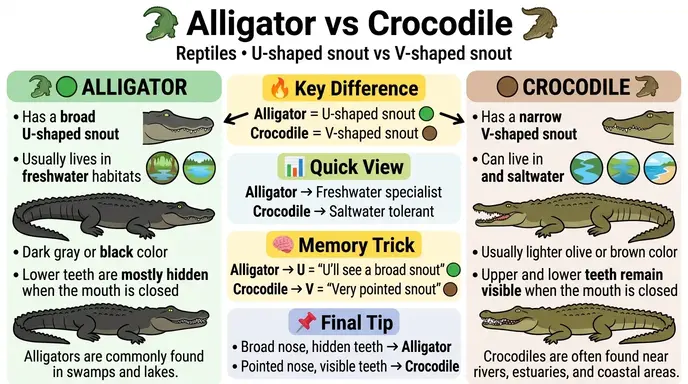
The difference between alligator and crocodile is that an alligator has a broad U shaped snout and prefers freshwater habitats, while a crocodile has a narrower V shaped snout and can live in both freshwater and saltwater environments.
Many people get confused about the difference between alligator and crocodile because both are large reptiles with similar appearances. However, they differ in physical features, habitat, behavior, and distribution.
If you’ve ever wondered what is an alligator vs crocodile, which one is more dangerous, or how to identify them, this guide will clearly explain the difference between alligator and crocodile in simple and practical language.
⚡ Quick Answer: Difference Between Alligator and Crocodile
- Alligator: Broad U shaped snout and mainly freshwater habitat
- Crocodile: Narrow V shaped snout and can tolerate saltwater
👉 Example: An alligator usually has a rounded snout, while a crocodile’s snout appears longer and more pointed.
📖 Definition of Alligator and Crocodile
- Alligator: A large reptile from the Alligatoridae family that primarily inhabits freshwater environments.
- Crocodile: A large reptile from the Crocodylidae family that can live in both freshwater and saltwater habitats.
🔊 Pronunciation (US & UK)
- Alligator: UK /ˈæl.ɪ.ɡeɪ.tə/ | US /ˈæl.ə.ɡeɪ.tɚ/
- Crocodile: UK /ˈkrɒk.ə.daɪl/ | US /ˈkrɑː.kə.daɪl/
Now let’s understand their differences clearly.
📊 Alligator vs Crocodile Comparison Table
| Feature | Alligator | Crocodile |
| Snout Shape | Broad U shape | Narrow V shape |
| Habitat | Mostly freshwater | Freshwater and saltwater |
| Skin Color | Dark gray or black | Olive, brown, or lighter gray |
| Teeth Visibility | Lower teeth hidden when mouth is closed | Upper and lower teeth visible |
| Salt Tolerance | Lower | Higher |
| Temperament | Generally less aggressive | Generally more aggressive |
| Distribution | Mainly U.S. and China | Africa, Asia, Australia, and the Americas |
| Average Size | Large | Often larger depending on species |
🔍 KEY DIFFERENCES EXPLAINED BETWEEN ALLIGATOR OR CROCODILE
👃 Snout Shape
The most noticeable difference is the shape of the snout.
👉 Alligators have a wide, rounded U shaped snout.
👉 Crocodiles have a narrower, pointed V shaped snout.
This feature is often the easiest way to tell them apart.
🦷 Teeth Visibility
When an alligator closes its mouth, most lower teeth are hidden.
When a crocodile closes its mouth, both upper and lower teeth remain visible.
👉 Crocodiles often appear to be showing their teeth even when resting.
🌊 Habitat
Alligators mostly live in freshwater swamps, rivers, marshes, and lakes.
Crocodiles can survive in freshwater environments and also tolerate saltwater habitats.
👉 Crocodiles are commonly found in coastal regions and estuaries.
🧂 Saltwater Adaptation
Crocodiles possess highly effective salt glands that help remove excess salt from their bodies.
Alligators have salt glands too, but they are less effective.
👉 This is why crocodiles are much more comfortable in saltwater environments.
⚠️ Behavior
Although both animals can be dangerous, crocodiles are generally considered more aggressive and territorial.
👉 Alligators are often less likely to attack humans unless threatened.
🌍 Geographic Distribution
Alligators have a limited range and are mainly found in:
- Southeastern United States
- Eastern China
Crocodiles are found across:
- Africa
- Asia
- Australia
- North America
- South America
👉 Crocodiles have a much wider global distribution.
🤔 What Is the Difference Between Crocodile and Alligator in Simple Words?
In simple words, an alligator has a broad snout and prefers freshwater, while a crocodile has a pointed snout and can live in both freshwater and saltwater.
👉 Alligator = broad snout
👉 Crocodile = pointed snout
🧠 Why Do People Confuse Alligator and Crocodile?
Both animals:
- Are large reptiles
- Live near water
- Have armored skin
- Belong to the crocodilian group
Main Difference:
- Alligator = U shaped snout
- Crocodile = V shaped snout
👉 Their overall appearance is very similar, which causes confusion.
🌍 Difference Between Alligator and Crocodile in Real Life
In practical wildlife observation:
- Alligators are commonly seen in freshwater wetlands.
- Crocodiles are more likely to be found near coastal waters.
- Florida is one of the few places where both species can be found.
👉 Habitat often provides a clue to identification.
⚖️ DIFFERENCE + SIMILARITY TABLE
| Feature | Alligator | Crocodile | Similarity |
| Reptile | Yes | Yes | Cold blooded animal |
| Semi Aquatic | Yes | Yes | Water dependent lifestyle |
| Carnivorous | Yes | Yes | Meat eating predators |
| Powerful Jaws | Yes | Yes | Hunting adaptation |
| Egg Laying | Yes | Yes | Reproduction method |
| Armored Skin | Yes | Yes | Protective scales |
| Long Lifespan | Yes | Yes | Long lived reptiles |
| Crocodilian Order | Yes | Yes | Closely related animals |
This table clearly shows the difference and similarity between difference between alligator and crocodile for quick understanding.
❌ Common Mistakes with Alligator or Crocodile
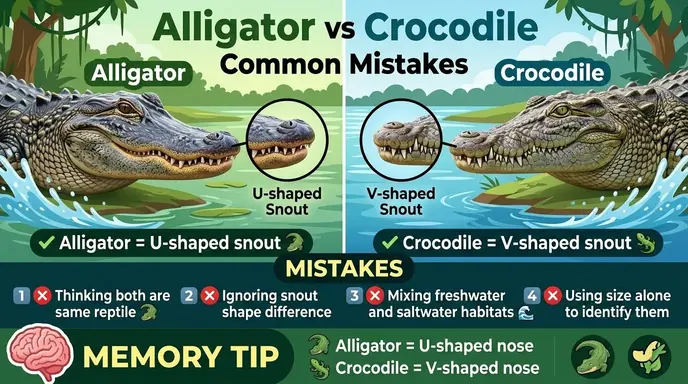
Thinking They Are the Same Animal
❌ Alligators and crocodiles are identical.
✅ They belong to different biological families.
Ignoring Snout Shape
❌ Snout shape is not important.
✅ It is one of the easiest identification features.
Assuming All Live in Saltwater
❌ Both thrive equally in saltwater.
✅ Crocodiles are much better adapted to saltwater environments.
Judging Only by Size
❌ The larger reptile is always a crocodile.
✅ Size varies depending on species and age.
Assuming Equal Aggression
❌ All crocodilians behave the same way.
✅ Crocodiles are generally considered more aggressive.
🏡 Real Life Examples with Alligator and Crocodile
🐊 American Alligator
Commonly found in freshwater swamps, rivers, and marshes.
🌊 Saltwater Crocodile
Known for living in coastal and marine environments.
🏞️ Wetland Ecosystems
Both species play important roles as apex predators.
📷 Wildlife Identification
Snout shape and visible teeth help distinguish the two.
🎯 WHEN TO USE EACH
Use Alligator When:
Referring to broad snouted crocodilians
Discussing freshwater habitats
Talking about species found mainly in the U.S. and China
Use Crocodile When:
Referring to narrow snouted crocodilians
Discussing saltwater capable reptiles
Talking about species with a wider global distribution
🤯 WHY PEOPLE GET CONFUSED IN ALLIGATOR AND CROCODILE
- Similar appearance
- Similar habitats
- Related species
- Both are large aquatic predators
⚙️ How Zoologists Understand Alligator vs Crocodile
Scientists distinguish them based on:
- Skull structure
- Snout shape
- Tooth placement
- Salt gland function
- Genetic classification
👉 Despite their similarities, they belong to different reptile families.
🧑🔬 EXPERT INSIGHT
Biologists consider alligators and crocodiles close relatives that evolved different adaptations over millions of years. Crocodiles developed stronger salt processing abilities and broader habitat flexibility, while alligators became more specialized for freshwater environments.
One important insight many people overlook is that snout shape relates to feeding style. Alligators use their broader snouts for crushing prey, while crocodiles use their narrower snouts for efficiently catching a variety of aquatic animals.
👉 Key insight:
The easiest way to identify them is by their snout shape—U shaped for alligators and V shaped for crocodiles.
❓ FAQ:
❓ What is the difference between alligator and crocodile?
Alligators have broad U shaped snouts, while crocodiles have narrow V shaped snouts.
❓ Which is more aggressive?
Crocodiles are generally more aggressive than alligators.
❓ Can crocodiles live in saltwater?
Yes, crocodiles can tolerate saltwater environments.
❓ Do alligators live in saltwater?
They mainly prefer freshwater habitats.
❓ Which is bigger?
Some crocodile species grow larger than most alligators.
❓ How can I identify them quickly?
Look at the snout shape and whether the lower teeth are visible.
❓ Are they related?
Yes, both belong to the crocodilian order.
❓ Do both lay eggs?
Yes, both reproduce by laying eggs.
🏁 Conclusion
The difference between alligator and crocodile mainly comes down to snout shape, habitat preference, salt tolerance, and behavior. Alligators have broad U shaped snouts and primarily inhabit freshwater environments, while crocodiles have narrow V shaped snouts and can thrive in both freshwater and saltwater habitats.
Understanding these distinctions makes identification much easier. In simple terms, alligators are broader snouted freshwater reptiles, while crocodiles are narrower snouted reptiles with greater saltwater adaptability.
Once you understand their key physical features, the difference between alligator and crocodile becomes easy to recognize.
Discover More Articles:

Hi, I’m Nabeel Hassan. I love exploring interesting topics and explaining how different things compare with each other. Through my writing, I aim to provide clear, helpful, and easy to read explanations. I cover subjects related to learning, science, technology and general knowledge.