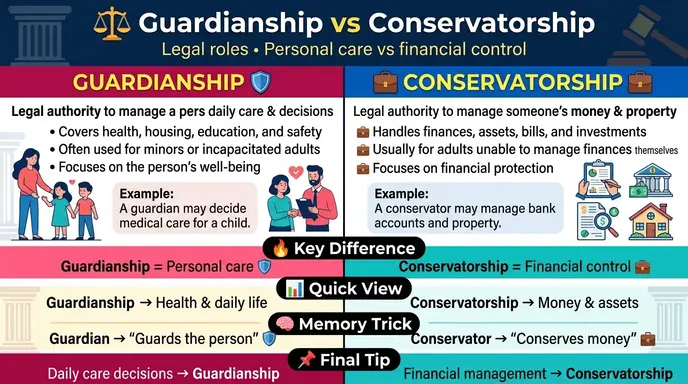
The difference between guardianship and conservatorship is that guardianship usually involves making personal and healthcare decisions for someone, while conservatorship mainly focuses on managing a person’s finances, property, or assets.
Many people get confused about the difference between guardianship and conservatorship because both are legal arrangements created to help individuals who cannot fully care for themselves or manage important responsibilities independently.
If you’ve ever wondered what is guardianship vs conservatorship, who needs these legal protections, or how courts separate these roles, this guide will clearly explain the difference between guardianship and conservatorship in simple and practical language.
⚡ Quick Answer: Difference Between Guardianship and Conservatorship
- Guardianship: Control over personal care and daily life decisions
- Conservatorship: Control over financial and property matters
👉 Example: A guardian may decide medical care, while a conservator may manage bank accounts and bills.
📖 Definition of Guardianship and Conservatorship
- Guardianship: A legal arrangement where a person is appointed to care for another person’s personal needs, health, or daily living decisions.
- Conservatorship: A legal arrangement where a person is appointed to manage another person’s finances, assets, or property.
🔊 Pronunciation (US & UK)
- Guardianship: UK /ˈɡɑː.di.ən.ʃɪp/ | US /ˈɡɑːr.di.ən.ʃɪp/
- Conservatorship: UK /kənˈsɜː.və.tə.ʃɪp/ | US /kənˈsɝː.və.t̬ɚ.ʃɪp/
Now let’s understand their differences clearly.
📊 Guardianship vs Conservatorship Comparison Table
| Feature | Guardianship | Conservatorship |
| Main Focus | Personal care | Financial management |
| Decisions Made | Health and daily life | Money and property |
| Common Purpose | Protect vulnerable individuals | Protect financial interests |
| Court Involvement | Yes | Yes |
| Covers Medical Decisions | Usually yes | Usually no |
| Covers Asset Management | Limited | Main responsibility |
| Typical Cases | Minors or disabled adults | financially incapable adults |
| Role Type | Personal support | Financial oversight |
🔍 KEY DIFFERENCES EXPLAINED BETWEEN GUARDIANSHIP AND CONSERVATORSHIP
🧑⚕️ Personal Care vs Financial Control
Guardianship focuses on personal well-being, while conservatorship focuses on financial protection.
👉 Example: Guardians may choose healthcare providers, while conservators manage investments.
💰 Financial Responsibilities
Conservators handle money, property, and legal financial matters. Guardians may not have authority over finances unless the court allows it.
👉 Example: Paying bills and managing bank accounts are usually conservator duties.
🏥 Medical and Daily Decisions
Guardians often make healthcare and living arrangement decisions.
👉 Example: Choosing assisted living care may fall under guardianship.
👶 Common Situations
Guardianship is often used for minors or adults with disabilities, while conservatorship is commonly used for adults unable to manage finances independently.
👉 Example: Older individuals with memory conditions may need conservatorship.
⚖️ Legal Authority Scope
Courts define different legal powers for guardians and conservators depending on the situation.
👉 Example: One person can sometimes hold both roles.
🏡 Daily Life Support
Guardians help with personal safety, education, and healthcare decisions. Conservators mainly oversee financial stability.
👉 Example: Guardians may decide school or therapy needs.
🤔 What Is the Difference Between Guardianship and Conservatorship in Simple Words?
In simple words, guardianship handles personal care decisions, while conservatorship handles financial decisions.
👉 Guardian = personal care
👉 Conservator = financial management
🧠 Why Do Courts Use Guardianship and Conservatorship?
Courts create these legal arrangements to protect people who cannot safely manage important parts of life on their own.
Guardianship may help with:
- Medical decisions
- Housing choices
- Education support
- Daily care needs
Conservatorship may help with:
- Paying bills
- Managing property
- Protecting assets
- Financial planning
👉 Both systems aim to protect vulnerable individuals.
🌍 Difference Between Guardianship and Conservatorship in Real Life
In practical use:
- Parents may become guardians for disabled adult children
- Courts may appoint conservators for adults with severe memory loss
- Some people require both personal and financial assistance
👉 Every legal case depends on the individual’s needs.
⚖️ DIFFERENCE + SIMILARITY TABLE OF CONSERVATORSHIP VS GUARDIANSHIP
| Feature | Guardianship | Conservatorship | Similarity |
| Court Approval | Required | Required | Legal process |
| Protects Individuals | Yes | Yes | Safety purpose |
| Legal Responsibility | Yes | Yes | Court-appointed role |
| Decision-Making Authority | Yes | Yes | Authorized control |
| Used for Vulnerable People | Common | Common | Protective role |
| Requires Oversight | Yes | Yes | Court supervision |
| Can Apply to Adults | Yes | Yes | Adult protection |
| May Limit Independence | Yes | Yes | Legal restrictions |
This table clearly shows the difference and similarity between difference between guardianship and conservatorship for quick understanding.
❌ Common Mistakes with Guardianship or Conservatorship
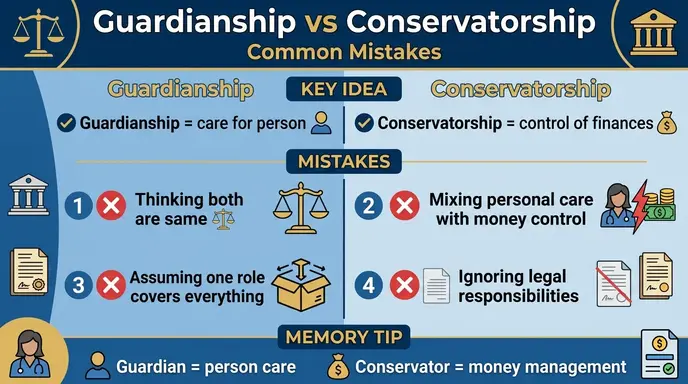
Thinking Both Terms Mean the Same Thing
❌ Guardianship and conservatorship are identical.
✅ Guardianship handles personal care, while conservatorship handles finances.
Their legal focus differs.
Assuming Conservators Handle Healthcare
❌ Conservators always make medical decisions.
✅ Medical authority often belongs to guardians.
Court powers vary.
Believing Only Olderly Adults Need These Protections
❌ Only older adults require guardianship or conservatorship.
✅ Minors and disabled adults may also need protection.
Age is not the only factor.
Ignoring Court Supervision
❌ Guardians and conservators act without oversight.
✅ Courts usually monitor their actions.
Legal accountability matters.
Assuming One Person Cannot Hold Both Roles
❌ A guardian can never be a conservator too.
✅ Courts may appoint one person to handle both responsibilities.
Cases vary.
🏡 Real Life Examples with Guardianship and Conservatorship
👶 Minor Child Protection
A guardian may care for a child whose parents cannot provide support.
🏥 Medical Care Decisions
A guardian may approve healthcare treatment for a disabled adult.
💳 Financial Management for Older Adults
A conservator may manage retirement funds and pay bills.
🏠 Property Protection
A conservator may oversee property sales or rental income.
🎯 WHEN TO USE EACH
Use Guardianship When:
✔ Discussing personal care decisions
✔ Talking about healthcare or living arrangements
✔ Referring to daily life support
Use Conservatorship When:
✔ Discussing financial control
✔ Talking about property or assets
✔ Referring to money management responsibilities
🤯 WHY PEOPLE GET CONFUSED IN CONSERVATORSHIP AND GUARDIANSHIP
- Both are court-appointed roles
- Both protect vulnerable individuals
- Laws differ by state or country
- Media coverage often mixes the terms
⚙️ How Courts Understand Guardianship vs Conservatorship
Courts separate these roles based on:
- Personal care needs
- Financial capability
- Medical decision-making ability
- Asset protection requirements
👉 The individual’s level of independence strongly affects court decisions.
🧑⚖️ EXPERT INSIGHT
In real scenarios, many families believe guardianship automatically includes financial authority, but courts often separate personal and financial responsibilities into different legal roles. This separation helps ensure better oversight and protection.
One important insight is that courts usually try to preserve as much independence as possible before granting full guardianship or conservatorship. Judges often review medical evaluations, financial records, and family situations carefully before making decisions.
👉 Key insight:
Guardianship protects personal well-being, while conservatorship protects financial stability.
❓ FAQ :
❓ What is the difference between guardianship and conservatorship?
Guardianship covers personal and healthcare decisions, while conservatorship covers financial matters.
❓ Can one person have both a guardian and conservator?
Yes, courts may appoint separate people or the same person for both roles.
❓ Does a guardian control money?
Usually not unless the court grants financial authority.
❓ What does a conservator do?
A conservator manages finances, property, and assets.
❓ Is conservatorship only for older people?
No, it may apply to anyone unable to manage finances safely.
❓ Can guardianship apply to minors?
Yes, guardianship is commonly used for children.
❓ Do courts supervise guardians and conservators?
Yes, courts usually monitor these legal arrangements.
❓ Why are these legal protections important?
They help protect vulnerable individuals from harm or financial problems.
🏁 Conclusion
The difference between guardianship and conservatorship mainly comes down to personal care versus financial responsibility. Guardianship focuses on healthcare, daily living, and personal support, while conservatorship focuses on managing money, assets, and property.
Understanding this difference helps families, caregivers, and individuals make informed legal decisions when extra support becomes necessary. In simple terms, guardians protect people’s personal well-being, while conservators protect financial interests.
Once you understand their separate legal roles, the distinction between the two becomes much easier to recognize.
Discover More Articles:

Hi, I’m Nabeel Hassan. I love exploring interesting topics and explaining how different things compare with each other. Through my writing, I aim to provide clear, helpful, and easy to read explanations. I cover subjects related to learning, science, technology and general knowledge.