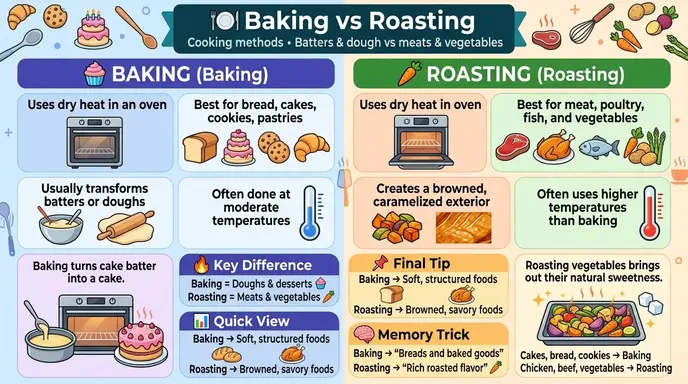
The difference between baking and roasting is that baking is typically used for foods that start with a liquid or dough like structure, while roasting is usually used for solid foods such as meats and vegetables.
Many people get confused about the difference between baking and roasting because both cooking methods use dry heat in an oven.
If you’ve ever wondered what is baking vs roasting, which cooking method is better, or how chefs use them differently, this guide will clearly explain the difference between baking and roasting in simple and practical language.
⚡ Quick Answer: Difference Between Baking and Roasting
- Baking: Uses dry heat to cook foods like bread, cakes, pastries, and casseroles.
- Roasting: Uses dry heat to cook solid foods like meat, poultry, fish, and vegetables.
👉 Example: You bake a cake, but you roast a chicken.
📖 Definition of Baking and Roasting
- Baking: A cooking method that uses indirect dry heat in an enclosed oven to cook batter based, dough based, or structured foods.
- Roasting: A cooking method that uses dry heat, often at higher temperatures, to brown and caramelize the exterior of solid foods.
🔊 Pronunciation (US & UK)
- Baking: UK /ˈbeɪ.kɪŋ/ | US /ˈbeɪ.kɪŋ/
- Roasting: UK /ˈrəʊ.stɪŋ/ | US /ˈroʊ.stɪŋ/
Now let’s understand their differences clearly.
📊 Baking vs Roasting Comparison Table
| Feature | Baking | Roasting |
| Main Use | Bread, cakes, pastries | Meat, poultry, vegetables |
| Food Type | Doughs and batters | Solid foods |
| Temperature | Moderate | Often higher |
| Browning Effect | Usually lighter | Usually stronger |
| Texture Goal | Soft interior structure | Crispy exterior |
| Moisture Loss | Lower | Higher |
| Caramelization | Limited | More pronounced |
| Common Examples | Cookies, bread, cake | Chicken, turkey, potatoes |
🔍 KEY DIFFERENCES EXPLAINED BETWEEN BAKING OR ROASTING
🍞 Type of Food
Baking is commonly used for foods made from dough or batter, while roasting is generally used for meats and vegetables.
👉 Example: Bread is baked, while carrots are roasted.
🌡️ Cooking Temperature
Roasting often uses higher temperatures to create browning and crispness, while baking frequently uses moderate temperatures.
👉 Example: Roasted vegetables often cook at higher heat than cakes.
🥔 Texture and Appearance
Roasting aims to develop a crispy, browned exterior. Baking usually focuses on creating a structured and evenly cooked interior.
👉 Example: Roasted potatoes develop a crisp outer layer.
🔥 Browning and Caramelization
Roasting encourages stronger browning and caramelization because of higher heat and exposed surfaces.
👉 Example: Roasted vegetables often develop sweet caramelized edges.
💧 Moisture Retention
Baked foods generally retain more internal moisture, while roasted foods may lose more moisture during cooking.
👉 Example: Roasted meat develops a browned exterior while losing some surface moisture.
👨🍳 Cooking Purpose
Baking creates and sets structure in foods like cakes and breads, while roasting enhances flavor through browning and caramelization.
👉 Example: A cake needs baking to hold its shape.
🤔 What Is the Difference Between Baking and Roasting in Simple Words?
In simple words, baking is mainly for breads, cakes, and pastries, while roasting is mainly for meats and vegetables that benefit from browning and crisping.
👉 Baking = doughs and batters
👉 Roasting = meats and vegetables
🧠 Why Do People Confuse Baking and Roasting?
Both methods use dry heat inside an oven.
Both involve:
- Oven cooking
- Dry heat
- Similar kitchen equipment
- Even heat distribution
Main difference:
- Baking focuses on structure
- Roasting focuses on browning and flavor
👉 The oven may be the same, but the cooking goal is different.
🌍 Difference Between Roasting and Baking in Real Life
In practical cooking:
- Cakes, muffins, and cookies baked.
- Chicken, turkey, and vegetables are roasted.
- Some foods technically be prepared using either term depending on context.
👉 Cooking traditions often influence the terminology.
⚖️ DIFFERENCE + SIMILARITY TABLE
| Feature | Baking | Roasting | Similarity |
| Uses Oven | Yes | Yes | Dry heat cooking |
| Requires Heat | Yes | Yes | Cooking process |
| Changes Food Texture | Yes | Yes | Food preparation |
| Common Home Method | Yes | Yes | Kitchen technique |
| Can Brown Food | Yes | Yes | Heat reaction |
| Uses Baking Pans | Often | Sometimes | Oven cookware |
| Enhances Flavor | Yes | Yes | Improves food |
| Popular Worldwide | Yes | Yes | Common cooking methods |
This table clearly shows the difference and similarity between difference between baking and roasting for quick understanding.
❌ Common Mistakes with Baking or Roasting
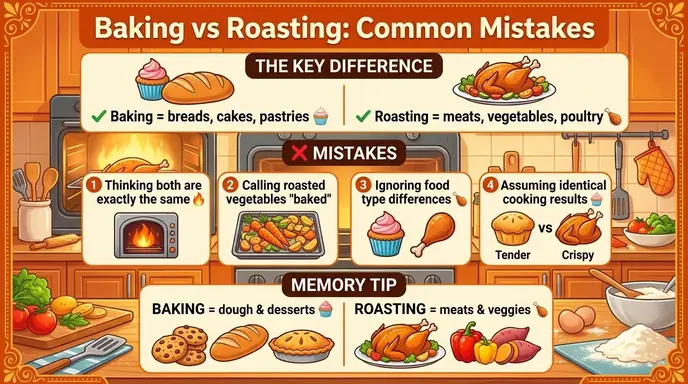
Thinking They Are Exactly the Same
❌Both are identical cooking methods.
✅ They use similar heat sources but often have different purposes.
Purpose matters.
Assuming Roasting Is Only for Meat
❌ Meat can be roasted.
✅ Vegetables are commonly roasted as well.
Food variety matters.
Using the Wrong Temperature
❌ All baked and roasted foods require the same temperature.
✅ Different foods need different heat levels.
Temperature matters.
Confusing Browning with Baking
❌ Every baked item should develop a dark brown crust.
✅ Many baked foods are lightly browned.
Desired result differs.
🏡 Real Life Examples with Baking and Roasting
🎂 Cake Preparation
Cakes are baked to create a stable structure.
🍗 Roast Chicken
Chicken is roasted to develop a flavorful browned exterior.
🥕 Roasted Vegetables
Vegetables become sweeter through roasting.
🍪 Cookies
Cookies baked until set and lightly browned.
🎯 WHEN TO USE EACH
Use Baking When:
✔ Making bread
✔ Preparing cakes
✔ Cooking cookies
✔ Working with batter or dough
Use Roasting When:
✔ Cooking meat
✔ Preparing poultry
✔ Cooking vegetables
✔ Seeking caramelization and crispness
🤯 WHY PEOPLE GET CONFUSED IN BAKING AND ROASTING
- Both use ovens
- Both use dry heat
- Similar equipment used
- Some foods overlap between methods
⚙️ How Chefs Understand Baking vs Roasting
Professional cooks distinguish them based on:
- Food structure
- Temperature range
- Desired texture
- Browning level
👉 Baking develops structure, while roasting emphasizes browning, flavor, and caramelization.
🧑🍳 EXPERT INSIGHT
Professional kitchens, baking and roasting rely on the same basic principle of dry heat, but the intended result is different. Baking focuses on transforming batters and doughs into structured foods through controlled heat. Roasting focuses on enhancing flavor, creating browning, and developing texture in meats and vegetables.
One important insight many people overlook is that the distinction is sometimes more traditional than technical.Both methods use oven heat, certain foods may be described as either baked or roasted depending on culinary tradition and recipe style.
👉 Key insight:
Baking is primarily about creating structure in foods like bread and cake, while roasting is about developing flavor, browning, and texture in solid foods.
❓ FAQ:
❓ What is the difference between baking and roasting?
Baking usually used for doughs and batters, while roasting is generally used for meats and vegetables.
❓ Do baking and roasting use the same oven?
Yes, both typically use an oven and dry heat.
❓ Is roasting hotter than baking?
Roasting often uses higher temperatures, though this can vary.
❓ Can vegetables be baked?
Yes, but the term roasting is more commonly used when browning is desired.
❓ Is chicken baked or roasted?
Both terms may be used, but whole chickens are commonly roasted.
❓ Are cookies baked or roasted?
Cookies are baked.
❓ Which method is used for cakes?
Cakes are baked.
🏁 Conclusion
The difference between baking and roasting mainly comes down to the type of food being cooked and the desired result. Baking is typically used for breads, cakes, pastries, and other foods that need structure, while roasting is commonly used for meats and vegetables that benefit from browning and caramelization.
Understanding this difference helps improve cooking techniques and recipe selection.
Once you understand their cooking goals, the difference between baking and roasting becomes much easier to recognize.
Discover More Articles:

I’m Owen Parker, and I write articles that focus on explaining the differences between common concepts, tools, and ideas. I enjoy simplifying complex information and turning it into clear comparisons that anyone can understand. My work often covers science , education, technology, and everyday knowledge topics.