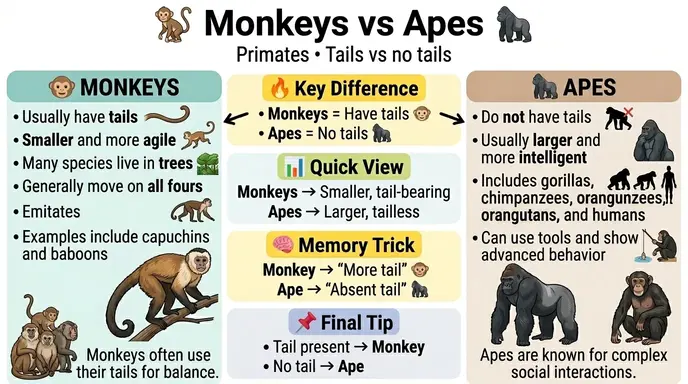
The difference between monkeys and apes is that monkeys usually have tails and smaller bodies, while apes do not have tails and generally have larger brains and more advanced behaviors.
Many people get confused about the difference between monkeys and apes because both belong to the primate group and share similar physical features. However, they differ in anatomy, intelligence, movement, and evolutionary characteristics.
If you’ve ever wondered what is a monkey vs ape, which one is more intelligent, or how to identify them, this guide will clearly explain the difference between monkeys and apes in simple and practical language.
⚡ Quick Answer: Difference Between Monkeys and Apes
- Monkeys: Usually have tails and smaller body structures
- Apes: Do not have tails and often have larger brains and more advanced behavior
👉 Example: A chimpanzee is an ape, while a capuchin is a monkey.
📖 Definition of Monkeys and Apes
- Monkeys: Primates generally characterized by tails, agile movement, and smaller body size.
- Apes: Tail less primates known for larger brains, upright posture, and higher cognitive abilities.
🔊 Pronunciation (US & UK)
- Monkey: UK /ˈmʌŋ.ki/ | US /ˈmʌŋ.ki/
- Ape: UK /eɪp/ | US /eɪp/
Now let’s understand their differences clearly.
📊 Monkeys vs Apes Comparison Table
| Feature | Monkeys | Apes |
| Tail | Usually present | No tail |
| Brain Size | Smaller | Larger |
| Intelligence | High | Generally higher |
| Body Size | Usually smaller | Usually larger |
| Movement | Running and climbing | Swinging and climbing |
| Posture | Mostly horizontal | More upright |
| Arm Length | Shorter | Longer |
| Examples | Baboon, macaque, capuchin | Gorilla, chimpanzee, orangutan |
🔍 KEY DIFFERENCES EXPLAINED BETWEEN MONKEYS OR APES
🐾 Tail Presence
One of the easiest differences is the tail.
👉 Most monkeys have tails.
👉 Apes do not have tails.
This is often the quickest way to identify them.
🧠 Intelligence
Apes generally have larger brains relative to body size and show more advanced problem solving abilities.
👉 Chimpanzees can use tools and learn complex behaviors.
Monkeys are intelligent too, but apes usually demonstrate more advanced cognition.
🚶 Body Posture
Monkeys typically move with a more horizontal body posture.
Apes can stand or move in a more upright position.
👉 Gorillas and chimpanzees can walk short distances upright.
💪 Arm Structure
Apes usually have longer and stronger arms designed for swinging and climbing.
👉 Gibbons are famous for swinging between branches using long arms.
Monkeys often rely more on running and climbing.
🌍 Evolutionary Classification
Apes and monkeys belong to different branches within the primate order.
👉 Apes are more closely related to humans than monkeys are.
🏞️ Habitat and Movement
Monkeys are often agile runners and climbers.
Apes tend to use more deliberate movement and may swing through trees using arm based locomotion.
👉 Orangutans spend much of their time climbing slowly in trees.
🤔 What Is the Difference Between Monkeys and Apes in Simple Words?
In simple words, monkeys usually have tails and smaller bodies, while apes do not have tails and generally have larger brains and more advanced behavior.
👉 Monkey = tail
👉 Ape = no tail
🧠 Why Do People Confuse Monkeys and Apes?
Both animals:
- Are primates
- Have similar facial features
- Live in trees or forests
- Use hands and feet for climbing
Main Difference:
- Monkeys usually have tails
- Apes never have tails
👉 Their similar appearance causes frequent confusion.
🌍 Difference Between Apes and Monkeys in Real Life
In practical observation:
- Monkeys are often seen jumping and running through trees.
- Apes may swing, climb slowly, or walk upright at times.
- Zoos and documentaries often display both together, which adds confusion.
👉 Watching the tail is usually the easiest identification method.
⚖️ DIFFERENCE + SIMILARITY TABLE
| Feature | Monkeys | Apes | Similarity |
| Primate | Yes | Yes | Mammal group |
| Opposable Thumbs | Yes | Yes | Grasping ability |
| Social Behavior | Yes | Yes | Group living |
| Tree Climbing | Yes | Yes | Arboreal skills |
| Intelligent | Yes | Yes | Cognitive abilities |
| Forward Facing Eyes | Yes | Yes | Depth perception |
| Mammal | Yes | Yes | Warm blooded animals |
| Related to Humans | Yes | Yes | Primate ancestry |
This table clearly shows the difference and similarity between difference between monkeys and apes for quick understanding.
❌ Common Mistakes with Monkeys or Apes
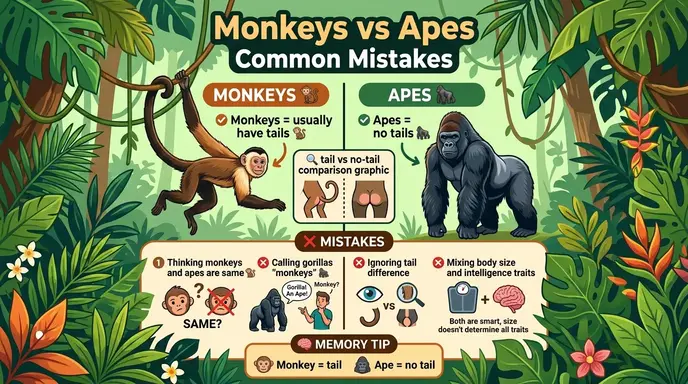
Calling All Primates Monkeys
❌ Every primate is a monkey.
✅ Apes and monkeys are different primate groups.
Thinking Apes Have Tails
❌ Some apes have tails.
✅ Apes do not have tails.
Assuming Monkeys Are Not Intelligent
❌ Only apes are smart.
✅ Many monkey species are highly intelligent.
Confusing Gorillas with Monkeys
❌ Gorillas are monkeys.
✅ Gorillas are apes.
Ignoring Evolutionary Differences
❌ Monkeys and apes are nearly identical biologically.
✅ They evolved into different primate branches.
🏡 Real Life Examples with Monkeys and Apes
🐵 Capuchin Monkey
Known for agility, tail use, and problem solving skills.
🦍 Gorilla
A large ape with no tail and powerful body structure.
🌳 Tree Movement
Monkeys often leap quickly between branches.
🧰 Tool Use
Some apes use sticks and objects as tools.
🎯 WHEN TO USE EACH
Use Monkey When:
✔ Referring to tailed primates
✔ Discussing smaller agile primates
✔ Talking about species like macaques or baboons
Use Ape When:
✔ Referring to tailless primates
✔ Discussing gorillas or chimpanzees
✔ Talking about advanced cognitive behavior
🤯 WHY PEOPLE GET CONFUSED IN MONKEYS AND APES
- Similar body structure
- Both are primates
- Similar facial appearance
- Shared tree dwelling behavior
⚙️ How Scientists Understand Monkeys vs Apes
Scientists distinguish them based on:
- Tail presence
- Skeletal structure
- Brain development
- Genetic relationships
- Evolutionary classification
👉 Apes are evolutionarily closer to humans than monkeys are.
🧑🔬 EXPERT INSIGHT
Primatologists classify monkeys and apes as related but distinct branches of the primate family tree. Apes evolved larger brains, more flexible shoulders, and advanced social behaviors that support complex communication and tool use. Monkeys, meanwhile, adapted successfully to many environments using agility, tails, and fast movement.
One important insight many people overlook is that humans are scientifically classified as apes, not monkeys. Humans share a closer evolutionary relationship with chimpanzees and gorillas than monkeys do.
👉 Key insight:
The easiest way to distinguish them is by the tail most monkeys have one, while apes never do.
❓ FAQ:
❓ What is the difference between monkeys and apes?
Monkeys usually have tails, while apes do not.
❓ Are apes more intelligent than monkeys?
Generally yes, apes tend to show more advanced cognitive abilities.
❓ Do monkeys have tails?
Most monkeys do have tails.
❓ Do apes have tails?
No, apes do not have tails.
❓ Is a gorilla a monkey?
No, a gorilla is an ape.
❓ Are humans apes?
Yes, humans are scientifically classified as apes.
❓ Which is larger?
Apes are generally larger than monkeys.
❓ Can both climb trees?
Yes, both monkeys and apes are skilled climbers.
🏁 Conclusion
The difference between monkeys and apes mainly comes down to tails, body structure, intelligence, and evolutionary classification. Monkeys usually have tails and smaller bodies, while apes lack tails and generally possess larger brains and more advanced behaviors.
Understanding these distinctions makes it easier to identify primates correctly. In simple terms, monkeys are tailed primates, while apes are tailless primates with more advanced physical and cognitive characteristics.
Once you understand their physical and evolutionary differences, the difference between monkeys and apes becomes much easier to recognize.
Discover More Articles:

I’m Owen Parker, and I write articles that focus on explaining the differences between common concepts, tools, and ideas. I enjoy simplifying complex information and turning it into clear comparisons that anyone can understand. My work often covers science , education, technology, and everyday knowledge topics.