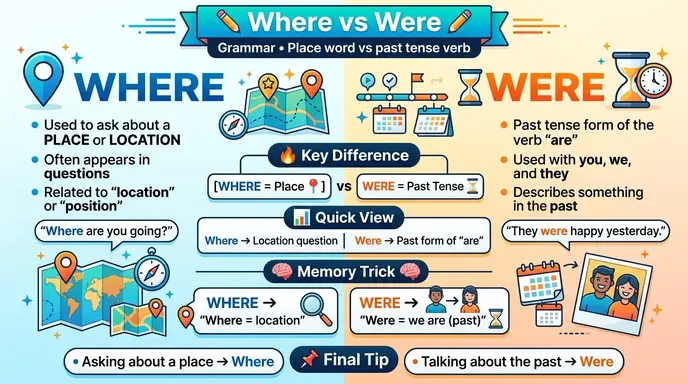
The difference between where and were is that “where” is used to ask about place or location, while “were” is a past-tense verb used with plural subjects and certain grammar structures.
Many English learners search for the difference between where and were because the two words sound similar in pronunciation but have completely different meanings and grammar functions.
In simple words, “where” relates to location, and “were” relates to actions or states in the past. Understanding the difference between where and were helps improve English writing, speaking, grammar accuracy, and sentence construction in daily communication.
💡 Quick Answer: Difference Between Where or Were
“Where” asks about place or location, while “were” is the past form of the verb “are.”
👉 Example:
- Where are you going?
- They were at the restaurant yesterday.
📘 Definition of Where and Were
- Where: A question word used to ask about place, position, or location.
- Were: The past tense form of “are,” used with plural subjects and some singular grammar situations.
🗣️ Pronunciation (US & UK)
- Where
- US: /wer/
- UK: /weə/
- Were
- US: /wɝː/
- UK: /wɜː/
These words are commonly used in English grammar, speaking, writing, school learning, and communication.
📊 Comparison Table: Where vs Were
| Feature | Where | Were | Similarity |
| Meaning | Refers to place or location | Past tense verb | Both are common English words |
| Grammar Type | Question word/adverb | Verb | Both used in sentences |
| Main Use | Asking about location | Describing past situations | Both important in communication |
| Example | Where is my phone? | They were late. | Both appear in everyday English |
| Time Relation | Not linked to tense | Linked to past tense | Both used in spoken English |
| Sentence Role | Introduces questions | Shows past state/action | Both affect sentence meaning |
| Common Usage | Questions about places | Past events or conditions | Both used in writing and speech |
| Learner Confusion | Sounds similar to “were” | Sounds similar to “where” | Both commonly confused |
This table clearly shows the difference and similarity between where and were for quick understanding.
🧠 Key Differences Explained Between Were and Where
📍 Meaning Difference
The biggest difference between where and were is meaning. “Where” refers to place, while “were” refers to past tense.
👉 Example:
- Where is your school?
- We were tired after the trip.
🧩 Grammar Function
“Where” acts as a question word, while “were” works as a verb.
⏳ Time Connection
“Were” relates to past time, while “where” has no direct tense connection.
👉 Example:
- They were friends in college.
- Where did they study?
🗣️ Sentence Usage
“Where” usually introduces questions, while “were” helps describe conditions or actions.
📚 English Learning Importance
Confusing these words can change sentence meaning completely.
✍️ Writing Accuracy
Correct use of “where” and “were” improves grammar and communication clarity.
🔤 Pronunciation Similarity
Many learners confuse the words because they sound alike in fast speech.
🧠 Why Where and Were Get Confused
The difference between where and were becomes confusing mainly because both words have similar pronunciation. In spoken English, learners may hear them incorrectly and then use the wrong spelling in writing.
🌐 How English Grammar Uses Were vs Where
English grammar classifies:
- “Where” as a question word or adverb
- “Were” as a past-tense verb
Language learning systems, grammar books, and educational apps teach them separately because they perform different roles in sentence construction.
Platforms like Duolingo, Grammarly, and Cambridge University Press commonly explain this grammar distinction to English learners.
📊 Difference + Similarity Table
| Feature | Where | Were | Similarity |
| Meaning | Asks about location | Past form of “are” | Both used in English grammar |
| Word Type | Question word | Verb | Both appear in sentences |
| Main Function | Refers to places | Refers to past conditions | Both affect communication |
| Example Sentence | Where do you live? | They were happy. | Both used daily |
| Tense Connection | No tense role | Past tense role | Both used in speaking and writing |
| Grammar Usage | Starts questions | Describes past situations | Both important for learners |
| Common Error | Misspelled as “were” | Misspelled as “where” | Both confuse beginners |
| Pronunciation | Similar sound | Similar sound | Both easily mixed up |
This table clearly shows the difference and similarity between where and were for quick understanding.
📝 Deep Explanation: How to Remember Where and Were
A simple way to remember the difference between where and were is:
- Where = place
- Were = past
👉 Memory Trick:
- “Where” contains the word “here,” which relates to location.
- “Were” connects to past tense forms like “was” and “are.”
Example:
- Where were you yesterday?
Here, “where” asks about location, while “were” describes the past.
This is why both words can appear in the same sentence but serve different purposes.
⚠️ Common Mistakes with Difference Between Where and Were
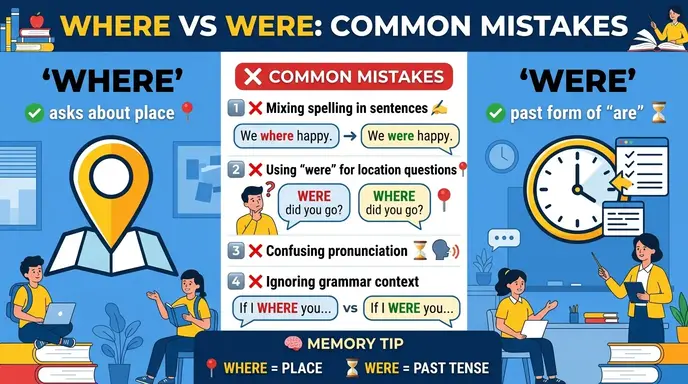
Using “Were” for Location Questions
❌ Were is my bag?
✅ Where is my bag?
Using “Where” as a Past-Tense Verb
❌ They where tired after work.
✅ They were tired after work.
Ignoring Grammar Function
❌ Where used as a verb in past tense sentences.
✅ Were is the correct past-tense verb.
Confusing Similar Pronunciation
❌ We where at the mall yesterday.
✅ We were at the mall yesterday.
Using Wrong Question Word
❌ Were do you live?
✅ Where do you live?
Spelling Errors in Writing
❌ The students where late.
✅ The students were late.
🧑💼 Real Life Examples with Where and Were
- Where is the nearest bus stop?
- They were excited about the concert.
- Where did you buy that jacket?
- We were classmates in school.
- Where are my keys?
- The players were ready for the match.
🎯 When to Use Where or Were
- Asking about location → where
- Talking about past situations → were
- Question about place → where
- Past tense with “they” or “we” → were
- Finding directions → where
- Describing past conditions → were
🤔 Why People Get Confused in Where and Were
- Both words sound similar
- Fast speech makes pronunciation harder to separate
- English learners focus on sound instead of grammar role
- Spelling confusion is very common
- Both are frequently used in daily conversation
🧠 How Language Systems Understand Were or Where
Grammar systems identify:
- “Where” as a location-related question word
- “Were” as a past-tense helping verb or main verb
Writing tools and grammar-checking systems analyze sentence structure to determine which word fits correctly.
🧠 Expert Insight
The difference between where and were is simple once you separate location from past tense. “Where” always relates to place, while “were” connects to actions, conditions, or situations in the past.
In practical English learning, reading sentences aloud and identifying whether the sentence asks about location or describes a past event helps learners avoid confusion quickly.
❓ FAQ:
1. What is the main difference between where and were?
“Where” refers to location, while “were” is a past-tense verb.
2. Is “where” a verb?
No, “where” is usually a question word or adverb.
3. Is “were” past tense?
Yes, “were” is the past form of “are.”
4. Why do people confuse where and were?
Because the words sound similar in pronunciation.
5. Can both words appear in one sentence?
Yes. Example: “Where were you yesterday?”
6. Which word asks about place?
“Where” asks about location or place.
7. Which word is used with “they” in past tense?
“Were” is used with “they” in past tense sentences.
🧾 Conclusion
The difference between where and were comes from grammar role and meaning. “Where” is used for asking about place or location, while “were” is a past-tense verb used to describe previous actions, conditions, or situations.
Understanding the difference between where and were improves grammar accuracy, writing quality, and spoken English confidence. Once you connect “where” with location and “were” with past tense, using the correct word becomes much easier in everyday communication and English learning.
Discover More Articles:

Hi, I’m Nabeel Hassan. I love exploring interesting topics and explaining how different things compare with each other. Through my writing, I aim to provide clear, helpful, and easy to read explanations. I cover subjects related to learning, science, technology and general knowledge.