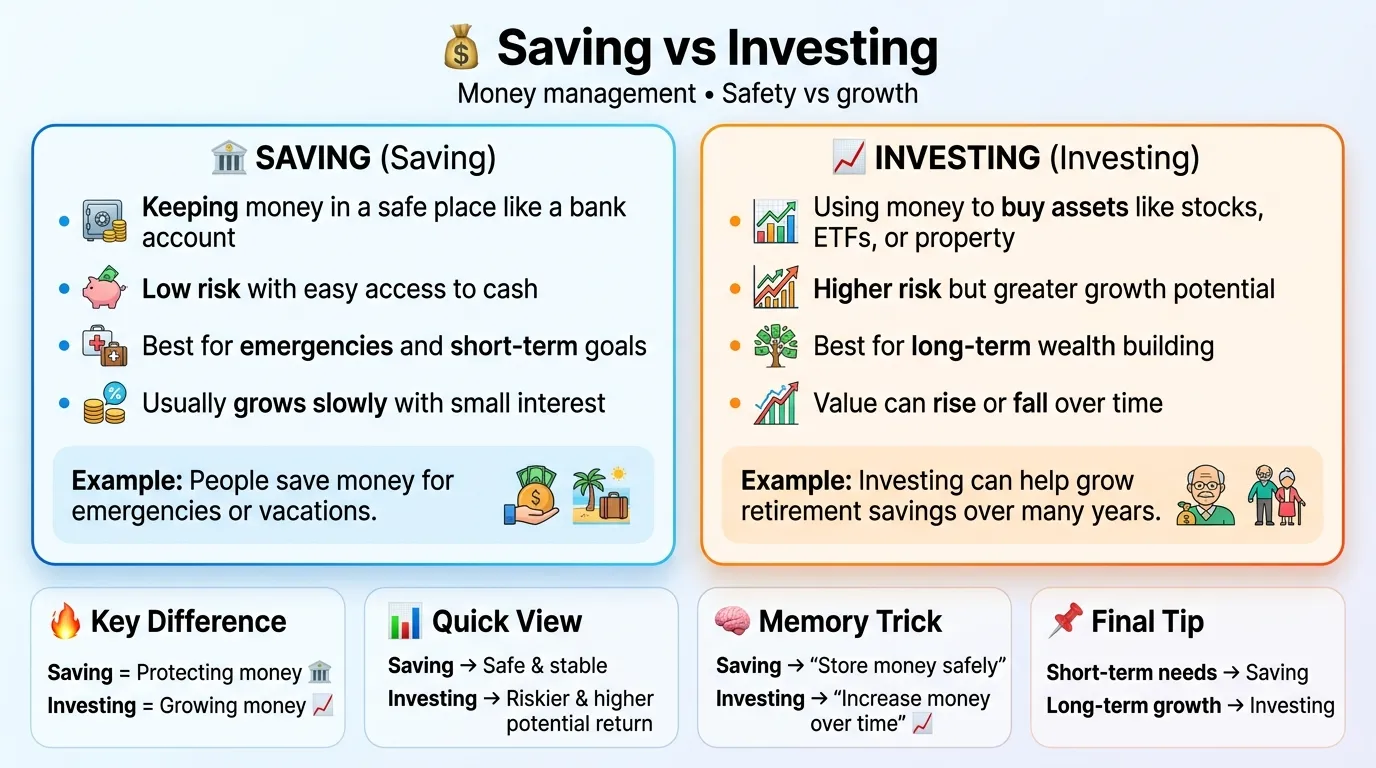
The difference between saving and investing is that saving focuses on protecting money for short term needs and safety, while investing focuses on growing money over time by taking some level of risk.
Many people search for the difference between saving and investing because both involve managing money, but they serve very different financial goals.
In simple words, saving is about security and easy access to money, while investing is about long term wealth growth.
Understanding the difference between saving and investing helps people make smarter financial decisions for emergencies, future planning, retirement, education, and lifestyle goals.
💡 Quick Answer: Difference Between Saving or Investing
Saving keeps money safe and accessible, while investing aims to increase money through long term growth opportunities.
👉 Example: Keeping money in a savings account is saving, while buying stocks or mutual funds is investing.
📘 Definition of Saving and Investing
- Saving: Setting aside money safely for short term goals, emergencies, or future expenses with low risk.
- Investing: Using money to purchase assets like stocks, funds, or property with the goal of long term financial growth.
🗣️ Pronunciation (US & UK)
- Saving
- US: /ˈseɪ.vɪŋ/
- UK: /ˈseɪ.vɪŋ/
- Investing
- US: /ɪnˈves.tɪŋ/
- UK: /ɪnˈves.tɪŋ/
These terms are commonly used in banking, personal finance, business planning, retirement preparation, and financial education.
📊 Comparison Table: Saving vs Investing
| Feature | Saving | Investing | Similarity |
| Main Purpose | Protect money safely | Grow money over time | Both help manage finances |
| Risk Level | Very low risk | Moderate to high risk | Both involve financial planning |
| Time Horizon | Short term | Long term | Both support future goals |
| Returns | Usually lower returns | Potentially higher returns | Both may increase financial stability |
| Accessibility | Easy access to funds | May take time to withdraw | Both involve storing money |
| Common Tools | Savings accounts | Stocks, bonds, funds | Both offered by financial institutions |
| Money Growth | Slow and steady | Faster but uncertain | Both can build financial security |
| Best For | Emergencies and short goals | Wealth building and retirement | Both improve money management |
This table clearly shows the difference and similarity between saving and investing for quick understanding.
🧠 Key Differences Explained Between Investing and Saving
💰 Safety vs Growth
The biggest difference between saving and investing is purpose. Saving protects money, while investing focuses on increasing wealth.
👉 Example: Emergency funds are usually saved, while retirement funds are often invested.
📉 Risk Level
Saving carries very little risk, while investing involves market fluctuations and possible losses.
⏳ Time Period
Saving is commonly used for short term goals, while investing works better for long term financial growth.
👉 Example: Saving for a vacation differs from investing for retirement.
📈 Potential Returns
Investments generally offer higher return opportunities compared to savings accounts.
🏦 Financial Products
Savings accounts, fixed deposits, and cash reserves support saving, while stocks, mutual funds, and real estate support investing.
💳 Accessibility
Saved money is usually easier to access quickly compared to investments.
🧑💼 Financial Strategy
Many financial experts recommend using both saving and investing together for balanced financial planning.
🧠 Why Saving and Investing Exist Separately
The difference between saving and investing exists because people have different financial goals. Some goals require safety and quick access, while others focus on long term growth and wealth building.
🌐 How Financial Systems Use Saving and Investing
Banks and financial companies provide different services for both purposes:
- Savings accounts for security
- Investment products for growth opportunities
Companies like Vanguard, Fidelity Investments, and Charles Schwab offer investment tools, while traditional banks mainly support saving products and cash management services.
📊 Difference + Similarity Table
| Feature | Saving | Investing | Similarity |
| Meaning | Keeping money secure | Using money for growth | Both manage personal finances |
| Goal | Financial safety | Wealth creation | Both support future planning |
| Risk | Low risk | Higher risk possible | Both involve money management |
| Returns | Lower earnings | Higher growth potential | Both can increase financial stability |
| Time Focus | Short term needs | Long term goals | Both help future preparation |
| Popular Options | Savings accounts, deposits | Stocks, bonds, funds | Both available through financial institutions |
| Accessibility | Quick withdrawals | Less immediate access sometimes | Both involve financial decisions |
| Best Use | Emergencies and daily needs | Retirement and long term wealth | Both improve financial organization |
This table clearly shows the difference and similarity between saving and investing for quick understanding.
📈 Deep Explanation: Why Investing Can Grow Money Faster
Saving usually provides small and stable returns because money remains protected in low risk environments. Investing works differently:
- Money is placed into assets
- Asset value may increase over time
- Dividends or profits may grow wealth
- Long term compounding can increase returns
👉 Example:
A savings account may grow slowly with interest, while stock investments may grow significantly over many years.
However, investments can also lose value temporarily because markets change constantly.
⚠️ Common Mistakes with Difference Between Saving and Investing
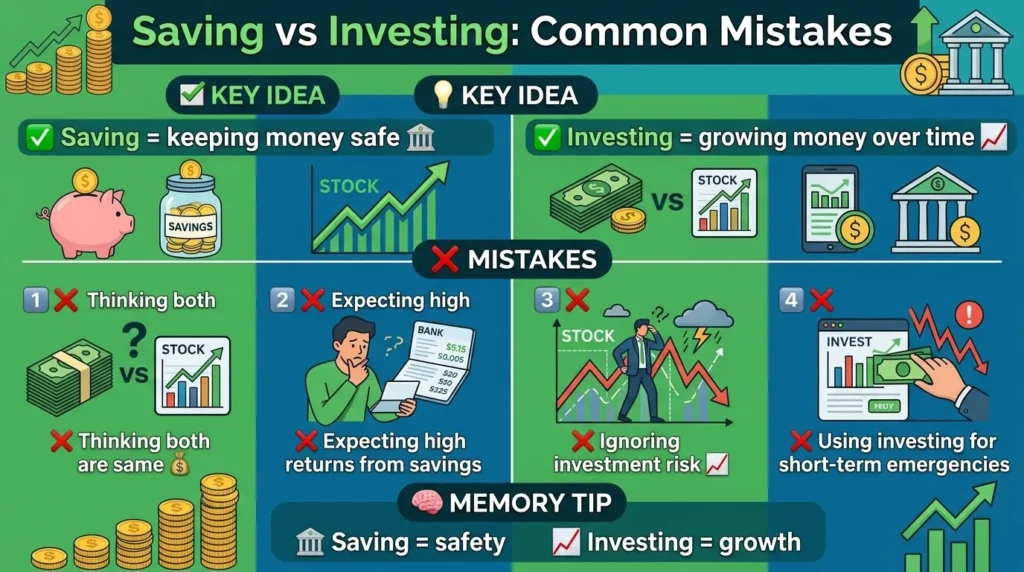
Thinking Saving and Investing Mean the Same Thing
❌ Saving and investing are identical financial activities.
✅ Saving focuses on safety, while investing focuses on growth.
Ignoring Risk Differences
❌ Investments always guarantee profits.
✅ Investing involves possible market losses and fluctuations.
Assuming Saving Builds Large Wealth Quickly
❌ Savings accounts usually create major long term wealth fast.
✅ Savings mainly provide stability and financial protection.
Using Investments for Emergency Funds
❌ Emergency money should always stay fully invested.
✅ Emergency funds are usually safer in savings accounts.
Confusing Accessibility
❌ Investment money is always instantly available without changes in value.
✅ Investments may require time to sell and can change in price.
Believing Only Wealthy People Invest
❌ Investing is only for rich individuals.
✅ Many beginners start investing with small amounts today.
🧑💼 Real Life Examples with Saving and Investing
- Saving money for medical emergencies
- Investing for retirement planning
- Saving for a new smartphone or vacation
- Investing in stock market index funds
- Saving for monthly expenses
- Investing for long term financial independence
🎯 When to Use Saving or Investing
- Emergency fund → saving
- Retirement planning → investing
- Short term purchases → saving
- Long term wealth growth → investing
- Stable financial security → saving
- Higher return opportunities → investing
🤔 Why People Get Confused in Saving and Investing
- Both involve managing money
- Banks often provide both services together
- Financial advice sometimes overlaps
- Beginners focus only on “putting money away”
- Both support future financial goals
🧠 How Financial Systems Understand Saving and Investing
Financial systems classify:
- Saving as low risk cash protection
- Investing as long term asset growth
Modern financial planning tools analyze:
- Risk tolerance
- Time horizon
- Income stability
- Financial goals
This helps users choose suitable saving and investment strategies.
🧠 Expert Insight
The difference between saving and investing is extremely important for long term financial stability. Saving protects money and provides quick access during emergencies, while investing creates opportunities for wealth growth and financial independence over time.
In practical financial planning, most successful strategies combine both approaches instead of relying entirely on one method.
❓ FAQ:
1. What is the main difference between saving and investing?
Saving protects money safely, while investing aims to grow money over time.
2. Is saving safer than investing?
Yes, saving generally carries much lower risk.
3. Which offers higher returns?
Investing usually offers higher long term return potential.
4. Can investments lose money?
Yes, investments may rise or fall in value.
5. Should emergency funds be saved or invested?
Emergency funds are usually better kept in savings.
6. Is investing only for wealthy people?
No, many people begin investing with small amounts.
7. Can someone do both saving and investing?
Yes, many financial plans use both together.
🧾 Conclusion
The difference between saving and investing comes from financial purpose, risk level, accessibility, and growth potential. Saving focuses on protecting money safely for short term needs and emergencies, while investing aims to increase wealth through long term financial growth opportunities.
Understanding the difference between saving and investing helps people build smarter financial habits, manage risks, and prepare for future goals more effectively. Once you connect saving with safety and investing with growth, choosing the right financial strategy becomes much easier for everyday money management and long term planning.
Discover More Articles:

Hi, I’m Nabeel Hassan. I love exploring interesting topics and explaining how different things compare with each other. Through my writing, I aim to provide clear, helpful, and easy to read explanations. I cover subjects related to learning, science, technology and general knowledge.