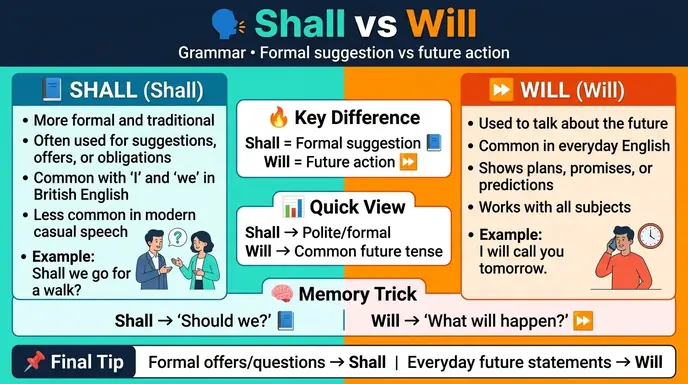
The difference between shall and will is that “shall” is traditionally used for formal suggestions, obligations, or future actions in certain contexts, while “will” is commonly used to express future actions, decisions, promises, or predictions in everyday English.
Many learners get confused about the difference between shall and will because both words can refer to the future, but their tone, usage, and level of formality are different.
If you’ve ever wondered what is shall vs will, which one sounds more formal, or when to use each correctly, this guide will clearly explain the difference between shall and will in simple and practical language.
⚡ Quick Answer: Difference Between Shall and Will
- Shall: More formal word often used for suggestions, obligations, or formal future actions
- Will: Common everyday word used for future events, promises, decisions, and predictions
👉 Example:
- “Shall we begin?”
- “I will call you tomorrow.”
📖 Definition of Shall and Will
- Shall: A modal verb traditionally used to express future intention, obligation, or polite suggestions in formal English.
- Will: A modal verb mainly used to describe future actions, predictions, willingness, or promises.
🔊 Pronunciation (US & UK)
- Shall: UK /ʃæl/ | US /ʃæl/
- Will: UK /wɪl/ | US /wɪl/
Now let’s understand their differences clearly.
📊 Shall vs Will Comparison Table
| Feature | Shall | Will |
| Common Usage | Formal English | Everyday English |
| Main Purpose | Suggestion or obligation | Future action |
| Tone | Formal or polite | Neutral and common |
| Modern Popularity | Less common | Very common |
| Used for Promises | Rarely | Frequently |
| Legal Documents | Common | Sometimes |
| Question Usage | Formal suggestions | Future intent |
| Example | Shall we go? | I will go tomorrow. |
🔍 KEY DIFFERENCES EXPLAINED BETWEEN SHALL AND WILL
📅 Future Actions
Both can refer to the future, but “will” is far more common in modern English.
👉 Example:
“I will visit next week” sounds more natural today.
🤝 Suggestions and Offers
“Shall” is often used for polite suggestions or offers, especially in questions.
👉 Example:
“Shall we start the meeting?”
⚖️ Formal and Legal Language
“Shall” frequently appears in legal contracts, rules, and official documents to express obligation.
👉 Example:
“The tenant shall pay rent monthly.”
💬 Everyday Conversation
Most native speakers use “will” in regular speech because it sounds more natural and modern.
👉 Example:
“I will help you later.”
🎯 Tone and Formality
“Shall” usually sounds more formal or traditional, while “will” sounds casual and direct.
👉 Example:
“Shall” is common in formal British English.
🧠 Traditional Grammar Rules
Older grammar rules sometimes used “shall” with “I” and “we” for future tense, but modern English mostly uses “will.”
👉 Example:
Traditional: “I shall return.”
Modern: “I will return.”
🤔 What Is the Difference Between Shall and Will in Simple Words?
In simple words, “shall” sounds more formal and is often used for suggestions or obligations, while “will” is the normal everyday word for future actions and decisions.
👉 Shall = formal suggestion or obligation
👉 Will = common future action
🧠 Why Do English Learners Confuse Shall and Will?
Both words can talk about the future, so they often seem interchangeable.
“Shall” is commonly used for:
- Formal questions
- Suggestions
- Legal obligations
- Traditional writing
“Will” is commonly used for:
- Future plans
- Predictions
- Promises
- Everyday conversation
👉 Modern English strongly favors “will.”
🌍 Difference Between Shall and Will in Real Life
In practical use:
- “Will” appears far more often in daily conversations
- “Shall” is common in contracts and formal speech
- British English sometimes uses “shall” more than American English
👉 Context and formality affect usage.
⚖️ DIFFERENCE + SIMILARITY TABLE
| Feature | Shall | Will | Similarity |
| Modal Verb | Yes | Yes | Grammar function |
| Talks About Future | Yes | Yes | Future meaning |
| Used in English | Yes | Yes | Common verbs |
| Forms Questions | Yes | Yes | Sentence structure |
| Shows Intention | Yes | Yes | Action expression |
| Used with Subjects | Yes | Yes | Grammar support |
| Helps Communication | Yes | Yes | Language usage |
| Can Express Decisions | Sometimes | Yes | Future-related meaning |
This table clearly shows the difference and similarity between difference between shall and will for quick understanding.
❌ Common Mistakes with Shall or Will
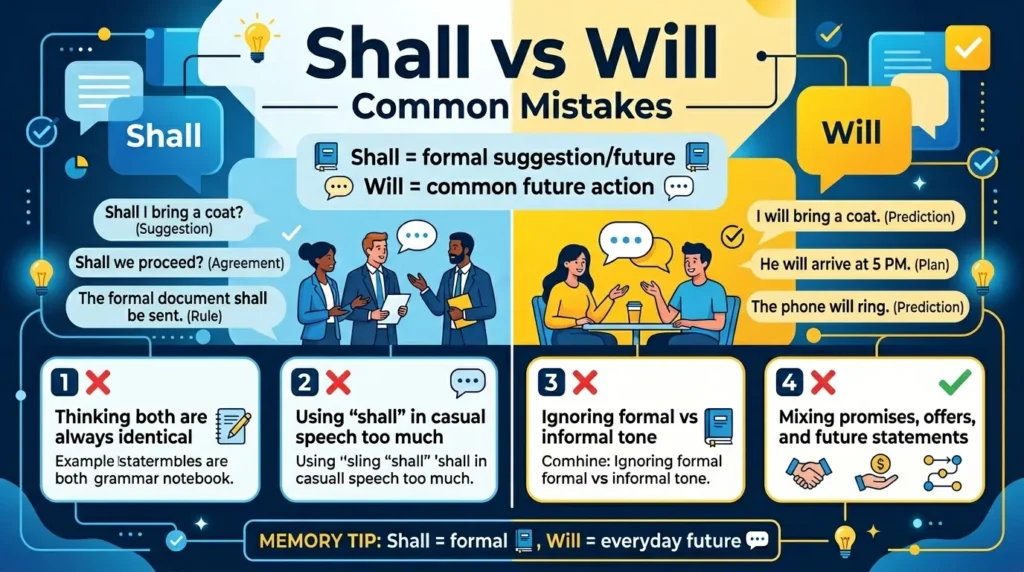
Using “Shall” in Every Future Sentence
❌ I shall call you tonight.
✅ I will call you tonight.
“Will” sounds more natural in modern English.
Forgetting Formal Usage of “Shall”
❌ Shall is never used anymore.
✅ “Shall” still appears in formal and legal English.
It remains important in some contexts.
Using “Will” for Formal Obligations
❌ The employee will follow company policy.
✅ The employee shall follow company policy.
Legal writing often prefers “shall.”
Confusing Suggestion Questions
❌ Will we dance?
✅ Shall we dance?
“Shall” often sounds more polite for suggestions.
Mixing Traditional and Modern Rules
❌ I shall always used with future tense.
✅ Modern English usually prefers “will.”
Language usage evolved over time.
🏡 Real Life Examples with Will and Shall
📞 Everyday Future Plan
“I will call you tomorrow.”
🤝 Polite Suggestion
“Shall we sit here?”
⚖️ Legal Contract Language
“The buyer shall pay within 30 days.”
🌦️ Prediction
“It will rain later today.”
🎯 WHEN TO USE EACH
Use Shall When:
✔ Making polite suggestions
✔ Writing formal rules or contracts
✔ Using formal British English
✔ Expressing obligations formally
Use Will When:
✔ Talking about future actions
✔ Making promises or predictions
✔ Speaking casually
✔ Writing everyday English
🤯 WHY PEOPLE GET CONFUSED IN SHALL OR WILL
- Both refer to future actions
- Older grammar rules overlap
- British and American English differ slightly
- Modern English changed traditional usage
⚙️ How Grammar Experts Understand Shall vs Will
Language experts separate these words based on:
- Formality level
- Context
- Sentence purpose
- Modern versus traditional usage
👉 “Will” dominates modern spoken English, while “shall” remains formal and specialized.
🧑🏫 EXPERT INSIGHT
In real communication, “will” has largely replaced “shall” in modern English because it sounds simpler and more natural in everyday speech. However, “shall” still carries importance in formal settings, especially in legal writing, official rules, and polite suggestions.
One important insight many learners miss is that native speakers rarely use “shall” in casual conversation unless making a polite suggestion like “Shall we begin?” Understanding tone and context is often more important than memorizing old grammar rules.
👉 Key insight:
“Will” is the standard modern future verb, while “shall” is mostly formal, legal, or politely suggestive.
❓ FAQ:
❓ What is the difference between shall and will?
“Shall” is more formal and often used for suggestions or obligations, while “will” is commonly used for future actions.
❓ Which is more common in modern English?
“Will” is much more common today.
❓ Is “shall” old-fashioned?
Sometimes yes, especially in casual conversation.
❓ Where is “shall” commonly used?
It is common in legal writing and formal questions.
❓ Can “shall” and “will” both refer to the future?
Yes, both can express future actions.
❓ Which sounds more polite?
“Shall” often sounds more polite in questions.
❓ Is “shall” more common in British English?
Yes, British English uses “shall” more often than American English.
❓ Should beginners mainly use “will”?
Usually yes, because it is more common in modern English.
🏁 Conclusion
The difference between shall and will mainly comes down to formality, tone, and modern usage. “Shall” is more formal and often used for suggestions, obligations, or legal language, while “will” is the standard everyday word for future actions, promises, and predictions.
Understanding this difference helps English learners communicate more naturally and correctly in both formal and casual situations. In simple terms, “will” dominates modern speech, while “shall” remains useful in specific formal contexts.
Once you understand the tone and purpose behind each word, choosing between shall and will becomes much easier.
Discover More Articles:

I’m Owen Parker, and I write articles that focus on explaining the differences between common concepts, tools, and ideas. I enjoy simplifying complex information and turning it into clear comparisons that anyone can understand. My work often covers science , education, technology, and everyday knowledge topics.