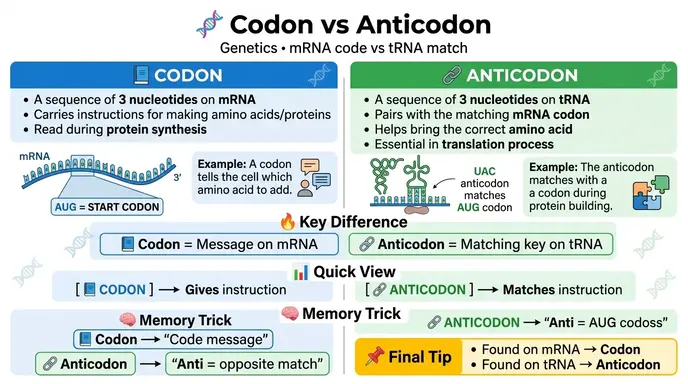
The difference between codon and anticodon is that a codon is a three letter genetic code found on messenger RNA (mRNA), while an anticodon is a matching three letter sequence found on transfer RNA (tRNA).
Many biology students get confused about the difference between codon and anticodon because both are involved in protein synthesis and work together during translation inside cells. However, they appear on different RNA molecules and perform different roles.
If you’ve ever wondered what is codon vs anticodon, how protein synthesis works, or why these sequences are important in genetics, this guide will clearly explain the difference between codon and anticodon in simple and practical language.
⚡ Quick Answer: Difference Between Codon and Anticodon
- Codon: Three nucleotide sequence on mRNA that codes for an amino acid
- Anticodon: Three nucleotide sequence on tRNA that matches a codon during protein synthesis
👉 Example: The codon AUG pairs with the anticodon UAC.
📖 Definition of Codon and Anticodon
- Codon: A group of three nucleotides on messenger RNA that carries instructions for building proteins.
- Anticodon: A complementary group of three nucleotides on transfer RNA that recognizes and binds to a codon.
🔊 Pronunciation (US & UK)
- Codon: UK /ˈkəʊ.dɒn/ | US /ˈkoʊ.dɑːn/
- Anticodon: UK /ˌæn.tiˈkəʊ.dɒn/ | US /ˌæn.t̬iˈkoʊ.dɑːn/
Now let’s understand their differences clearly.
📊 Codon vs Anticodon Comparison Table
| Feature | Codon | Anticodon |
| Found On | mRNA | tRNA |
| Function | Codes for amino acids | Matches codons |
| Role in Translation | Sends instructions | Delivers amino acids |
| Structure | Three nucleotides | Three nucleotides |
| Pairing Style | Read by ribosome | Complementary pairing |
| Genetic Purpose | Protein coding | Codon recognition |
| Location in Cell | Messenger RNA strand | Transfer RNA molecule |
| Example | AUG | UAC |
🔍 KEY DIFFERENCES EXPLAINED BETWEEN CODON AND ANTICODON
🧾 Different RNA Molecules
Codons exist on messenger RNA, while anticodons exist on transfer RNA.
👉 Example: mRNA carries the genetic message from DNA.
🔗 Complementary Pairing
Anticodons pair with codons using complementary base pairing rules.
👉 Example: A pairs with U, and C pairs with G.
🏭 Role in Protein Synthesis
Codons tell the cell which amino acid is needed, while anticodons help bring the correct amino acid to the ribosome.
👉 Example: tRNA acts like a delivery system during translation.
🧬 Genetic Instructions vs Recognition
Codons contain the actual protein building instructions, while anticodons recognize those instructions.
👉 Example: Codons determine amino acid order in proteins.
⚙️ Position During Translation
Codons are read directly by ribosomes, while anticodons attach temporarily during amino acid delivery.
👉 Example: Ribosomes read mRNA codons step by step.
🔄 Working Together
Codons and anticodons work together to build proteins accurately inside cells.
👉 Example: Incorrect pairing can affect protein formation.
🤔 What Is the Difference Between Codon and Anticodon in Simple Words?
In simple words, a codon is a genetic instruction on mRNA, while an anticodon is the matching sequence on tRNA that helps read that instruction.
👉 Codon = instruction
👉 Anticodon = matching reader
🧠 Why Are Codons and Anticodons Important?
They are essential for protein production inside living cells.
Codons help:
- Store protein instructions
- Determine amino acid order
- Control translation
Anticodons help:
- Match codons correctly
- Deliver amino acids
- Ensure protein accuracy
👉 Without them, cells could not build proteins properly.
🌍 Difference Between Codon and Anticodon in Real Life Biology
In practical biology:
- Codons guide how proteins are assembled
- Anticodons ensure correct amino acids are added
- Every living organism uses this system for protein production
👉 Protein synthesis is one of the most important cellular processes.
⚖️ DIFFERENCE + SIMILARITY TABLE
| Feature | Codon | Anticodon | Similarity |
| RNA Sequence | Yes | Yes | RNA based structures |
| Three Nucleotides | Yes | Yes | Triplet structure |
| Involved in Translation | Yes | Yes | Protein synthesis role |
| Genetic Information Related | Yes | Yes | Cellular communication |
| Base Pairing Needed | Yes | Yes | Complementary interaction |
| Found in Cells | Yes | Yes | Biological molecules |
| Essential for Proteins | Yes | Yes | Protein production |
| Work Together | Yes | Yes | Translation partnership |
This table clearly shows the difference and similarity between difference between codon and anticodon for quick understanding.
❌ Common Mistakes with Codon or Anticodon
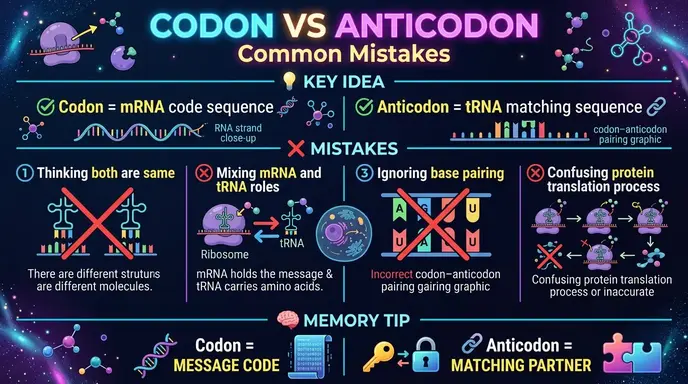
Thinking Codons and Anticodons Are the Same
❌ Codons and anticodons are identical structures.
✅ They appear on different RNA molecules and perform different jobs.
Location matters.
Mixing Up mRNA and tRNA
❌ Codons are found on tRNA.
✅ Codons are located on mRNA.
RNA type matters.
Forgetting Complementary Pairing
❌ Codons pair randomly with anticodons.
✅ Pairing follows strict base pair rules.
Accuracy matters.
Assuming Anticodons Carry Instructions
❌ Anticodons contain the main genetic code.
✅ Codons carry the actual protein instructions.
Function differs.
Ignoring Protein Synthesis Roles
❌ Codons and anticodons are unrelated to proteins.
✅ Both are essential during translation.
Protein building depends on them.
🏡 Real Life Examples with Codon or Anticodon
🧬 AUG and UAC Pairing
The codon AUG pairs with the anticodon UAC during translation.
🏭 Protein Formation
Cells use codon anticodon pairing to assemble amino acids into proteins.
🔬 Biology Education
Students learn codons and anticodons while studying genetics and molecular biology.
🧫 Medical Research
Scientists study codon systems in genetics, mutations, and biotechnology.
🎯 WHEN TO USE EACH
Use Codon When:
✔ Referring to genetic instructions on mRNA
✔ Discussing amino acid coding
✔ Talking about translation signals
Use Anticodon When:
✔ Referring to matching tRNA sequences
✔ Discussing codon recognition
✔ Talking about amino acid delivery
🤯 WHY PEOPLE GET CONFUSED IN ANTICODON AND CODON
- Both involve RNA sequences
- Both contain three nucleotides
- Both participate in protein synthesis
- Their names sound very similar
⚙️ How Biologists Understand Codon vs Anticodon
Biologists separate these terms based on:
- RNA molecule type
- Protein synthesis role
- Genetic instruction flow
- Base pairing interactions
👉 Their partnership is essential for accurate translation.
🧑🔬 EXPERT INSIGHT
In real biological systems, codons and anticodons act like a communication system between genetic instructions and amino acid delivery. The codon provides the message, while the anticodon confirms the correct amino acid is added during protein synthesis.
One important insight many beginners miss is that the ribosome reads codons directly from mRNA, but tRNA molecules carrying anticodons physically bring amino acids to build proteins step by step. This coordination is one of the core mechanisms that keeps living cells functioning properly.
👉 Key insight:
Codons carry genetic instructions, while anticodons recognize and match those instructions during translation.
❓ FAQ:
❓ What is the difference between codon and anticodon?
A codon is a three letter sequence on mRNA, while an anticodon is a matching sequence on tRNA.
❓ Where are codons found?
Codons are found on messenger RNA (mRNA).
❓ Where are anticodons found?
Anticodons found on transfer RNA (tRNA).
❓ Why are codons important?
They provide instructions for building proteins.
❓ What does an anticodon do?
It matches a codon and helps deliver the correct amino acid.
❓ How many nucleotides are in a codon?
A codon contains three nucleotides.
❓ Do codons and anticodons pair together?
Yes, they pair using complementary base pairing rules.
❓ Are codons involved in translation?
Yes, codons play a major role in protein synthesis.
🏁 Conclusion
The difference between codon and anticodon mainly comes down to their location and role in protein synthesis. Codons are three letter genetic instructions found on messenger RNA, while anticodons are complementary sequences on transfer RNA that recognize and match those instructions.
Understanding this difference helps explain how cells accurately build proteins, which are essential for life. In simple terms, codons provide the message, while anticodons help read and translate that message correctly.
Once you understand how these RNA sequences work together, the difference between codon and anticodon becomes much easier to understand.
Discover More Articles:

Hi, I’m Nabeel Hassan. I love exploring interesting topics and explaining how different things compare with each other. Through my writing, I aim to provide clear, helpful, and easy to read explanations. I cover subjects related to learning, science, technology and general knowledge.