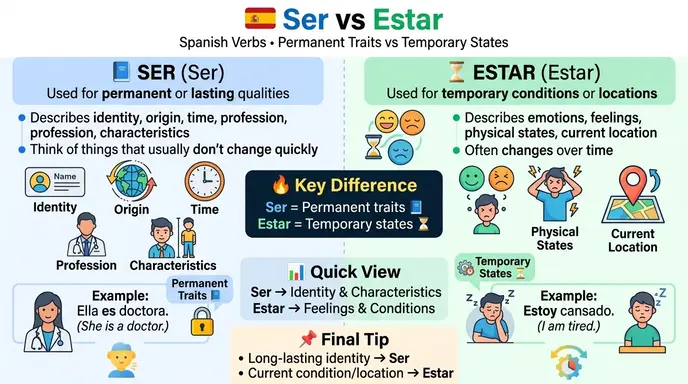
The difference between ser and estar is that “ser” is mainly used for permanent characteristics, identity, origin, and general facts, while “estar” is used for temporary conditions, locations, emotions, and changing states.
Many Spanish learners search for the difference between ser and estar because both verbs translate to “to be” in English, yet they are used in completely different situations in Spanish grammar.
In simple words, ser describes what something is, while estar often describes how something is or where it is at a specific moment. Understanding the difference between ser and estar helps improve Spanish speaking, writing, grammar accuracy, and real life communication.
💡 Quick Answer: Difference Between Ser or Estar
Ser used for identity, permanent traits, and facts, while estar used for temporary conditions, emotions, and locations.
👉 Example:
- Ella es inteligente. → She is intelligent.
- Ella está cansada. → She is tired.
The first describes a characteristic, while the second describes a temporary condition.
📘 Definition of Ser and Estar
- Ser: A Spanish verb meaning “to be” used for identity, origin, characteristics, and permanent qualities.
- Estar: A Spanish verb meaning “to be” used for temporary states, emotions, conditions, and locations.
🗣️ Pronunciation (US & UK)
- Ser
- US: /ser/
- UK: /seə/
- Estar
- US: /esˈtar/
- UK: /esˈtɑː/
These verbs are among the most important grammar concepts in Spanish learning and everyday conversation.
📊 Comparison Table: Ser vs Estar
| Feature | Ser | Estar | Similarity |
| Main Use | Permanent traits and identity | Temporary states and locations | Both mean “to be” |
| Personality Description | Commonly used | Rarely used | Both are Spanish verbs |
| Emotional State | Usually not used | Commonly used | Both describe people and things |
| Location Usage | Used for events | Used for physical locations | Both appear in daily conversation |
| Time and Date | Used for time and dates | Not normally used | Both are essential grammar verbs |
| Condition Description | Less common | Frequently used | Both describe situations |
| Nationality and Origin | Commonly used | Not used | Both connect subjects with information |
| Grammar Importance | Core Spanish grammar verb | Core Spanish grammar verb | Both are foundational in Spanish |
This table clearly shows the difference and similarity between ser and estar for quick understanding.
🧠 Key Differences Explained Between Estar and Ser
🧍 Permanent vs Temporary
The biggest difference between ser and estar is permanence. Ser describes identity or lasting traits, while estar describes temporary conditions.
👉 Example:
- Él es alto. → He is tall.
- Él está enfermo. → He is sick.
Height is usually permanent, while sickness is temporary.
📍 Location Usage
Estar commonly used for physical locations.
👉 Example:
- La casa está en Madrid. → The house is in Madrid.
😊 Emotions and Feelings
Temporary emotions usually use estar.
👉 Example:
- Estoy feliz. → I am happy.
🕒 Time and Dates
Ser used for time, dates, and schedules.
👉 Example:
- Es lunes. → It is Monday.
🌍 Identity and Origin
Nationality and profession commonly use ser.
🎉 Events and Occasions
Locations of events use ser rather than estar.
👉 Example:
- La fiesta es en el hotel. → The party is at the hotel.
🧠 Descriptive Meaning Changes
Some adjectives change meaning depending on whether ser or estar is used.
🧠 Why Ser and Estar Get Confused
The difference between ser and estar becomes confusing because English uses only one main verb “to be,” while Spanish separates permanent and temporary meanings into two different verbs.
🌐 How Language Learning Systems Teach Ser and Estar
Language education systems classify:
- Ser for identity, characteristics, and permanent information
- Estar for temporary conditions and locations
Platforms like Duolingo, Babbel, and Rosetta Stone teach ser and estar through:
- Conversation practice
- Grammar exercises
- Real life examples
- Interactive lessons
These systems help learners understand usage patterns naturally.
📊 Difference + Similarity Table
| Feature | Ser | Estar | Similarity |
| Meaning | Used for identity and facts | Used for conditions and location | Both translate as “to be” |
| Personality Traits | Commonly used | Rarely used | Both describe people |
| Temporary Conditions | Usually avoided | Commonly used | Both are essential verbs |
| Location Purpose | Used for event locations | Used for physical places | Both appear in daily Spanish |
| Emotion Usage | Less common | Frequently used | Both connect subjects and descriptions |
| Nationality Usage | Commonly used | Not commonly used | Both are grammar fundamentals |
| State of Being | Permanent or defining | Temporary or changing | Both explain situations |
| Language Role | Core Spanish structure | Core Spanish structure | Both are required for fluency |
This table clearly shows the difference and similarity between ser and estar for quick understanding.
🗣️ Deep Explanation: Why Spanish Uses Two “To Be” Verbs
Spanish separates different meanings of “to be”:
- Identity and permanent facts → ser
- Temporary conditions and locations → estar
- Emotional states → mostly estar
👉 Example:
- Ella es aburrida. → She is boring.
- Ella está aburrida. → She is bored.
The adjective changes meaning depending on the verb used.
This system allows Spanish speakers to express subtle differences more clearly than English in many situations.
⚠️ Common Mistakes with Difference Between Ser and Estar
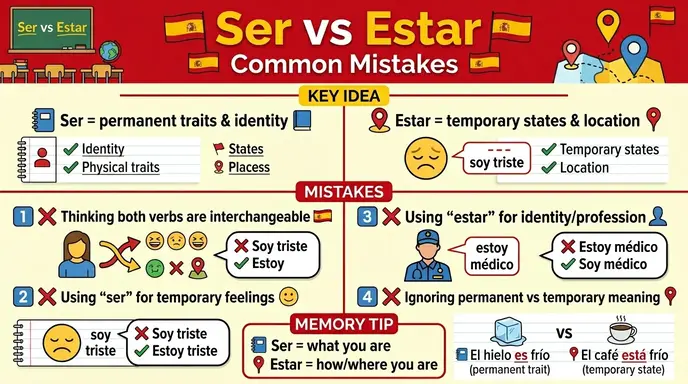
Using Ser for Temporary Feelings
❌ Yo soy cansado.
✅ Yo estoy cansado.
Using Estar for Nationality
❌ Ella está mexicana.
✅ Ella es mexicana.
Confusing Location Rules
❌ Madrid es en España.
✅ Madrid está en España.
Ignoring Permanent Characteristics
❌ Él está inteligente.
✅ Él es inteligente.
Using Estar for Time
❌ Está lunes.
✅ Es lunes.
🧑🏫 Real Life Examples with Ser and Estar
- Introducing nationality using ser
- Describing emotions using estar
- Talking about location using estar
- Describing professions using ser
- Discussing personality traits using ser
- Explaining temporary conditions using estar
🎯 When to Use Ser or Estar
- Identity and profession → ser
- Temporary emotions → estar
- Physical locations → estar
- Nationality and origin → ser
- Personality traits → ser
- Temporary conditions → estar
🤔 Why People Get Confused in Ser and Estar
- English mainly uses one verb “to be”
- Some adjectives change meaning
- Temporary vs permanent ideas can overlap
- Beginners translate directly from English
- Real conversations move quickly between both verbs
🧠 How Spanish Grammar Systems Understand Ser and Estar
Spanish grammar systems analyze:
- Permanence vs temporary condition
- Identity and description
- Emotional states
- Location context
- Sentence meaning
This structure helps Spanish communicate detailed meaning more precisely.
🧠 Expert Insight
The difference between ser and estar mainly comes from permanence and condition. Ser defines identity, characteristics, and general truths, while estar describes temporary states, emotions, and locations.
In practical Spanish learning, mastering ser and estar is one of the biggest steps toward natural communication because these verbs appear constantly in everyday conversation.
❓ FAQ: Difference Between Estar or Ser
1. What is the main difference between ser and estar?
Ser describes identity and permanent traits, while estar describes temporary conditions and locations.
2. Which verb is used for emotions?
Estar commonly used for emotions and feelings.
3. Is ser used for nationality?
Yes, nationality and origin normally use ser.
4. Which verb is used for location?
Estar is generally used for physical locations.
5. Why are ser and estar difficult for learners?
English mainly uses one verb “to be,” while Spanish uses two.
6. Can adjectives change meaning with ser and estar?
Yes, some adjectives change meaning depending on the verb used.
7. Which verb used for professions?
Professions usually use ser.
🧾 Conclusion
The difference between ser and estar comes from permanence, identity, temporary condition, and location. Ser mainly used for lasting characteristics, professions, nationality, and facts, while estar used for emotions, temporary states, and physical locations.
Understanding the difference between ser and estar helps Spanish learners improve grammar accuracy, communication confidence, and natural conversation skills. Once you connect ser with identity and permanence and estar with temporary conditions and locations, the distinction becomes much easier to understand in everyday Spanish.
Discover More Articles:

I’m Owen Parker, and I write articles that focus on explaining the differences between common concepts, tools, and ideas. I enjoy simplifying complex information and turning it into clear comparisons that anyone can understand. My work often covers science , education, technology, and everyday knowledge topics.