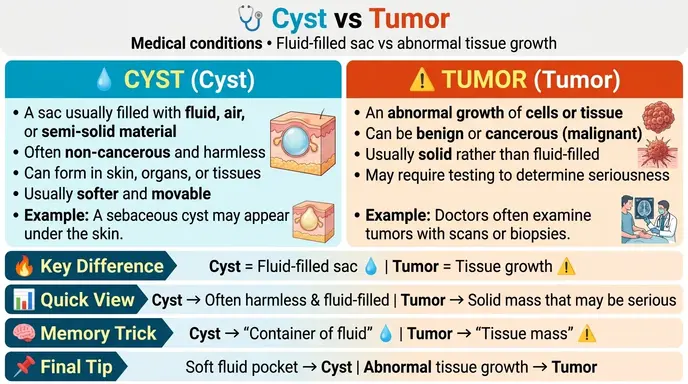
The difference between cyst and tumor is that a cyst is usually a fluid filled sac, while a tumor is an abnormal mass of tissue that may be benign or cancerous.
Many people search for the difference between cyst and tumor because both can appear as lumps in the body, causing confusion and concern. Although they may sometimes feel similar from the outside, they are medically different conditions with different causes, structures, and treatment approaches.
In simple words, a cyst commonly contains fluid, air, or semi solid material, while a tumor forms from abnormal cell growth. Understanding the difference between cyst and tumor helps people recognize symptoms, understand medical reports, and communicate more clearly with healthcare professionals.
💡 Quick Answer: Difference Between Cyst or Tumor
A cyst is generally a sac filled with fluid or material, while a tumor is a solid abnormal tissue growth that can be benign or malignant.
👉 Example: A small fluid filled skin lump may be a cyst, while an abnormal tissue mass detected in imaging may be classified as a tumor.
📘 Definition of Cyst and Tumor
- Cyst: A closed sac like structure in the body that usually contains fluid, pus, air, or semi solid material.
- Tumor: An abnormal growth of tissue caused by uncontrolled cell multiplication.
🗣️ Pronunciation (US & UK)
- Cyst
- US: /sɪst/
- UK: /sɪst/
- Tumor
- US: /ˈtuː.mɚ/
- UK: /ˈtʃuː.mə/
These terms are commonly used in medical discussions, healthcare reports, imaging scans, surgery consultations, and pathology examinations.
📊 Comparison Table: Cyst vs Tumor
| Feature | Cyst | Tumor | Similarity |
| Structure | Fluid or material filled sac | Solid tissue growth | Both can form lumps |
| Main Cause | Blockage, infection, or fluid buildup | Abnormal cell growth | Both may require medical evaluation |
| Texture | Often soft or movable | May feel firm or solid | Both vary in size |
| Cancer Risk | Usually noncancerous | Can be benign or cancerous | Both can appear in many body areas |
| Growth Type | Sac formation | Tissue multiplication | Both may grow over time |
| Diagnosis | Ultrasound or examination | Imaging and biopsy | Both may need medical tests |
| Pain Level | Sometimes painful if infected | May or may not cause pain | Both can cause discomfort |
| Treatment | Drainage or monitoring | Observation, surgery, or therapy | Both may require treatment |
This table clearly shows the difference and similarity between cyst and tumor for quick understanding.
🧠 Key Differences Explained Between Tumor and Cyst
💧 Fluid Filled vs Solid Growth
The biggest difference between cyst and tumor is structure. Cysts are usually filled with fluid or material, while tumors are made of abnormal tissue cells.
👉 Example: A sebaceous cyst under the skin may contain oily material, while a tumor forms from tissue growth.
🧬 Cell Growth
Tumors develop because cells multiply abnormally, while cysts usually form from blockage, infection, or trapped fluid.
⚠️ Cancer Potential
Most cysts are harmless, while some tumors can become cancerous.
👉 Example: Many skin cysts are benign, but certain tumors require immediate medical attention.
🖐️ Physical Feel
Cysts often feel softer and movable, while tumors may feel firmer.
📈 Growth Behavior
Tumors may grow aggressively depending on type, while cyst growth is often slower or limited.
🏥 Medical Evaluation
Doctors often use imaging tests and biopsies to distinguish between cysts and tumors.
💊 Treatment Differences
Cysts may only need drainage or monitoring, while tumors may require surgery, radiation, or medication depending on diagnosis.
🧠 Why Cysts and Tumors Get Confused
The difference between cyst and tumor becomes confusing because both can appear as lumps or bumps in the body. Many people cannot identify the internal structure without medical imaging or professional examination.
🌐 How Medical Systems Understand Cysts and Tumors
Healthcare systems classify:
- Cysts as sac like abnormal structures
- Tumors as tissue growth abnormalities
Medical organizations and hospitals use scans, laboratory testing, and pathology reports to determine whether a lump is a cyst or tumor.
Organizations like World Health Organization, American Cancer Society, and Mayo Clinic provide educational resources about abnormal growths and cancer screening.
📊 Difference + Similarity Table
| Feature | Cyst | Tumor | Similarity |
| Meaning | Fluid filled sac | Abnormal tissue mass | Both may form body lumps |
| Internal Structure | Liquid or semi solid contents | Solid cell growth | Both may require scans |
| Common Cause | Blockage or infection | Abnormal cell multiplication | Both can grow in the body |
| Cancer Risk | Usually low | Sometimes cancerous | Both need evaluation if changing |
| Physical Texture | Often softer | Usually firmer | Both vary in appearance |
| Medical Testing | Ultrasound common | Imaging and biopsy common | Both examined by doctors |
| Treatment Options | Drainage or observation | Surgery or specialized treatment | Both may need monitoring |
| Growth Behavior | Often limited growth | May grow aggressively | Both can increase in size |
This table clearly shows the difference and similarity between cyst and tumor for quick understanding.
🩺 Deep Explanation: How Doctors Distinguish Between Cysts and Tumors
Doctors usually examine:
- Texture and mobility
- Imaging scan appearance
- Growth behavior
- Symptoms
- Tissue composition
👉 Example:
- A cyst often appears fluid filled on ultrasound
- A tumor often appears solid during imaging studies
Sometimes doctors perform biopsies to study cells under a microscope and confirm the diagnosis accurately.
⚠️ Common Mistakes with Difference Between Cyst and Tumor
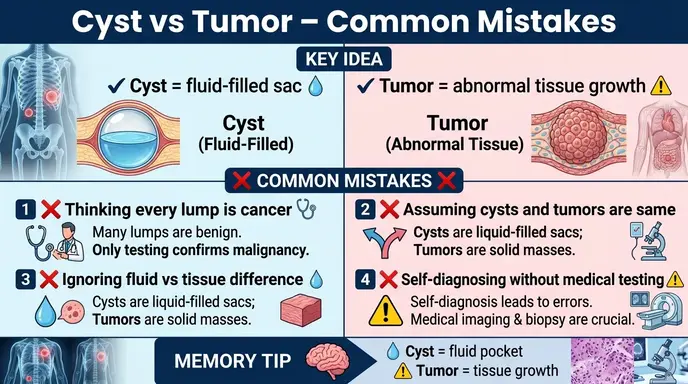
Thinking Every Lump Is Cancer
❌ All lumps are dangerous tumors.
✅ Many lumps are harmless cysts or benign growths.
Assuming Cysts and Tumors Are Identical
❌ Cysts and tumors mean the same medical condition.
✅ Their structure and causes are medically different.
Ignoring Medical Evaluation
❌ Small lumps never need medical attention.
✅ Persistent or changing lumps should be examined professionally.
Believing All Tumors Are Cancerous
❌ Every tumor automatically means cancer.
✅ Many tumors are benign and noncancerous.
Using Terms Incorrectly
❌ A fluid filled sac is always called a tumor.
✅ Fluid filled sacs are usually classified as cysts.
Self Diagnosing Based on Appearance
❌ Lump appearance alone confirms diagnosis.
✅ Medical testing is often necessary for accurate identification.
🧑⚕️ Real Life Examples with Cyst and Tumor
- Sebaceous cysts under the skin
- Ovarian cysts detected through ultrasound
- Benign breast tumors
- Brain tumors identified through imaging scans
- Dental cysts in jaw areas
- Noncancerous fatty tumors called lipomas
🎯 When Medical Attention Is Important
Seek professional evaluation if a lump:
- Grows rapidly
- Causes pain
- Changes color or shape
- Feels very hard
- Causes unexplained symptoms
- Persists for a long time
Early evaluation helps doctors determine whether the lump is a cyst, benign tumor, or another condition.
🤔 Why People Get Confused in Tumor vs Cyst
- Both may appear as body lumps
- Both can occur internally or externally
- Medical terminology sounds complex
- Imaging results may mention both terms together
- Online information often oversimplifies diagnosis
🧠 How Healthcare Systems Analyze Cysts and Tumors
Medical systems use:
- Ultrasound
- MRI scans
- CT scans
- Biopsies
- Laboratory testing
These tools help identify whether growths contain fluid, tissue, or abnormal cellular changes.
🧠 Expert Insight
The difference between cyst and tumor mainly comes from internal structure and cell behavior. Cysts are generally sac like structures containing fluid or material, while tumors develop through abnormal tissue growth and may be benign or malignant.
In practical healthcare situations, proper medical examination is extremely important because appearance alone cannot reliably distinguish all growth types.
❓ FAQ:
1. What is the main difference between cyst and tumor?
A cyst is usually fluid filled, while a tumor is a solid tissue growth.
2. Are all tumors cancerous?
No, many tumors are benign and noncancerous.
3. Can cysts become dangerous?
Some cysts may become infected or require treatment.
4. How do doctors identify cysts and tumors?
Doctors use imaging tests, examinations, and sometimes biopsies.
5. Are cysts softer than tumors?
Cysts are often softer, but texture can vary.
6. Can tumors appear anywhere in the body?
Yes, tumors can develop in many body tissues and organs.
7. Should every lump be checked by a doctor?
Persistent or changing lumps should be medically evaluated.
🧾 Conclusion
The difference between cyst and tumor comes from structure, growth behavior, causes, and medical risk. Cysts are commonly fluid filled sacs caused by blockage or buildup, while tumors are abnormal tissue growths that may be benign or cancerous.
Understanding the difference between cyst and tumor helps people better interpret symptoms, medical imaging, and healthcare discussions. Once you connect cysts with sac like fluid structures and tumors with tissue growth, the distinction becomes much easier to understand in medical and health related situations.
Discover More Articles:

Hi, I’m Nabeel Hassan. I love exploring interesting topics and explaining how different things compare with each other. Through my writing, I aim to provide clear, helpful, and easy to read explanations. I cover subjects related to learning, science, technology and general knowledge.