The difference between astronomy and astrology is that astronomy is a scientific study of space, planets, and the universe, while astrology is a belief system that connects celestial movements with human personality and life events.
Many people search for the difference between astronomy and astrology because the two words sound similar and both involve stars, planets, and space. However, their purpose, methods, and credibility are completely different.
In simple words, astronomy is based on science and evidence, while astrology is based on interpretations and beliefs. Understanding the difference between astronomy and astrology helps students, readers, and curious learners avoid confusion between scientific research and spiritual or cultural practices.
💡 Quick Answer: Difference Between Astronomy or Astrology
Astronomy studies celestial objects scientifically, while astrology studies how celestial positions supposedly influence human life.
👉 Example: An astronomer studies black holes and galaxies using telescopes, while an astrologer creates horoscopes based on zodiac signs.
📘 Definition of Astronomy and Astrology
- Astronomy: A branch of science that studies stars, planets, galaxies, moons, and the universe using observation, mathematics, and physics.
- Astrology: A belief system claiming that the positions of celestial bodies affect human personality, emotions, and future events.
🗣️ Pronunciation (US & UK)
- Astronomy
- US: /əˈstrɑː.nə.mi/
- UK: /əˈstrɒn.ə.mi/
- Astrology
- US: /əˈstrɑː.lə.dʒi/
- UK: /əˈstrɒl.ə.dʒi/
These words sound very similar, which is one major reason many beginners confuse them.
📊 Comparison Table: Astronomy vs Astrology
| Feature | Astronomy | Astrology | Similarity |
| Type | Scientific field | Belief system | Both involve celestial objects |
| Focus | Universe, planets, stars | Human personality and destiny | Both study sky-related concepts |
| Basis | Evidence and research | Interpretations and traditions | Both observe celestial positions |
| Tools Used | Telescopes, physics, mathematics | Birth charts and zodiac signs | Both analyze planetary positions |
| Credibility | Recognized science | Not considered science | Both have historical roots |
| Purpose | Understand the universe | Predict personality or events | Both attract public interest |
| Education | Taught in science programs | Usually learned through traditions | Both require study and interpretation |
| Examples | Studying galaxies | Reading horoscopes | Both discuss planets and stars |
This table clearly shows the difference and similarity between astronomy and astrology for quick understanding.
🧠 Key Differences Between Astrology and Astronomy
🔭 Scientific vs Belief System
Astronomy is a real science based on experiments and observations, while astrology is a belief system based on symbolic interpretations.
👉 Example: Astronomy uses physics to explain eclipses, while astrology may interpret eclipses spiritually.
🌌 Purpose and Goals
Astronomy aims to understand how the universe works. Astrology focuses on personality traits, compatibility, and predictions.
📚 Evidence and Testing
Astronomy relies on measurable evidence and scientific testing. Astrology does not follow scientific testing standards.
♈ Zodiac Usage
Astrology heavily uses zodiac signs and birth charts. Astronomy studies constellations scientifically without linking them to personal destiny.
🛰️ Technology and Research
Astronomy uses advanced tools like satellites, telescopes, and space missions. Astrology mainly uses charts and symbolic calculations.
🌍 Academic Recognition
Astronomy is taught in schools and universities as a science. Astrology is generally considered a cultural or spiritual practice rather than science.
📜 Historical Development
Astronomy and astrology were connected in ancient times, but later became separate fields as scientific methods evolved.
🧠 Why Astronomy and Astrology Exist
The difference between astronomy and astrology developed over centuries. Ancient civilizations observed the sky for navigation, farming, religion, and timekeeping. Over time:
- Astronomy became a scientific discipline
- Astrology remained connected to beliefs and personal interpretations
🏷️ How Modern Society Uses Astronomy and Astrology
Today:
- Astronomy helps space exploration, satellite communication, and scientific discovery
- Astrology is popular in horoscopes, personality readings, and entertainment content
Many people read astrology casually, while astronomy drives scientific research and technological advancement.
📊 Difference + Similarity Table
| Feature | Astronomy | Astrology | Similarity |
| Meaning | Scientific study of space | Belief about cosmic influence on life | Both involve stars and planets |
| Main Purpose | Understand the universe | Interpret human behavior and future | Both focus on celestial bodies |
| Scientific Status | Accepted science | Considered pseudoscience by scientists | Both have ancient origins |
| Methods | Observation and calculations | Horoscope and zodiac interpretation | Both analyze planetary positions |
| Tools | Telescopes and satellites | Birth charts and zodiac systems | Both use sky-related information |
| Education | University science subject | Learned through traditions or practice | Both require knowledge and study |
| Real-World Use | Space research and exploration | Personal guidance and entertainment | Both influence public interest |
| Connection to People | Studies physical universe | Claims influence on human life | Both discuss planets and constellations |
This table clearly shows the difference and similarity between astronomy and astrology for quick understanding.
⚠️ Common Mistakes with Difference Between Astronomy and Astrology
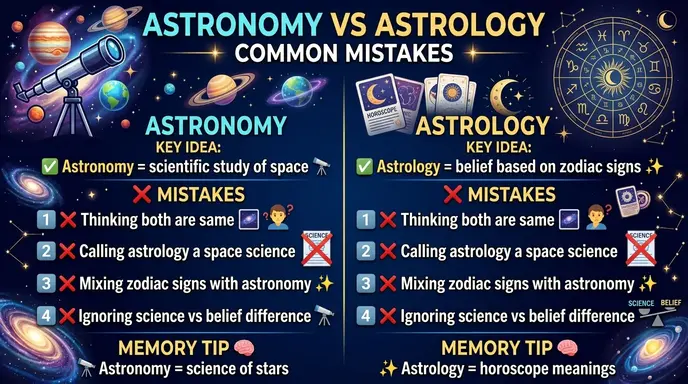
Thinking Astronomy and Astrology Are the Same
❌ Astronomy and astrology are identical fields.
✅ Astronomy is science, while astrology is a belief system.
Confusing Astronomers with Astrologers
❌ An astrologer studies galaxies using telescopes.
✅ An astronomer studies galaxies using scientific tools.
Assuming Astrology Is Scientifically Proven
❌ Astrology is fully supported by scientific evidence.
✅ Astrology is based on traditions and interpretations, not scientific proof.
Believing Zodiac Signs Are Part of Astronomy
❌ Astronomy uses zodiac signs to predict personality.
✅ Astrology uses zodiac signs, while astronomy studies constellations scientifically.
Ignoring Historical Differences
❌ Astronomy and astrology always developed separately.
✅ They were connected in ancient times before science evolved.
Using Terms Incorrectly in Conversation
❌ She studied astrology to become a space scientist.
✅ She studied astronomy to become a space scientist.
🧑💼 Real Life Examples with Astronomy and Astrology
- A scientist studies black holes through astronomy
- A person reads daily horoscopes through astrology
- Space agencies use astronomy for satellite missions
- Astrology apps provide zodiac compatibility predictions
- Astronomy students learn physics and mathematics
- Astrology followers analyze birth charts and signs
🎯 When to Use Astronomy or Astrology
- Scientific space study → astronomy
- Horoscope reading → astrology
- Space missions and satellites → astronomy
- Zodiac compatibility discussions → astrology
- Academic science education → astronomy
- Spiritual or personal interpretation → astrology
🤔 Why People Get Confused
- Both words sound similar
- Both involve stars and planets
- Ancient history connected the two fields
- Media and entertainment mix the terms
- Zodiac signs create overlap in public understanding
🧠 How Educational and Information Systems Understand This Topic
Modern educational systems classify:
- Astronomy as a natural science
- Astrology as a belief-based or cultural practice
Science institutions focus on astronomy because it uses evidence, observation, and testing methods.
🧠 Expert Insight
The difference between astronomy and astrology is one of the clearest examples of science versus belief-based interpretation. Astronomy contributes to real-world discoveries like satellites, space travel, and understanding galaxies. Astrology remains culturally significant because many people enjoy its personal and symbolic meaning.
Understanding both correctly helps avoid misinformation and improves scientific literacy.
❓ FAQ:
1. Are astronomy and astrology the same?
No, astronomy is science and astrology is a belief system.
2. Is astrology scientifically proven?
No, astrology is not supported by scientific evidence.
3. What does astronomy study?
Astronomy studies planets, stars, galaxies, and the universe.
4. What does astrology focus on?
Astrology focuses on zodiac signs and supposed cosmic influence on people.
5. Why do people confuse astronomy and astrology?
Because both involve celestial objects and have similar names.
6. Is astronomy taught in universities?
Yes, astronomy is an academic science subject.
7. Are horoscopes part of astronomy?
No, horoscopes belong to astrology.
🧾 Conclusion
The difference between astronomy and astrology comes down to science versus belief. Astronomy is a scientific field that studies the universe using evidence, observation, mathematics, and technology. Astrology is a belief system that connects celestial movements with personality traits and future predictions.
Although both involve stars, planets, and celestial objects, their goals and methods are completely different. Understanding the difference between astronomy and astrology helps people separate scientific facts from symbolic interpretations. Once you understand this distinction, it becomes much easier to recognize how each field is used in education, culture, entertainment, and everyday life.
Discover More Articles:

Hi, I’m Nabeel Hassan. I love exploring interesting topics and explaining how different things compare with each other. Through my writing, I aim to provide clear, helpful, and easy to read explanations. I cover subjects related to learning, science, technology and general knowledge.