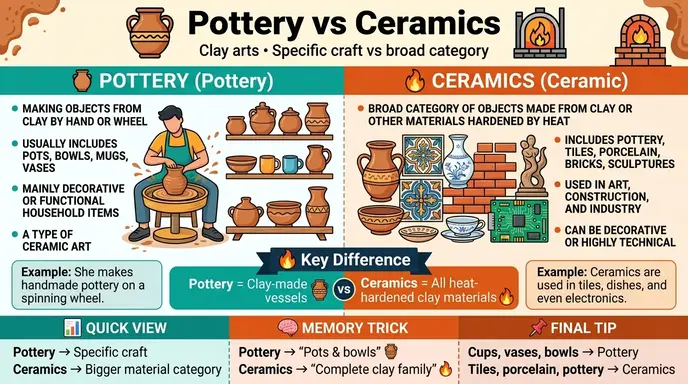
The difference between pottery and ceramics is that pottery usually refers to handmade clay items like pots, bowls, and vases, while ceramics is a broader term that includes all objects made from hardened clay or similar non metal materials.
Many people get confused about the difference between pottery and ceramics because both involve clay, heat, and artistic or functional creations. However, pottery is actually a type of ceramic, not a completely separate material.
If you’ve ever wondered what is pottery vs ceramics, which one is stronger, or how artists and manufacturers use these terms, this guide will clearly explain the difference between pottery and ceramics in simple and practical language.
⚡ Quick Answer: Difference Between Pottery and Ceramics
- Pottery: Clay objects like pots, mugs, bowls, and vases made by shaping and firing clay
- Ceramics: A larger category that includes pottery plus tiles, porcelain, industrial materials, and more
👉 Example: A handmade clay flower vase is pottery, while bathroom tiles and porcelain dishes are ceramics.
📖 Definition of Pottery and Ceramics
- Pottery: Objects made mainly from clay and shaped into containers or decorative items before firing.
- Ceramics: All hardened non-metal materials created through high heat, including pottery, porcelain, and industrial ceramic products.
🔊 Pronunciation (US & UK)
- Pottery: UK /ˈpɒt.ər.i/ | US /ˈpɑː.t̬ɚ.i/
- Ceramics: UK /səˈræm.ɪks/ | US /səˈræm.ɪks/
Now let’s understand their differences clearly.
📊 Pottery vs Ceramics Comparison Table
| Feature | Pottery | Ceramics |
| Meaning | Clay-made vessels and art | Broad category of fired materials |
| Material | Mainly clay | Clay and other mineral materials |
| Scope | Narrow category | Larger category |
| Common Products | Pots, mugs, vases | Tiles, porcelain, pottery, industrial parts |
| Artistic Focus | Often handmade | Artistic and industrial |
| Manufacturing Style | Traditional crafting | Traditional and industrial |
| Heat Treatment | Fired in kiln | Fired at high temperatures |
| Relationship | Type of ceramic | Includes pottery |
🔍 KEY DIFFERENCES EXPLAINED BETWEEN POTTERY AND CERAMICS
🏺 Pottery Is a Type of Ceramic
Pottery belongs inside the ceramic category, but not all ceramics are pottery.
👉 Example: A clay mug is pottery, but a ceramic dental crown is not pottery.
🧱 Wider Material Range
Ceramics include many materials beyond traditional clay pots, including porcelain, industrial ceramics, and heat-resistant materials.
👉 Example: Ceramic tiles and laboratory ceramics are not considered pottery.
🎨 Artistic vs Industrial Use
Pottery is strongly connected to handmade art and traditional craftsmanship. Ceramics also include industrial and technological products.
👉 Example: Pottery is common in art studios, while ceramics are common in factories.
🔥 Firing Process
Both pottery and ceramics are hardened through high-temperature firing in a kiln. However, some ceramics require much higher temperatures and advanced processing.
👉 Example: Porcelain ceramics often use higher firing temperatures.
🏠 Everyday Household Use
Pottery commonly appears as bowls, cups, and decorative items, while ceramics include sinks, tiles, dishes, and electronics components.
👉 Example: Bathroom tiles are ceramics but not pottery.
⚙️ Strength and Durability
Some advanced ceramics are much stronger and more heat-resistant than traditional pottery.
👉 Example: Industrial ceramics can survive extreme temperatures.
🤔 What Is the Difference Between Pottery and Ceramics in Simple Words?
In simple words, pottery refers mainly to handmade clay containers and decorative objects, while ceramics include all fired clay-based and non-metal mineral materials.
👉 Pottery = specific clay art objects
👉 Ceramics = larger material category
🧠 Why Are Pottery and Ceramics Important?
Both play important roles in art, construction, manufacturing, and daily life.
Pottery is commonly used for:
- Bowls and plates
- Decorative art
- Handmade crafts
- Flower pots
Ceramics are commonly used for:
- Tiles and sinks
- Porcelain dishes
- Industrial equipment
- Electronic components
👉 Ceramics combine creativity with practical engineering.
🌍 Difference Between Ceramics and Pottery in Real Life
In practical use:
- Artists often create pottery by hand using clay wheels
- Construction industries use ceramic tiles and materials
- Modern technology also uses ceramics in electronics and medical tools
👉 Pottery focuses more on artistic objects, while ceramics cover many industries.
⚖️ DIFFERENCE + SIMILARITY TABLE
| Feature | Pottery | Ceramics | Similarity |
| Made with Heat | Yes | Yes | Kiln firing process |
| Uses Clay Materials | Yes | Often | Mineral-based materials |
| Decorative Use | Common | Common | Artistic applications |
| Household Products | Yes | Yes | Everyday usage |
| Handmade Possibility | Yes | Yes | Craftsmanship involved |
| Durable Material | Moderate | Often high | Long-lasting products |
| Ancient History | Yes | Yes | Historical importance |
| Requires Shaping Process | Yes | Yes | Formed before firing |
This table clearly shows the difference and similarity between difference between pottery and ceramics for quick understanding.
❌ Common Mistakes with Pottery or Ceramics
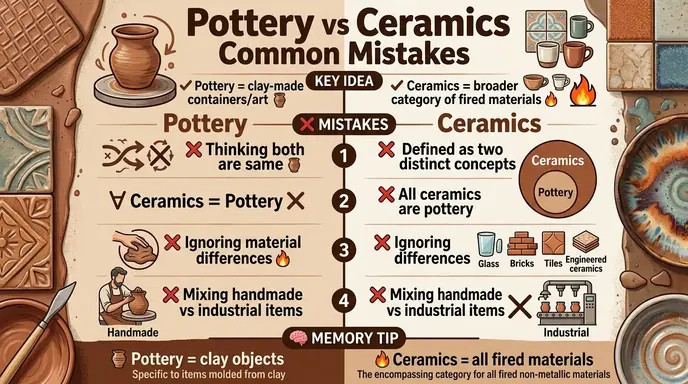
Thinking Both Terms Mean Exactly the Same
❌ Pottery and ceramics are identical terms.
✅ Pottery is one category within ceramics.
Ceramics are broader.
Calling Every Ceramic Product Pottery
❌ All ceramic objects are pottery.
✅ Many ceramics are industrial or technical materials.
Function matters.
Assuming Ceramics Are Always Handmade
❌ Ceramics are only handmade art pieces.
✅ Many ceramics are factory-produced.
Industrial manufacturing is common.
Believing Pottery Is Always Fragile
❌ All pottery breaks easily.
✅ Properly fired pottery can be durable.
Material quality matters.
Ignoring Industrial Ceramic Uses
❌ Ceramics are only decorative products.
✅ Ceramics are widely used in technology and engineering.
Modern applications are extensive.
🏡 Real Life Examples with Pottery or Ceramics
☕ Handmade Coffee Mug
A clay coffee mug created on a pottery wheel is pottery.
🏠 Bathroom Tiles
Ceramic tiles used in homes are ceramics, not pottery.
🎨 Decorative Vase
Handmade decorative vases are common pottery products.
📱 Electronic Components
Some electronics contain heat-resistant ceramic materials.
🎯 WHEN TO USE EACH
Use Pottery When:
✔ Talking about handmade clay objects
✔ Referring to bowls, mugs, or vases
✔ Discussing traditional clay art
Use Ceramics When:
✔ Talking about broader fired materials
✔ Referring to tiles, porcelain, or industrial materials
✔ Discussing engineering or manufacturing uses
🤯 WHY PEOPLE GET CONFUSED IN POTTERY AND CERAMICS
- Both involve clay and kilns
- Pottery is part of ceramics
- Stores often use the terms loosely
- Handmade ceramic products resemble pottery
⚙️ How Artists and Industries Understand Pottery vs Ceramics
Artists and manufacturers separate these terms based on:
- Product purpose
- Material composition
- Manufacturing process
- Artistic versus industrial use
👉 Pottery is more specific, while ceramics cover a much larger field.
🧑🎨 EXPERT INSIGHT
In real scenarios, many beginners assume pottery and ceramics are completely different materials, but pottery actually belongs within the ceramic category. The biggest distinction comes from scope. Pottery focuses mostly on traditional clay-made containers and decorative art, while ceramics include everything from porcelain dishes to advanced industrial materials used in technology and medicine.
One important insight many people overlook is that modern ceramics are not limited to art. Advanced ceramics are used in aerospace, electronics, dentistry, and engineering because of their heat resistance and durability.
👉 Key insight:
All pottery is ceramic, but not all ceramics are pottery.
❓ FAQ:
❓ What is the difference between pottery and ceramics?
Pottery refers to clay-made containers and decorative items, while ceramics include a much broader range of fired materials.
❓ Is pottery considered ceramic?
Yes, pottery is one type of ceramic.
❓ Are ceramic tiles pottery?
No, tiles are ceramics but not pottery.
❓ Which is stronger, pottery or ceramics?
Some advanced ceramics are much stronger than traditional pottery.
❓ Do both use clay?
Most pottery uses clay, and many ceramics also use clay-based materials.
❓ Are ceramics handmade?
Some are handmade, while many are factory-produced.
❓ Is porcelain pottery?
Porcelain is a ceramic material but is usually classified separately from traditional pottery.
❓ Why are ceramics important in technology?
They resist heat, pressure, and wear very effectively.
🏁 Conclusion
The difference between pottery and ceramics mainly comes down to scope and usage. Pottery refers specifically to handmade clay objects like bowls, mugs, and vases, while ceramics include a much wider category of fired materials used in art, construction, technology, and manufacturing.
Understanding this difference helps clarify why pottery is considered one type of ceramic rather than a separate material entirely. In simple terms, pottery focuses on traditional clay crafts, while ceramics cover both artistic and industrial applications.
Once you understand the broader meaning of ceramics, the distinction between pottery and ceramics becomes much easier to recognize.
Discover More Articles:

Hi, I’m Nabeel Hassan. I love exploring interesting topics and explaining how different things compare with each other. Through my writing, I aim to provide clear, helpful, and easy to read explanations. I cover subjects related to learning, science, technology and general knowledge.