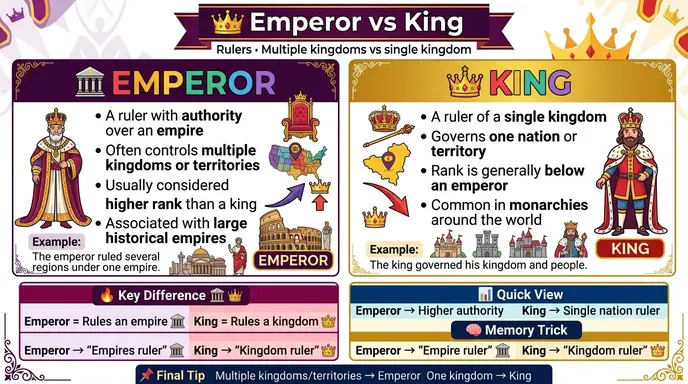
The difference between emperor and king is that an emperor usually rules over multiple kingdoms or a large empire, while a king typically rules a single kingdom or nation.
Many people get confused about the difference between emperor and king because both are powerful royal titles connected to monarchy, leadership, and historical rule. However, their authority, territory, and political rank are different.
If you’ve ever wondered what is emperor vs king, which title is higher, or how royal systems worked in history, this guide will clearly explain the difference between emperor and king in simple and practical language.
⚡ Quick Answer: Difference Between Emperor and King
- Emperor: Ruler of an empire made up of multiple regions or kingdoms
- King: Ruler of a single kingdom or territory
👉 Example: The ruler of the Roman Empire was called an emperor, while the ruler of England was traditionally called a king.
📖 Definition of Emperor and King
- Emperor: A monarch who rules an empire containing different territories, nations, or kingdoms.
- King: A male monarch who rules one kingdom or independent nation.
🔊 Pronunciation (US & UK)
- Emperor: UK /ˈem.pər.ər/ | US /ˈem.pɚ.ɚ/
- King: UK /kɪŋ/ | US /kɪŋ/
Now let’s understand their differences clearly.
📊 Emperor vs King Comparison Table
| Feature | Emperor | King |
| Territory Size | Empire with multiple regions | Single kingdom |
| Rank | Higher royal rank | Lower than emperor |
| Authority Scope | Broader control | More limited control |
| Historical Usage | Large empires | Individual nations |
| Political Power | Often greater | Usually regional |
| Number of Lands Ruled | Multiple | Usually one |
| Symbol of Rule | Empire leadership | Kingdom leadership |
| Common Female Title | Empress | Queen |
🔍 KEY DIFFERENCES EXPLAINED BETWEEN EMPEROR AND KING
🌍 Size of Territory
An emperor usually controls a much larger territory than a king. Empires often include several kingdoms or nations.
👉 Example: The Ottoman Empire covered multiple regions under one emperor-like ruler.
👑 Royal Rank and Status
An emperor is traditionally considered higher in rank than a king. Kings may sometimes serve under an emperor within an empire.
👉 Example: In some historical empires, local kings answered to emperors.
🏰 Type of Government Structure
Kings usually rule one kingdom, while emperors oversee a broader imperial system with multiple territories.
👉 Example: The Roman Empire included many regions under one emperor.
⚔️ Historical Expansion
Empires were often built through conquest, alliances, or expansion into multiple lands. Kingdoms were generally smaller and more localized.
👉 Example: Empires expanded by controlling neighboring territories.
📜 Political Authority
Emperors often held wider political and military influence than kings because they governed larger populations.
👉 Example: Imperial rulers sometimes controlled trade routes and armies across continents.
🌐 Cultural Diversity
Empires often included different languages, cultures, and ethnic groups under one ruler. Kingdoms were usually more unified culturally.
👉 Example: Ancient empires governed diverse populations.
🤔 What Is the Difference Between Emperor and King in Simple Words?
In simple words, an emperor rules an empire made up of multiple regions or kingdoms, while a king rules a single kingdom.
👉 Emperor = ruler of an empire
👉 King = ruler of one kingdom
🧠 Why Did Empires and Kingdoms Exist?
Monarchies developed to organize societies, protect territories, and manage governments.
Empires usually formed through:
- Military expansion
- Political alliances
- Trade control
- Territorial conquest
Kingdoms usually focused on:
- Governing one nation
- Protecting local populations
- Managing regional laws
- Maintaining royal authority
👉 The size of control often determined the ruler’s title.
🌍 Difference Between Emperor and King in Real Life History
In historical use:
- Emperors often ruled vast empires with many cultures
- Kings usually governed smaller territories or nations
- Some rulers changed titles after expanding territory
👉 Royal titles reflected political power and land control.
⚖️ DIFFERENCE + SIMILARITY TABLE
| Feature | Emperor | King | Similarity |
| Monarch Title | Yes | Yes | Royal rulers |
| Political Authority | Yes | Yes | Government leadership |
| Military Power | Common | Common | Defense role |
| Royal Family | Yes | Yes | Monarchy system |
| Historical Importance | High | High | Influenced history |
| Crown Symbolism | Yes | Yes | Royal identity |
| Inherited Position | Often | Often | Family succession |
| Controlled Territory | Yes | Yes | Land governance |
This table clearly shows the difference and similarity between difference between emperor and king for quick understanding.
❌ Common Mistakes with Emperor or King
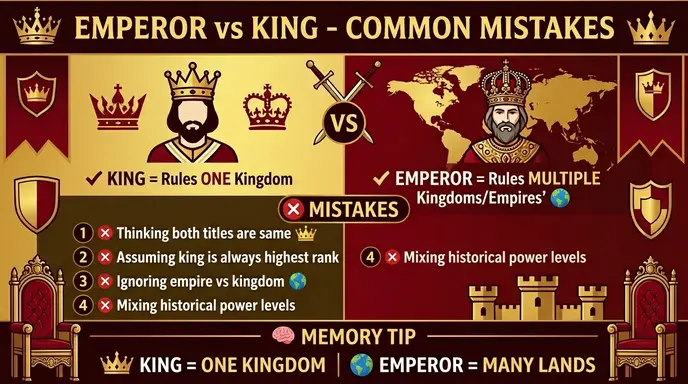
Thinking Emperor and King Mean the Same Thing
❌ Emperor and king are identical titles.
✅ Emperors usually rank higher and rule larger territories.
Royal rank differs.
Assuming Every Large Kingdom Is an Empire
❌ Any big kingdom automatically becomes an empire.
✅ Empires usually include multiple territories or kingdoms.
Political structure matters.
Confusing Kings with Emperors in History
❌ All ancient rulers were emperors.
✅ Many rulers were kings of individual kingdoms.
Titles depended on territory and authority.
Believing Modern Monarchies Use Emperor Titles Commonly
❌ Most modern monarchies use emperors.
✅ King and queen titles are far more common today.
Historical usage changed over time.
Ignoring Cultural Differences
❌ Every civilization used the same royal ranking system.
✅ Royal titles varied between cultures and historical periods.
Context matters.
🏰 Real Life Examples with Emperor or King
🏛️ Roman Empire
The Roman ruler was called an emperor because he governed a large empire.
🇬🇧 English Monarchy
England traditionally used the title king or queen for its ruler.
⚔️ Expanding Territories
Some rulers became emperors after conquering multiple kingdoms.
🌏 Multi-Cultural Empires
Empires often governed people with different languages and traditions.
🎯 WHEN TO USE EACH
Use Emperor When:
✔ Referring to rulers of empires
✔ Talking about large multi-region rule
✔ Describing higher imperial authority
Use King When:
✔ Referring to rulers of kingdoms
✔ Talking about single-nation monarchies
✔ Describing traditional royal leadership
🤯 WHY PEOPLE GET CONFUSED IN KING AND EMPEROR
- Both are monarch titles
- Both wear crowns and rule territories
- Historical movies often mix the terms
- Different cultures used titles differently
⚙️ How Historians Understand Emperor vs King
Historians separate these titles based on:
- Territory size
- Political authority
- Number of regions controlled
- Historical context
👉 Imperial rule usually involved broader power than kingdom rule.
🧑🏫 EXPERT INSIGHT
In real historical scenarios, the title “emperor” often carried greater political and symbolic weight than “king.” Empires usually controlled multiple nations, cultures, and kingdoms, which required larger administrative systems and stronger military organization. Kings, on the other hand, often focused more on governing one kingdom and maintaining regional stability.
One important detail many people overlook is that royal titles changed depending on culture and historical period. Some civilizations used different words with similar meanings, but the overall distinction between empire rule and kingdom rule remained important.
👉 Key insight:
An emperor rules an empire with broader authority, while a king rules a single kingdom.
❓ FAQ:
❓ What is the difference between emperor and king?
An emperor rules an empire with multiple territories, while a king rules a single kingdom.
❓ Is an emperor higher than a king?
Traditionally, yes. An emperor usually ranks above a king.
❓ Can a king become an emperor?
Historically, some kings became emperors after expanding territory.
❓ Do emperors still exist today?
Very few nations still use the emperor title today.
❓ What is the female version of emperor?
The female title is empress.
❓ What is the female version of king?
The female title is queen.
❓ Did empires contain kingdoms?
Yes, many empires included multiple kingdoms or regions.
❓ Why were emperors powerful?
They controlled large territories, populations, and military systems.
🏁 Conclusion
The difference between emperor and king mainly comes down to territory size, political authority, and royal rank. An emperor usually rules an empire made up of multiple regions or kingdoms, while a king typically governs a single kingdom or nation.
Understanding this difference makes it easier to recognize how historical monarchies and empires were organized. In simple terms, emperors ruled larger imperial systems, while kings ruled individual kingdoms.
Once you understand the scale of authority behind each title, the distinction between emperor and king becomes much clearer.
Discover More Articles:

I’m Owen Parker, and I write articles that focus on explaining the differences between common concepts, tools, and ideas. I enjoy simplifying complex information and turning it into clear comparisons that anyone can understand. My work often covers science , education, technology, and everyday knowledge topics.