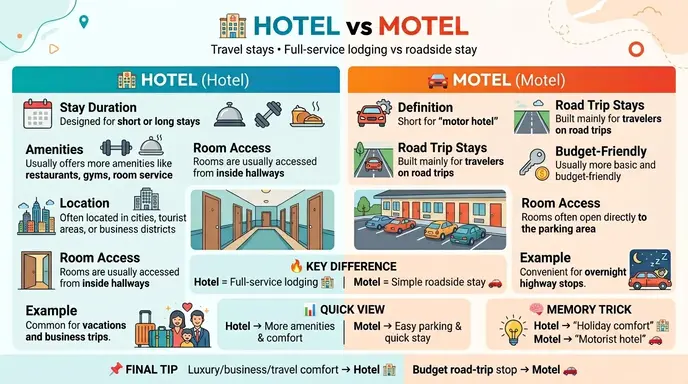
The difference between hotel and motel is that hotels are usually larger accommodations designed for short or long stays with multiple services and amenities, while motels are smaller roadside accommodations mainly designed for travelers needing quick and convenient overnight stays.
Many travelers search for the difference between hotel and motel because both provide temporary lodging, yet they differ in location, structure, services, pricing, and travel purpose.
In simple words, hotels focus more on comfort, services, and extended stays, while motels focus on convenience and easy road access for drivers. Understanding the difference between hotel and motel helps travelers choose the right accommodation based on budget, trip style, comfort needs, and travel distance.
💡 Quick Answer: Difference Between Hotel or Motel
Hotels offer more services and amenities for travelers, while motels are simpler roadside accommodations designed mainly for short stays.
👉 Example:
A luxury city building with restaurants and room service is usually a hotel, while a roadside stay with parking directly outside the room is typically a motel.
📘 Definition of Hotel and Motel
- Hotel: A lodging establishment offering rooms, services, and amenities for travelers and guests.
- Motel: A roadside accommodation designed mainly for motorists needing convenient short-term stays.
🗣️ Pronunciation (US & UK)
- Hotel
- US: /hoʊˈtel/
- UK: /həʊˈtel/
- Motel
- US: /moʊˈtel/
- UK: /məʊˈtel/
These terms are commonly used in tourism, travel planning, hospitality services, business trips, and vacation bookings.
📊 Comparison Table: Hotel vs Motel
| Feature | Hotel | Motel | Similarity |
| Main Purpose | Comfortable lodging with services | Convenient roadside stay | Both provide accommodation |
| Typical Location | Cities, tourist areas, airports | Highways and roadside areas | Both host travelers |
| Building Structure | Multi-floor buildings | Single or double-story layouts | Both offer guest rooms |
| Room Access | Interior hallways | Exterior door access common | Both provide private rooms |
| Amenities | Restaurants, gyms, pools, room service | Basic facilities and parking | Both may offer Wi-Fi |
| Length of Stay | Short or long stays | Mostly short overnight stays | Both support temporary lodging |
| Parking Style | Separate parking areas or garages | Parking near room entrance | Both accommodate vehicles |
| Pricing | Often higher cost | Usually more budget-friendly | Both vary by location |
This table clearly shows the difference and similarity between hotel and motel for quick understanding.
🧠 Key Differences Explained Between Motel and Hotel
🏢 Size and Structure
The biggest difference between hotel and motel is design. Hotels are usually larger buildings with interior hallways, while motels often have rooms facing parking areas.
👉 Example:
Guests at motels may park directly outside their room door.
🚗 Travel Purpose
Motels were originally designed for road travelers needing quick overnight stops.
🛎️ Services and Amenities
Hotels generally provide more amenities like:
- Room service
- Restaurants
- Fitness centers
- Pools
- Conference rooms
👉 Example:
Business travelers often prefer hotels because of extra facilities.
💰 Pricing Differences
Motels are often cheaper because they offer fewer services.
🌆 Location
Hotels are common in downtown areas, tourist zones, and airports, while motels are common near highways.
⏳ Length of Stay
Hotels commonly support longer vacations or business stays.
🧳 Guest Experience
Hotels usually focus more on comfort and hospitality experiences.
🧠 Why Hotel and Motel Get Confused
The difference between hotel and motel becomes confusing because both provide rooms for temporary stays. Modern motels and budget hotels may also look similar, especially after renovations and branding changes.
🌐 How the Travel Industry Uses Hotels and Motels
The hospitality industry classifies:
- Hotels as service-focused lodging properties
- Motels as convenient roadside accommodations
Travel platforms like Booking.com, Airbnb, and Expedia categorize accommodations based on:
- Amenities
- Guest services
- Location
- Pricing
- Travel purpose
These systems help travelers choose suitable lodging options.
📊 Difference + Similarity Table
| Feature | Hotel | Motel | Similarity |
| Meaning | Full-service lodging accommodation | Roadside traveler accommodation | Both provide temporary stays |
| Typical Guests | Tourists, business travelers, families | Road travelers and motorists | Both host travelers |
| Room Access | Interior hallways common | Exterior access common | Both offer private rooms |
| Service Level | Higher service and amenities | Basic convenience services | Both may provide Wi-Fi |
| Location Type | Cities and tourist centers | Highways and roadside areas | Both support tourism |
| Parking Design | Separate parking areas | Parking near rooms | Both support vehicle access |
| Stay Duration | Short or extended stays | Usually overnight stays | Both accommodate temporary lodging |
| Cost Range | Often higher prices | Usually budget-friendly | Both vary by quality and location |
This table clearly shows the difference and similarity between hotel and motel for quick understanding.
🏨 Deep Explanation: Why Motels Became Popular
Motels became popular during the rise of automobile travel:
- Drivers needed quick roadside lodging
- Easy parking access became important
- Short overnight stays increased along highways
👉 Example:
Families traveling long distances by car often stayed in motels because parking and room access were convenient.
Hotels, however, evolved more toward:
- Tourism
- Luxury stays
- Business travel
- Conferences
- Extended vacations
Today, some modern motels look similar to budget hotels, which increases confusion between the two.
⚠️ Common Mistakes with Difference Between Hotel and Motel
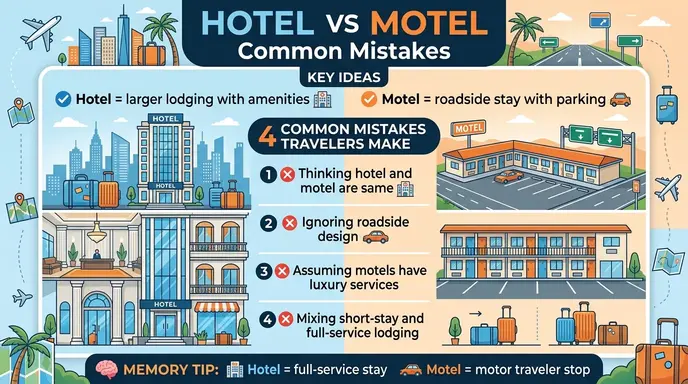
Thinking Hotels and Motels Are Exactly the Same
❌ Hotels and motels have identical designs and services.
✅ Hotels usually offer more amenities and different layouts.
Assuming Motels Are Always Low Quality
❌ Every motel is unsafe or poor quality.
✅ Many motels provide clean and comfortable stays.
Ignoring Location Purpose
❌ Hotels and motels are built for the same travel situations.
✅ Motels were mainly designed for road travelers.
Using Terms Incorrectly
❌ A roadside property with direct room parking is always a hotel.
✅ That design is commonly associated with motels.
Believing Hotels Are Always Expensive
❌ All hotels cost far more than motels.
✅ Budget hotels also exist in many locations.
Confusing Modern Branding
❌ Every property labeled “inn” or “lodge” fits one category perfectly.
✅ Modern hospitality branding can blur traditional distinctions.
🧑💼 Real Life Examples with Hotel and Motel
- Families staying in highway motels during road trips
- Business travelers booking airport hotels
- Tourists using city hotels near attractions
- Drivers choosing motels for overnight convenience
- Vacation resorts operating as luxury hotels
- Budget roadside accommodations serving travelers
🎯 When to Choose a Hotel or Motel
- Luxury amenities and comfort → hotel
- Quick roadside overnight stop → motel
- Business conferences → hotel
- Budget road travel → motel
- Extended vacations → hotel
- Easy parking access → motel
🤔 Why People Get Confused in Hotel and Motel
- Both provide lodging rooms
- Some modern motels resemble hotels
- Branding styles overlap
- Travelers use terms casually
- Hospitality designs have evolved over time
🧠 How Travel Systems Understand Hotels and Motels
Travel systems analyze:
- Property layout
- Service level
- Location type
- Guest facilities
- Travel purpose
This helps booking platforms organize accommodations for travelers based on comfort, convenience, and budget preferences.
🧠 Expert Insight
The difference between hotel and motel mainly comes from travel purpose, building design, amenities, and guest experience. Hotels generally focus on broader hospitality services and comfort, while motels focus on convenience for travelers, especially motorists needing short stays.
In practical travel situations, choosing between a hotel and motel depends on budget, trip duration, comfort expectations, and travel style.
❓ FAQ: Difference Between Motel or Hotel
1. What is the main difference between hotel and motel?
Hotels offer more services and amenities, while motels focus on convenient roadside lodging.
2. Why are motels usually near highways?
Motels were designed mainly for motorists and road travelers.
3. Are hotels more expensive than motels?
Hotels are often more expensive because they usually provide more services.
4. Do motels have room service?
Most motels offer limited services compared to hotels.
5. Can motels be comfortable?
Yes, many motels provide clean and comfortable accommodations.
6. Do hotels support long stays?
Yes, hotels commonly support both short and extended stays.
7. Why do people confuse hotels and motels?
Because modern properties sometimes combine features of both.
🧾 Conclusion
The difference between hotel and motel comes from structure, services, location, and travel purpose. Hotels are generally larger accommodations offering more amenities and hospitality services, while motels are simpler roadside properties designed for convenient short-term stays.
Understanding the difference between hotel and motel helps travelers make smarter accommodation decisions based on comfort, budget, convenience, and trip style. Once you connect hotels with broader hospitality services and motels with roadside convenience, the distinction becomes much easier to understand in modern travel planning.
Discover More Articles:

I’m Owen Parker, and I write articles that focus on explaining the differences between common concepts, tools, and ideas. I enjoy simplifying complex information and turning it into clear comparisons that anyone can understand. My work often covers science , education, technology, and everyday knowledge topics.