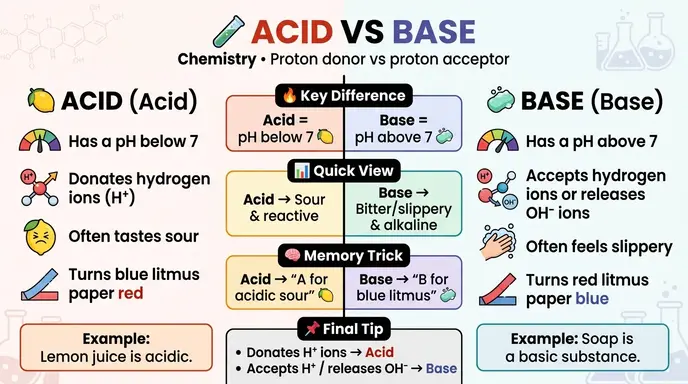
The difference between acid and base is that acids release hydrogen ions in water and usually taste sour, while bases release hydroxide ions and usually feel slippery or taste bitter.
Many students and beginners search for the difference between acid and base because both are important parts of chemistry and are used in daily life, laboratories, cooking, medicine, and cleaning products.
In simple words, acids and bases have opposite chemical properties. Understanding the difference between acid and base helps explain how chemical reactions work, why substances behave differently, and how common household products are classified.
💡 Quick Answer: Difference Between Acid and Base
Acids donate hydrogen ions and have a low pH, while bases accept hydrogen ions or release hydroxide ions and have a high pH.
👉 Example: Lemon juice is acidic, while soap water is basic.
📘 Definition of Acid or Base
- Acid: A substance that releases hydrogen ions (H⁺) in water and usually has a pH below 7.
- Base: A substance that releases hydroxide ions (OH⁻) or accepts hydrogen ions and usually has a pH above 7.
🗣️ Pronunciation (US & UK)
- Acid
- US: /ˈæs.ɪd/
- UK: /ˈæs.ɪd/
- Base
- US: /beɪs/
- UK: /beɪs/
These chemistry terms are commonly used in science education, laboratories, medicine, food production, and industrial processes.
📊 Comparison Table: Acid vs Base
| Feature | Acid | Base | Similarity |
| Ion Released | Hydrogen ions (H⁺) | Hydroxide ions (OH⁻) | Both react chemically in water |
| pH Level | Below 7 | Above 7 | Both measured using pH scale |
| Taste | Sour | Bitter | Both have distinct properties |
| Feel | Can sting or burn | Slippery or soapy | Both can be strong or weak |
| Litmus Test | Turns blue litmus red | Turns red litmus blue | Both react with indicators |
| Common Examples | Lemon juice, vinegar | Soap, baking soda | Both found in daily life |
| Chemical Behavior | Donates protons | Accepts protons | Both participate in reactions |
| Neutralization | Reacts with bases | Reacts with acids | Both can form salt and water |
This table clearly shows the difference and similarity between acid and base for quick understanding.
🧠 Key Differences Between Base and Acid
⚗️ Ion Difference
Acids release hydrogen ions, while bases release hydroxide ions or accept hydrogen ions.
👉 Example: Hydrochloric acid releases H⁺ ions, while sodium hydroxide releases OH⁻ ions.
📉 pH Scale Difference
Acids have a pH below 7, while bases have a pH above 7.
0 < \text{Acid pH} < 7 < \text{Base pH} < 14
👅 Taste and Feel
Acids usually taste sour, while bases taste bitter and feel slippery.
👉 Example: Lemon tastes sour because it is acidic, while soap feels slippery because it is basic.
🧪 Litmus Paper Reaction
Acids turn blue litmus paper red, while bases turn red litmus paper blue.
🔥 Chemical Reactivity
Acids often react with metals and carbonates, while bases react with acids to form neutral substances.
🧴 Everyday Usage
Acids are common in foods and batteries, while bases are common in cleaning products and soaps.
⚖️ Neutralization Reaction
When acids and bases react together, they can neutralize each other.
\text{Acid} + \text{Base} \rightarrow \text{Salt} + \text{Water}
🧠 Why Acids and Bases Exist
The difference between acid and base exists because substances interact differently at the molecular level. These chemical properties are important for biological systems, industrial production, medicine, food preparation, and environmental balance.
🏷️ How Acids and Bases Are Used in Daily Life
Acids are used in:
- Food preservation
- Soft drinks
- Car batteries
- Digestion in the stomach
Bases are used in:
- Soap and detergents
- Cleaning products
- Baking soda
- Antacid medicines
📊 Difference + Similarity Table
| Feature | Acid | Base | Similarity |
| Meaning | Substance releasing H⁺ ions | Substance releasing OH⁻ ions | Both are chemical compounds |
| pH Range | Less than 7 | Greater than 7 | Both measured by pH scale |
| Taste | Sour | Bitter | Both have identifiable properties |
| Touch Feeling | Can sting | Slippery feeling | Both react with skin differently |
| Litmus Test | Blue to red | Red to blue | Both react with indicators |
| Everyday Products | Vinegar and citrus fruits | Soap and detergents | Both found in homes |
| Chemical Reaction | Donates protons | Accepts protons | Both participate in reactions |
| Neutralization | Reacts with bases | Reacts with acids | Both can form salt and water |
This table clearly shows the difference and similarity between acid and base for quick understanding.
⚠️ Common Mistakes with Difference Between Acid and Base
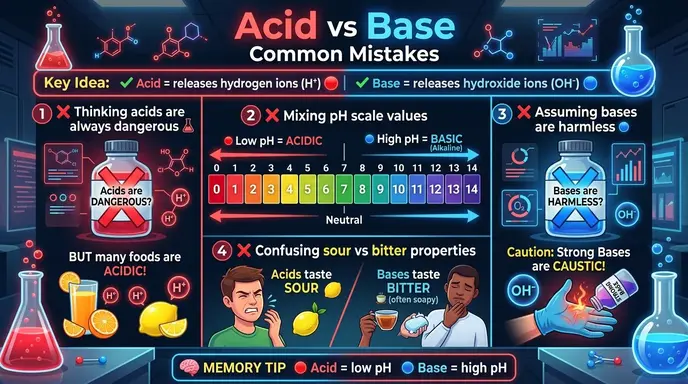
Assuming All Acids Are Dangerous
❌ Every acid is highly harmful and corrosive.
✅ Some acids like citric acid in lemons are safe for consumption.
Thinking Bases Cannot Be Harmful
❌ Bases are always safe because they feel slippery.
✅ Strong bases can burn skin and damage materials.
Confusing pH Values
❌ A pH above 7 means a substance is acidic.
✅ A pH above 7 means the substance is basic.
Ignoring Neutralization Reactions
❌ Acids and bases never react together.
✅ Acids and bases can neutralize each other to form salt and water.
Using Litmus Rules Incorrectly
❌ Acids turn red litmus blue.
✅ Acids turn blue litmus red.
Assuming Taste Is the Only Test
❌ Sour taste alone proves every substance is an acid.
✅ Scientific testing is needed to identify acids and bases safely.
🧑💼 Real Life Examples with Base vs Acid
- Lemon juice contains citric acid
- Vinegar contains acetic acid
- Soap solution is basic
- Baking soda acts as a mild base
- Stomach acid helps digestion
- Antacid tablets neutralize excess stomach acid
🎯 When to Use Acid or Base Knowledge
- Science education → understand chemical reactions
- Cooking and baking → ingredient balance
- Cleaning products → safe chemical handling
- Medicine → antacids and digestion
- Laboratory work → pH testing and reactions
🤔 Why People Get Confused
- Both are chemistry terms
- Strong acids and bases can both be dangerous
- pH scale can seem confusing to beginners
- Similar scientific vocabulary causes misunderstanding
- Many substances contain both acidic and basic properties in different conditions
🧠 How Scientific Systems Understand Acids and Bases
Science classifies acids and bases using:
- pH measurements
- Ion behavior
- Chemical reactions
- Indicator testing
These classifications help laboratories, industries, and researchers understand how substances behave.
🧠 Expert Insight
The difference between acid and base is one of the most fundamental concepts in chemistry. Acids and bases influence everything from digestion and food preparation to industrial manufacturing and environmental science.
In practical learning, students understand this topic more easily when they connect chemical properties with real-life examples like lemons, vinegar, soap, and baking soda.
❓ FAQ:
1. What is the main difference between acid and base?
Acids release hydrogen ions, while bases release hydroxide ions or accept hydrogen ions.
2. Is pH 7 acidic or basic?
pH 7 is neutral.
3. Why do acids taste sour?
Because of their hydrogen ion properties.
4. Why do bases feel slippery?
Bases react with oils and proteins on the skin surface.
5. Can acids and bases react together?
Yes, they neutralize each other.
6. Is soap acidic or basic?
Soap is basic.
7. What happens during neutralization?
An acid and base form salt and water.
🧾 Conclusion
The difference between acid and base comes from their chemical properties, ion behavior, and reactions. Acids release hydrogen ions and usually have a sour nature with a pH below 7, while bases release hydroxide ions or accept hydrogen ions and usually have a bitter or slippery nature with a pH above 7.
Understanding the difference between acid and base helps explain chemical reactions in science, daily life, medicine, food, and industry. Once you connect these concepts with common examples like lemons, vinegar, soap, and baking soda, the topic becomes much easier to understand and remember.
Discover More Articles:

Hi, I’m Nabeel Hassan. I love exploring interesting topics and explaining how different things compare with each other. Through my writing, I aim to provide clear, helpful, and easy to read explanations. I cover subjects related to learning, science, technology and general knowledge.