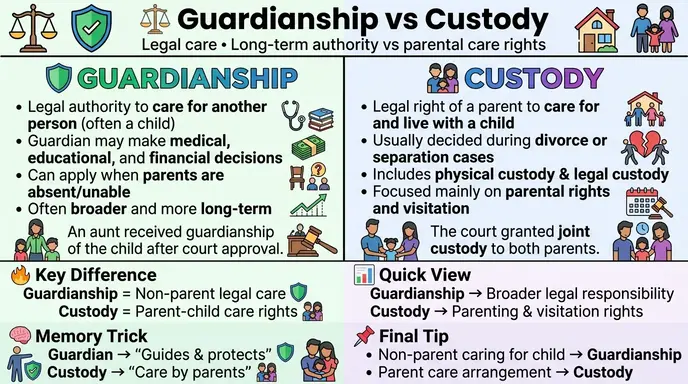
The difference between guardianship and custody is that custody usually refers to a parent’s legal right to care for and make decisions for a child, while guardianship gives a non-parent legal authority to care for a child or dependent person when parents cannot.
Many people get confused about the difference between guardianship and custody because both involve responsibility, care, and legal decision-making.
If you’ve ever wondered what is guardianship vs custody, who gets legal authority, or how courts treat each arrangement, this guide will clearly explain the difference between guardianship and custody in a simple and practical way.
⚡ Quick Answer: Difference Between Guardianship and Custody
- Custody: Legal care rights usually given to parents
- Guardianship: Legal authority given to someone who is not the child’s parent
👉 Example: A parent may have custody, while a grandparent may receive guardianship if parents are unable to care for the child.
📖 Definition of Difference Between Guardianship and Custody
- Guardianship: A legal arrangement where a court gives someone authority to care for a child or dependent person when the parents cannot fulfill that role.
- Child Custody: A legal right and responsibility, usually involving parents, to care for and make decisions about a child’s upbringing.
🔊 Pronunciation (US & UK)
- Guardianship: UK /ˈɡɑː.di.ən.ʃɪp/ | US /ˈɡɑːr.di.ən.ʃɪp/
- Custody: UK /ˈkʌs.tə.di/ | US /ˈkʌs.tə.di/
Now let’s break this down clearly.
📊 Comparison Table: Guardianship vs Custody
| Feature | Guardianship | Custody | Explanation |
| Main Purpose | Care by non-parent | Care by parent | Core difference |
| Legal Authority | Court-appointed | Parent-focused | Responsibility |
| Typical Holder | Relative/guardian | Parent | Common situation |
| Duration | Often long-term | Can vary | Timeframe |
| Decision Rights | Broad legal authority | Parenting rights | Control |
| Court Involvement | Usually required | Common in family disputes | Legal process |
| Parent Rights | May remain partially | Usually active | Parent role |
| Use Case | Parents unavailable | Divorce/separation | Context |
🔍 KEY DIFFERENCES EXPLAINED BETWEEN GUARDIANSHIP AND CUSTODY
1️⃣ Who Receives the Rights
Custody is usually given to parents, guardianship to non-parents.
👉 Example: Parent vs grandparent
2️⃣ Legal Purpose
Guardianship protects a child when parents cannot care for them.
👉 Example: Emergency care situations
3️⃣ Court Authority
Guardianship often requires stronger court involvement.
👉 Example: Formal appointment process
4️⃣ Parent Involvement
Parents may still retain some rights during guardianship.
👉 Example: Limited parental rights
5️⃣ Daily Decision-Making
Both can include decisions about education and healthcare.
👉 Example: Child welfare responsibilities
6️⃣ Common Situations
Custody is common after divorce, guardianship during parental absence.
👉 Example: Different legal contexts
💡 What Is the Difference Between Guardianship and Custody in Simple Words?
In simple words, custody usually means parents caring for their child, while guardianship means another trusted adult legally steps in when parents cannot.
👉 Parent care vs substitute care.
🧠 Why Do Guardianship and Custody Exist?
They exist to protect children and ensure proper care:
- Custody organizes parental responsibility
- Guardianship provides legal care when parents are unavailable
👉 Both focus on child welfare.
🌍 Difference Between Guardianship or Custody in Real Life
In real scenarios:
- Custody often happens after divorce or separation
- Guardianship happens when relatives or others take responsibility for a child
👉 Different family situations require different legal arrangements.
⚖️ DIFFERENCE + SIMILARITY TABLE OF Custody or Guardianship
| Feature | Guardianship | Custody | Similarity |
| Legal Role | Child care authority | Child care authority | Same purpose |
| Court Involvement | Legal process | Legal process | Family law |
| Responsibility | Child welfare | Child welfare | Protection |
| Decision-Making | Yes | Yes | Authority |
| Focus | Child’s best interest | Child’s best interest | Shared goal |
| Family Impact | Major role | Major role | Emotional/legal effect |
This table clearly shows the difference and similarity between difference between guardianship and custody for quick understanding.
❌ Common Mistakes with Guardianship or Custody
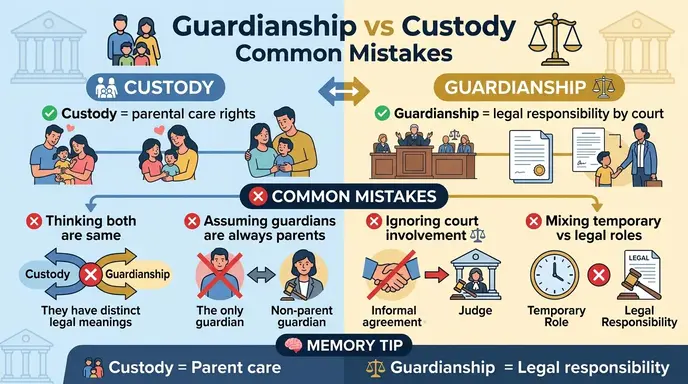
Thinking They Mean the Same Thing
❌ Guardianship and custody are identical.
✅ They involve different legal relationships and responsibilities.
Legal roles differ.
Assuming Only Parents Can Have Legal Authority
❌ Only parents can legally care for a child.
✅ Courts can appoint guardians when needed.
Non-parents may receive authority.
Ignoring Court Involvement
❌ Guardianship happens informally.
✅ Formal guardianship usually requires court approval.
Legal procedures matter.
Confusing Temporary and Permanent Roles
❌ Guardianship is always permanent.
✅ It may be temporary or long-term depending on circumstances.
Duration varies.
Believing Parents Lose All Rights
❌ Parents always lose every right during guardianship.
✅ Some parental rights may still remain.
Rights depend on court decisions.
🌍 Real Life Examples with Difference Between Guardianship and Custody
1️⃣ Divorce Cases
Parents share custody arrangements
2️⃣ Grandparent Care
Grandparents receive guardianship when parents are unable to care for a child
3️⃣ Medical Decisions
Both guardians and custodial parents may make healthcare decisions
4️⃣ School Enrollment
Legal authority determines who can register the child
🎯 WHEN TO USE EACH
Use custody when:
✔ Referring to parental rights and responsibilities
✔ Talking about divorce or separation situations
Use guardianship when:
✔ Referring to non-parent legal care
✔ Talking about long-term substitute care arrangements
🤔 WHY PEOPLE GET CONFUSED IN DIFFERENCE BETWEEN GUARDIANSHIP AND CUSTODY
- Both involve child care
- Similar legal responsibilities
- Overlapping decision-making powers
- Family law terminology can be confusing
⚙️ How Family Law Systems Understand Guardianship vs Custody
Family courts evaluate:
- Best interests of the child
- Parent availability
- Legal responsibility
👉 This helps determine whether custody or guardianship is more appropriate.
🧑⚖️ EXPERT INSIGHT
In real scenarios, the biggest misunderstanding is assuming guardianship automatically replaces custody.
Family law professionals usually view custody as a parental right, while guardianship is a protective legal arrangement used when parents cannot fully provide care. Courts focus heavily on stability, safety, and the child’s long-term well-being before making either decision.
👉 Key insight:
Custody supports parental care, guardianship replaces or supplements it when necessary.
❓ FAQ about Custody and Guardianship
❓ What is the difference between guardianship and custody?
Custody usually belongs to parents, while guardianship gives legal care authority to a non-parent.
❓ Can grandparents get guardianship?
Yes, courts may grant guardianship to grandparents.
❓ Does guardianship remove parental rights?
Not always; some rights may remain.
❓ Is custody only for parents?
Usually yes, especially in family law cases.
❓ Which requires court approval?
Guardianship almost always requires court involvement.
❓ Can guardians make school decisions?
Yes, legal guardians often can.
❓ Is guardianship temporary?
It can be temporary or long-term.
❓ Which is more common after divorce?
Custody arrangements are more common.
🏁 Conclusion
The difference between guardianship and custody mainly comes down to who receives legal authority and why. Custody usually refers to parental rights and responsibilities, while guardianship gives a non-parent legal authority to care for a child when parents cannot.
Understanding this difference is important in family law and child care situations. In simple terms, custody focuses on parents, while guardianship provides substitute legal care when needed.
Once you understand this, it becomes much easier to recognize which arrangement applies in different real-life situations.
Discover More Articles:

Hi, I’m Nabeel Hassan. I love exploring interesting topics and explaining how different things compare with each other. Through my writing, I aim to provide clear, helpful, and easy to read explanations. I cover subjects related to learning, science, technology and general knowledge.