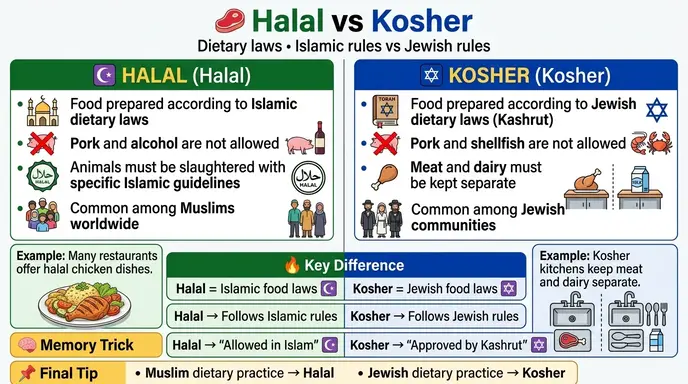
The difference between halal and kosher is that halal follows Islamic dietary laws, while kosher follows Jewish dietary laws.
Many people search for the difference between halal and kosher because both involve religious food rules, special preparation methods, and permitted or forbidden foods. Although they share some similarities, halal and kosher are based on different religious traditions and guidelines.
In simple words, halal comes from Islam and kosher comes from Judaism. Understanding the difference between halal and kosher helps people make informed choices about food, cultural practices, restaurant dining, and packaged products. This guide explains everything clearly with examples, comparisons, similarities, and common misunderstandings.
💡 Quick Answer: Difference Between Halal and Kosher
Halal and kosher are religious dietary systems, but they follow different faiths and food laws.
Halal follows Islamic rules from the Quran, while kosher follows Jewish laws from the Torah.
👉 Example: Both halal and kosher avoid pork, but the slaughter methods and food preparation rules are different.
📘 Definition of Halal and Kosher
- Halal: Food and drink permitted under Islamic dietary laws followed by Muslims.
- Kosher: Food prepared according to Jewish dietary laws followed by Jewish communities.
🗣️ Pronunciation (US & UK)
- Halal
- US: /həˈlɑːl/
- UK: /həˈlɑːl/
- Kosher
- US: /ˈkoʊ.ʃɚ/
- UK: /ˈkəʊ.ʃə/
Understanding these terms correctly is important because they are commonly used on food labels, restaurant menus, and grocery packaging worldwide.
📊 Comparison Table: Halal vs Kosher
| Feature | Halal | Kosher | Similarity |
| Religion | Islam | Judaism | Both are faith-based dietary systems |
| Holy Text | Quran | Torah | Both follow religious scriptures |
| Pork Rule | Forbidden | Forbidden | Both prohibit pork |
| Slaughter Method | Islamic slaughter process | Jewish slaughter process | Both require special slaughter rules |
| Alcohol | Not allowed | Some forms allowed depending on rules | Both regulate food and drink carefully |
| Certification | Halal-certified authority | Kosher-certified authority | Both use food certification systems |
| Food Preparation | Must avoid contamination with non-halal items | Must avoid mixing certain foods | Both require strict preparation standards |
| Followers | Muslims | Jewish communities | Both guide religious food practices |
This table clearly shows the difference and similarity between halal and kosher for quick understanding.
🧠 Key Differences Between Kosher and Halal
🕌 Religious Origin
Halal comes from Islamic teachings, while kosher comes from Jewish religious laws.
👉 Example: Muslims follow halal rules from the Quran, while Jewish communities follow kosher laws from the Torah.
🍖 Slaughter Method
Both systems require specific slaughter methods, but the religious prayers and procedures differ.
👉 Example: Halal slaughter includes invoking the name of Allah, while kosher slaughter follows Jewish ritual guidelines.
🍷 Alcohol Rules
Halal strictly forbids alcohol, while kosher may allow certain alcoholic drinks if prepared according to Jewish law.
🥛 Mixing Food Rules
Kosher has strict rules about mixing meat and dairy products. Halal does not have this restriction.
👉 Example: A kosher meal cannot combine cheeseburger ingredients, while halal rules focus more on ingredient permissibility.
🐖 Pork Restrictions
Both halal and kosher prohibit pork products completely.
🏷️ Certification Systems
Food companies use halal and kosher certifications to show products meet religious requirements.
👉 Example: Many packaged foods display halal or kosher symbols for consumers.
🌍 Global Food Industry Usage
Restaurants, airlines, and food manufacturers often provide halal and kosher options to serve diverse communities.
🧠 Why Halal and Kosher Exist
The difference between halal and kosher comes from religious teachings designed to guide ethical eating, cleanliness, discipline, and spiritual practice. These systems also help followers maintain religious identity through food choices.
🏷️ How Food Brands Use Halal and Kosher Labels
Food companies use halal and kosher labels to:
- Serve religious communities
- Build customer trust
- Expand international food markets
- Meet cultural dietary preferences
Many supermarkets now include separate halal and kosher sections because global demand continues growing.
📊 Difference + Similarity Table
| Feature | Halal | Kosher | Similarity |
| Meaning | Permitted under Islamic law | Permitted under Jewish law | Both define acceptable food |
| Main Followers | Muslims | Jewish communities | Both guide religious lifestyles |
| Pork Consumption | Completely forbidden | Completely forbidden | Both ban pork |
| Alcohol Use | Not permitted | Some alcohol may be allowed | Both regulate beverages |
| Meat Preparation | Islamic slaughter rules | Jewish slaughter rules | Both require ritual preparation |
| Dairy Rules | Dairy and meat can mix | Meat and dairy separated | Both have food preparation laws |
| Certification | Halal certification label | Kosher certification label | Both use approved inspection systems |
| Food Industry Use | Restaurants and packaged foods | Restaurants and packaged foods | Both influence global food markets |
This table clearly shows the difference and similarity between halal and kosher for quick understanding.
⚠️ Common Mistakes with Difference Between Halal and Kosher
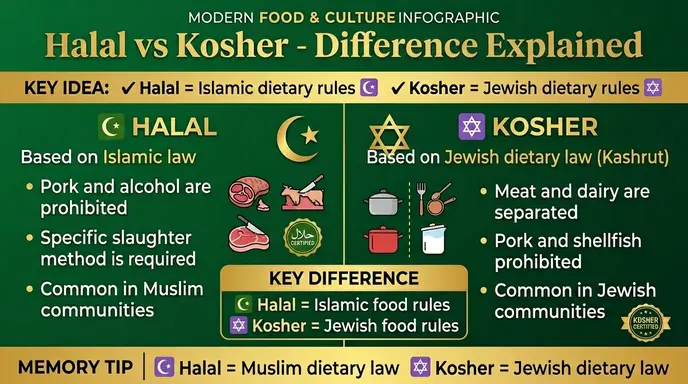
Assuming Halal and Kosher Are Exactly the Same
❌ Halal and kosher food follow identical rules.
✅ Halal and kosher share similarities, but they follow different religious laws.
Thinking Both Allow Alcohol
❌ Halal and kosher both allow alcohol freely.
✅ Halal forbids alcohol, while kosher rules about alcohol are different.
Ignoring Meat and Dairy Rules
❌ Kosher meals can freely mix meat and cheese.
✅ Kosher dietary laws separate meat and dairy products.
Believing All Kosher Food Is Halal
❌ Every kosher product is automatically halal.
✅ Some kosher foods may still contain ingredients not allowed in halal rules.
Confusing Religious Origins
❌ Halal belongs to Judaism and kosher belongs to Islam.
✅ Halal comes from Islam, while kosher comes from Judaism.
Using Certification Terms Incorrectly
❌ This restaurant is halal-certified kosher food.
✅ This restaurant serves halal food or kosher food separately depending on certification.
🧑💼 Real Life Examples with Halal or Kosher
- A Muslim family checks halal meat certification before buying food
- A Jewish household keeps separate utensils for dairy and meat meals
- International airlines provide halal and kosher meal options
- Restaurants use halal or kosher labels to attract diverse customers
🎯 When to Use Halal or Kosher
- Muslim dietary practice → halal
- Jewish dietary practice → kosher
- Religious food certification → both depending on requirement
- International travel meals → halal or kosher request options
- Packaged food labeling → certification helps consumers choose correctly
🤔 Why People Get Confused
- Both prohibit pork
- Both involve religious food laws
- Similar certification labels on packaging
- Restaurants sometimes offer both options together
- Many people assume all religious food systems are identical
🧠 How Food and Language Systems Understand This Topic
Modern food industries analyze:
- Religious dietary requirements
- Regional food demand
- Consumer labeling expectations
- Cultural food preferences
This is why restaurants, airlines, and supermarkets clearly separate halal and kosher categories.
🧠 Expert Insight
The difference between halal and kosher is more than food preparation it reflects religious identity, tradition, and cultural practice. While both systems promote careful food selection and ethical preparation, their rules, interpretation, and religious foundations remain distinct.
In practical use, understanding these differences helps avoid misunderstandings in travel, dining, food production, and multicultural communication.
❓ FAQ: Difference Between Halal and Kosher
1. Are halal and kosher the same?
No, they are different religious dietary systems.
2. Can Muslims eat kosher food?
Some Muslims may eat kosher food, but opinions vary depending on interpretation.
3. Do halal and kosher both ban pork?
Yes, both prohibit pork products.
4. Does halal allow alcohol?
No, halal dietary rules forbid alcohol.
5. Why does kosher separate meat and dairy?
It follows Jewish dietary laws from religious teachings.
6. Is kosher meat slaughtered differently from halal meat?
Yes, both use different religious slaughter methods.
7. Why do products have halal or kosher labels?
Certification helps consumers identify approved foods.
🧾 Conclusion
The difference between halal and kosher comes from their religious foundations, food preparation methods, and dietary rules. Halal follows Islamic teachings, while kosher follows Jewish dietary laws. Although both systems prohibit pork and require religious food preparation standards, they differ in alcohol rules, dairy restrictions, slaughter methods, and certification practices.
Understanding the difference between halal and kosher helps people make informed food choices, respect cultural traditions, and avoid confusion when shopping or dining.
Both systems continue to play an important role in global food culture, restaurants, packaged foods, and international travel. Once you understand their core principles, the similarities and differences become much easier to recognize.
Discover More Articles:

Hi, I’m Nabeel Hassan. I love exploring interesting topics and explaining how different things compare with each other. Through my writing, I aim to provide clear, helpful, and easy to read explanations. I cover subjects related to learning, science, technology and general knowledge.