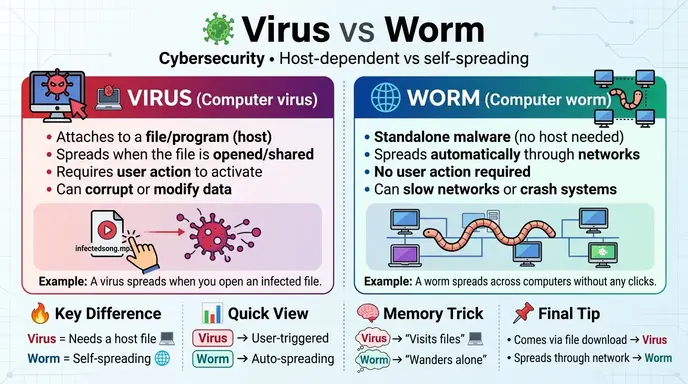
The difference between virus and worm is that a virus needs a host file or user action to spread, while a worm spreads automatically across systems without needing a host.
Many users get confused about the difference between virus and worm because both are types of malicious software that can harm computers and networks.
If you’ve ever wondered what is a virus vs worm, how they spread, or which one is more dangerous, this guide will clearly explain the difference between virus and worm in a simple and practical way.
⚡ Quick Answer: Difference Between Virus and Worm
- Virus: Requires a host file and user action to spread
- Worm: Self-replicates and spreads automatically
👉 Example: Opening an infected file spreads a virus, while a worm spreads through networks on its own.
📖 Definition of Difference Between Virus and Worm
- Computer Virus: A type of malicious program that attaches itself to files or programs and spreads when the infected file is executed.
- Computer Worm: A standalone malicious program that replicates itself and spreads automatically across networks without user interaction.
🔊 Pronunciation (US & UK)
- Virus: UK /ˈvaɪə.rəs/ | US /ˈvaɪ.rəs/
- Worm: UK /wɜːm/ | US /wɝːm/
Now let’s break it down clearly.
📊 Comparison Table: Virus vs Worm
| Feature | Virus | Worm | Explanation |
| Dependency | Needs host file | Independent | Core difference |
| Spread Method | User action required | Automatic spread | Behavior |
| Speed | Slower | Faster | Propagation |
| Target | Files/programs | Networks/systems | Focus |
| Activation | When file runs | Immediately active | Trigger |
| Damage Type | File corruption | Network overload | Impact |
| Visibility | Often hidden | Rapidly noticeable | Detection |
| Example Scenario | Email attachment | Network attack | Real use |
🔍 KEY DIFFERENCES EXPLAINED BETWEEN WORM AND VIRUS
1️⃣ Dependency
A virus needs a host file, a worm does not.
👉 Example: Virus attaches to programs
2️⃣ Spread Mechanism
Viruses require user action, worms spread automatically.
👉 Example: Clicking vs auto-spread
3️⃣ Speed of Spread
Worms spread much faster than viruses.
👉 Example: Network-wide infection
4️⃣ Activation
Viruses activate when executed, worms run on their own.
👉 Example: Manual vs automatic
5️⃣ Impact Area
Viruses affect files, worms impact networks.
👉 Example: Local vs widespread damage
6️⃣ Control Level
Viruses depend on users, worms act independently.
👉 Example: Human vs system-driven
💡 What Is the Difference Between Worm and Virus in Simple Words?
In simple words, a virus needs your action to spread, while a worm spreads by itself without you doing anything.
👉 Manual vs automatic infection.
🧠 Why Do Viruses and Worms Exist?
They exist as types of malicious software created for:
- Disrupting systems
- Stealing data
- Spreading damage
👉 Different methods, same harmful goal.
🌍 Difference Between Virus and Worm in Real Life
In real scenarios:
- A virus spreads when you open an infected file
- A worm spreads across networks without interaction
👉 Behavior is the key difference.
⚖️ DIFFERENCE + SIMILARITY TABLE
| Feature | Virus | Worm | Similarity |
| Type | Malware | Malware | Same category |
| Purpose | Harm systems | Harm systems | Same goal |
| Environment | Computers | Computers | Digital systems |
| Risk | Security threat | Security threat | Dangerous |
| Spread | Infection | Infection | Malicious activity |
| Control | Program-based | Program-based | Software threat |
This table clearly shows the difference and similarity between difference between virus and worm for quick understanding.
❌ Common Mistakes with Virus or Worm
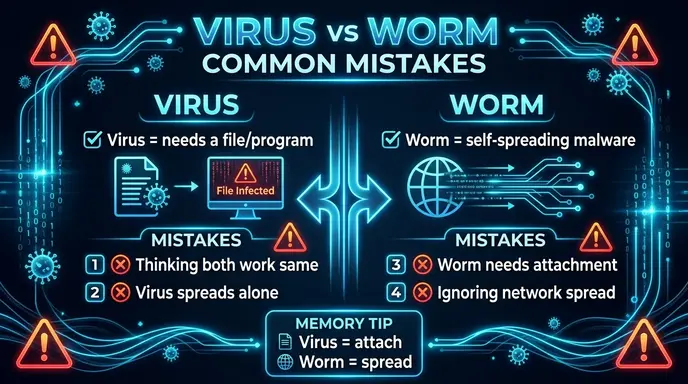
Thinking They Are the Same
❌ Virus and worm are identical.
✅ They differ in how they spread.
Spread mechanism is key.
Ignoring Automatic Spread
❌ Worms need user action.
✅ Worms spread automatically.
No user interaction needed.
Assuming All Malware Is a Virus
❌ Every malware is a virus.
✅ Worm is a different type of malware.
Different categories exist.
Underestimating Worm Damage
❌ Worms are harmless.
✅ Worms can crash entire networks.
Impact can be severe.
Confusing Infection Methods
❌ Both spread the same way.
✅ Viruses attach to files; worms spread independently.
Mechanism differs.
🌍 Real Life Examples with Difference Between Virus and Worm
1️⃣ Email Attachments
Virus spreads when opened
2️⃣ Network Attacks
Worm spreads across systems
3️⃣ File Corruption
Virus damages files
4️⃣ System Overload
Worm consumes network resources
🎯 WHEN TO USE EACH
Use virus when:
✔ Referring to file-based infections
✔ Talking about user-triggered malware
Use worm when:
✔ Referring to self-spreading malware
✔ Talking about network-based attacks
🤔 WHY PEOPLE GET CONFUSED IN DIFFERENCE BETWEEN VIRUS or WORM
- Both are malware
- Similar effects
- Overlapping terminology
- Lack of technical knowledge
⚙️ How Systems Understand Worm vs Virus
Modern platforms like Microsoft Windows, macOS, and enterprise security tools categorize threats based on behavior:
- Virus = file-based infection
- Worm = network-based self-replication
👉 This helps security systems detect and stop threats efficiently.
🧑💻 EXPERT INSIGHT
In real scenarios, the biggest mistake users make is treating all malware as viruses.
Security professionals distinguish worms as more dangerous in network environments because they can spread rapidly without user action. A single worm can infect thousands of systems in minutes if not controlled. Understanding this difference is crucial for effective cybersecurity practices.
👉 Key insight:
Virus spreads with help, worm spreads alone.
❓ FAQ about Worm and Virus
❓ What is the difference between virus and worm?
A virus needs user action to spread; a worm spreads automatically.
❓ Which is more dangerous?
Worms can spread faster and affect networks more widely.
❓ Do viruses need a host?
Yes, they attach to files or programs.
❓ Do worms need a host?
No, they are independent programs.
❓ Can both harm computers?
Yes, both are harmful types of malware.
❓ How do viruses spread?
Through infected files or programs.
❓ How do worms spread?
Through networks automatically.
❓ Are they still a threat today?
Yes, both remain cybersecurity threats.
🏁 Conclusion
The difference between virus and worm mainly lies in how they spread and operate. A virus requires a host file and user action to infect systems, while a worm is a self-contained program that spreads automatically across networks.
Understanding this difference helps you better protect your systems and recognize potential threats. In simple terms, viruses depend on user interaction, while worms act independently and spread rapidly.
Once you understand this, identifying and preventing these threats becomes much easier.
Discover More Articles:

Hi, I’m Nabeel Hassan. I love exploring interesting topics and explaining how different things compare with each other. Through my writing, I aim to provide clear, helpful, and easy to read explanations. I cover subjects related to learning, science, technology and general knowledge.