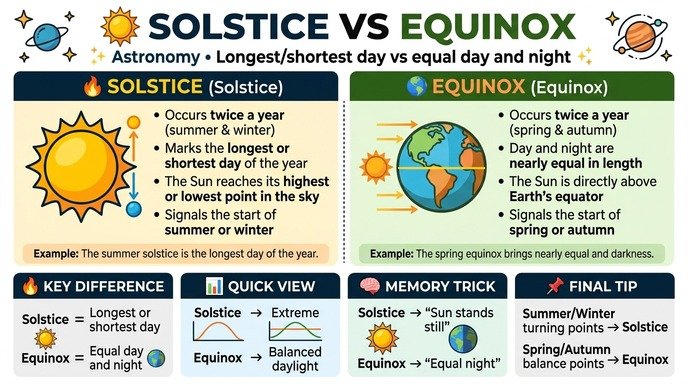
The difference between solstice and equinox is that a solstice occurs when the Sun reaches its highest or lowest point in the sky relative to Earth, resulting in the longest or shortest day of the year, while an equinox occurs when day and night are nearly equal in length worldwide.
Many people get confused about the difference between solstice and equinox because both are important astronomical events that mark seasonal changes. However, they differ in sunlight distribution, day length, and their position in Earth’s yearly orbit.
If you’ve ever wondered what is a solstice vs equinox, why seasons change, or how these events affect daylight, this guide will clearly explain the difference between solstice and equinox in simple and practical language.
⚡ Quick Answer: Difference Between Solstice and Equinox
- Solstice: Marks the longest or shortest day of the year
- Equinox: Marks the time when day and night are nearly equal
👉 Example: The summer solstice brings the longest day of the year, while the spring equinox brings nearly equal daylight and darkness.
📖 Definition of Solstice and Equinox
- Solstice: An astronomical event that occurs when one hemisphere of Earth is tilted most toward or away from the Sun.
- Equinox: An astronomical event that occurs when the Sun is positioned directly above Earth’s equator, making day and night nearly equal.
🔊 Pronunciation (US & UK)
- Solstice: UK /ˈsɒl.stɪs/ | US /ˈsɑːl.stɪs/
- Equinox: UK /ˈiː.kwɪ.nɒks/ | US /ˈiː.kwə.nɑːks/
Now let’s understand their differences clearly.
📊 Solstice vs Equinox Comparison Table
| Feature | Solstice | Equinox |
| Meaning | Longest or shortest day | Equal day and night |
| Occurs | Twice a year | Twice a year |
| Daylight Length | Maximum or minimum | Nearly equal worldwide |
| Sun Position | Furthest north or south | Directly above the equator |
| Seasonal Marker | Start of summer or winter | Start of spring or autumn |
| Earth’s Tilt Effect | Strongest effect | Balanced effect |
| Hemisphere Impact | Opposite seasons | Transition seasons |
| Astronomical Significance | Extreme daylight change | Equal daylight distribution |
🔍 KEY DIFFERENCES EXPLAINED BETWEEN SOLSTICE OR EQUINOX
☀️ Daylight Duration
A solstice produces the longest or shortest day of the year, while an equinox produces nearly equal hours of daylight and darkness.
👉 Example: Summer solstice usually has the most daylight hours.
🌎 Position of the Sun
During a solstice, the Sun appears furthest north or south of the equator. During an equinox, it appears directly above the equator.
👉 Example: The March equinox occurs when the Sun crosses the equator.
🍂 Seasonal Significance
Equinoxes mark the beginnings of spring and autumn, while solstices mark the beginnings of summer and winter.
👉 Example: The autumn equinox signals the start of fall in the Northern Hemisphere.
🌗 Balance of Day and Night
Equinoxes are associated with balanced daylight and darkness, while solstices represent the greatest imbalance.
👉 Example: Around an equinox, sunrise and sunset are closer to 12 hours apart.
🧭 Earth’s Tilt
Solstices occur when Earth’s tilt points most directly toward or away from the Sun. Equinoxes occur when the tilt is neither toward nor away.
👉 Example: Earth’s axial tilt creates both events.
🌍 Hemisphere Effects
During a solstice, one hemisphere experiences summer while the other experiences winter. During an equinox, both hemispheres experience seasonal transitions.
👉 Example: June brings summer in the Northern Hemisphere and winter in the Southern Hemisphere.
🤔 What Is the Difference Between Equinox and Solstice in Simple Words?
In simple words, a solstice is when daylight reaches its yearly maximum or minimum, while an equinox is when day and night are nearly equal in length.
👉 Solstice = longest or shortest day
👉 Equinox = equal day and night
🧠 Why Do People Compare Solstice and Equinox?
Both events help define Earth’s seasons.
Solstices are known for:
- Longest day
- Shortest day
- Summer and winter beginnings
- Extreme daylight changes
Equinoxes are known for:
- Equal daylight and darkness
- Spring and autumn beginnings
- Seasonal transitions
- Balanced sunlight
👉 Both are important markers in the yearly calendar.
🌍 Difference Between Solstice and Equinox in Real Life
In practical life:
- Summer solstice often brings the most daylight for outdoor activities.
- Winter solstice brings the least daylight.
- Spring equinox signals warming temperatures.
- Autumn equinox signals shorter days ahead.
👉 Many cultures celebrate both events with festivals and traditions.
⚖️ DIFFERENCE + SIMILARITY TABLE
| Feature | Solstice | Equinox | Similarity |
| Astronomical Event | Yes | Yes | Earth Sun relationship |
| Occurs Twice Yearly | Yes | Yes | Annual cycle |
| Marks Seasons | Yes | Yes | Seasonal changes |
| Based on Earth’s Tilt | Yes | Yes | Astronomy phenomenon |
| Affects Daylight | Yes | Yes | Sunlight changes |
| Observed Worldwide | Yes | Yes | Global event |
| Related to Orbit | Yes | Yes | Earth’s movement |
| Used in Calendars | Yes | Yes | Seasonal reference |
This table clearly shows the difference and similarity between difference between solstice and equinox for quick understanding.
❌ Common Mistakes with Solstice or Equinox
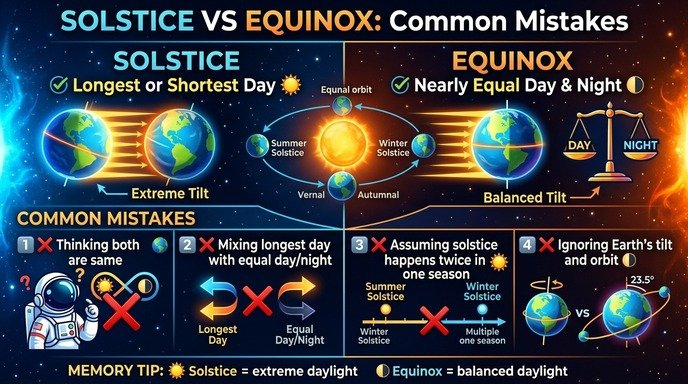
Thinking They Are the Same Event
❌ Solstice and equinox are identical.
✅ They describe different positions of Earth relative to the Sun.
Meaning matters.
Assuming Equinox Means Exactly 12 Hours Everywhere
❌ Every location receives exactly 12 hours of daylight during an equinox.
✅ Day and night are nearly equal but can vary slightly.
Small differences exist.
Confusing Summer Solstice with Hottest Day
❌ The summer solstice is always the hottest day of the year.
✅ Peak temperatures often occur later.
Seasonal lag matters.
Believing Solstices Cause Seasons Alone
❌ Solstices create seasons by themselves.
✅ Earth’s tilt throughout the year creates seasonal changes.
The process is ongoing.
Mixing Up Spring and Autumn Equinoxes
❌ Both equinoxes occur in the same season worldwide.
✅ Seasons are opposite in the two hemispheres.
Hemisphere location matters.
🏡 Real Life Examples with Solstice and Equinox
🌞 Summer Solstice
The longest day of the year occurs during the summer solstice.
❄️ Winter Solstice
The shortest day of the year occurs during the winter solstice.
🌸 Spring Equinox
Spring begins in many regions during the March equinox.
🍁 Autumn Equinox
Fall begins in many regions during the September equinox.
🎯 WHEN TO USE EACH
Use Solstice When:
✔ Referring to the longest day
✔ Referring to the shortest day
✔ Discussing summer or winter beginnings
✔ Talking about maximum daylight changes
Use Equinox When:
✔ Referring to equal day and night
✔ Discussing spring or autumn beginnings
✔ Talking about balanced sunlight
✔ Mentioning seasonal transitions
🤯 WHY PEOPLE GET CONFUSED IN SOLSTICE AND EQUINOX
- Both occur twice a year
- Both mark seasonal changes
- Both involve Earth’s orbit
- Both affect daylight patterns
⚙️ How Astronomers Understand Solstice vs Equinox
Astronomers distinguish them based on:
- Sun’s position relative to the equator
- Daylight duration
- Earth’s axial tilt
- Seasonal significance
👉 Solstices represent daylight extremes, while equinoxes represent daylight balance.
🧑🏫 EXPERT INSIGHT
In astronomy, solstices and equinoxes are among the most important markers of Earth’s annual journey around the Sun. Solstices occur when Earth’s tilt causes one hemisphere to receive the maximum or minimum amount of sunlight. Equinoxes occur when sunlight is distributed more evenly between the hemispheres.
One important insight many people overlook is that these events do not cause immediate temperature extremes. Because land and oceans take time to warm and cool, the hottest and coldest periods often occur weeks after the solstices.
👉 Key insight:
Solstices mark the longest and shortest days, while equinoxes mark nearly equal periods of daylight and darkness.
❓ FAQ:
❓ What is the difference between solstice and equinox?
A solstice marks the longest or shortest day of the year, while an equinox marks nearly equal day and night.
❓ How many solstices occur each year?
There are two solstices each year.
❓ How many equinoxes occur each year?
There are two equinoxes each year.
❓ Which event starts summer?
The summer solstice traditionally marks the beginning of summer.
❓ Which event starts spring?
The spring equinox traditionally marks the beginning of spring.
❓ Is day and night exactly equal during an equinox?
They are nearly equal, though slight variations may occur.
❓ Why do solstices happen?
They occur because of Earth’s axial tilt as it orbits the Sun.
❓ Are seasons opposite in the Southern Hemisphere?
Yes, when one hemisphere experiences summer, the other experiences winter.
🏁 Conclusion
The difference between solstice and equinox mainly comes down to daylight extremes versus daylight balance. A solstice occurs when Earth experiences its longest or shortest day of the year, while an equinox occurs when day and night are nearly equal in length.
Understanding this difference helps explain how Earth’s tilt and orbit create the changing seasons. In simple terms, solstices mark the extremes of daylight, while equinoxes mark the balance between light and darkness.
Once you understand how these astronomical events work, the difference between solstice and equinox becomes much easier to recognize.
Discover More Articles:

I’m Owen Parker, and I write articles that focus on explaining the differences between common concepts, tools, and ideas. I enjoy simplifying complex information and turning it into clear comparisons that anyone can understand. My work often covers science , education, technology, and everyday knowledge topics.