The difference between CapEx and OpEx is that CapEx refers to long term investments in assets or infrastructure, while OpEx refers to everyday operating expenses needed to run a business.
Many people get confused about the difference between CapEx and OpEx because both involve company spending and financial planning. However, they differ in purpose, accounting treatment, lifespan, and budgeting impact.
If you’ve ever wondered what is CapEx vs OpEx, which costs are capital expenses, or how businesses classify spending, this guide will clearly explain the difference between CapEx and OpEx in simple and practical language.
⚡ Quick Answer: Difference Between CapEx and OpEx
- CapEx (Capital Expenditure): Money spent on long term assets or major investments
- OpEx (Operating Expenditure): Money spent on daily business operations and routine expenses
👉 Example: Buying a new factory is CapEx, while paying monthly electricity bills is OpEx.
📖 Definition of CapEx and OpEx
- CapEx: Business spending used to purchase, upgrade, or maintain long term assets such as buildings, machinery, or equipment.
- OpEx: Ongoing business expenses required for daily operations, such as salaries, rent, utilities, and supplies.
🔊 Pronunciation (US & UK)
- CapEx: UK /ˈkæp.eks/ | US /ˈkæp.eks/
- OpEx: UK /ˈɒp.eks/ | US /ˈɑːp.eks/
Now let’s understand their differences clearly.
📊 CapEx vs OpEx Comparison Table
| Feature | CapEx | OpEx |
| Full Form | Capital Expenditure | Operating Expenditure |
| Purpose | Long term investment | Daily operations |
| Asset Ownership | Usually creates assets | Usually does not create assets |
| Time Benefit | Multi year benefit | Short term benefit |
| Accounting Treatment | Capitalized | Expensed immediately |
| Examples | Buildings, machinery | Salaries, rent |
| Budget Type | Investment budget | Operating budget |
| Financial Impact | Long term | Ongoing recurring costs |
🔍 KEY DIFFERENCES EXPLAINED BETWEEN OPEX OR CAPEX
🏢 Long Term vs Short Term Spending
CapEx involves investments expected to benefit the company for many years, while OpEx covers short term operational needs.
👉 Example: Purchasing office equipment is CapEx, while paying internet bills is OpEx.
📊 Accounting Treatment
CapEx costs are usually spread over time through depreciation or amortization, while OpEx is recorded as an expense immediately.
👉 Example: A company depreciates machinery over several years.
🏭 Asset Creation
CapEx often results in ownership of physical or long term assets. OpEx usually supports daily business functions without creating long term assets.
👉 Example: Buying land creates a company asset.
💰 Budget Planning
Businesses often plan CapEx carefully because it requires major investment decisions. OpEx is part of regular operating budgets.
👉 Example: Building a warehouse requires large capital planning.
⏳ Financial Lifespan
CapEx investments usually provide value over many years, while OpEx supports current operational activity.
👉 Example: Employee salaries help current business operations.
📈 Business Growth Impact
CapEx often supports expansion and infrastructure growth, while OpEx keeps existing operations running smoothly.
👉 Example: Opening a new manufacturing facility is CapEx.
🤔 What Is the Difference Between OpEx and CapEx in Simple Words?
In simple words, CapEx is money spent on long term business investments, while OpEx is money spent on everyday operating costs.
👉 CapEx = investment spending
👉 OpEx = operational spending
🧠 Why Are CapEx and OpEx Important?
Both are essential for business management and financial planning.
CapEx helps businesses:
- Expand operations
- Buy equipment
- Build infrastructure
- Increase long term capacity
OpEx helps businesses:
- Run daily operations
- Pay employees
- Cover utilities and rent
- Maintain workflow
👉 Healthy businesses balance both types of spending.
🌍 Difference Between CapEx and OpEx in Real Life
In practical business situations:
- A company buying trucks uses CapEx
- Fuel and driver wages are OpEx
- Software subscriptions are often OpEx, while custom systems may become CapEx
👉 The purpose and lifespan of spending determine classification.
⚖️ DIFFERENCE + SIMILARITY TABLE
| Feature | CapEx | OpEx | Similarity |
| Business Expense | Yes | Yes | Company spending |
| Financial Planning Needed | Yes | Yes | Budget management |
| Affects Profitability | Yes | Yes | Financial impact |
| Recorded in Accounting | Yes | Yes | Accounting importance |
| Supports Business Operations | Yes | Yes | Company function |
| Impacts Cash Flow | Yes | Yes | Financial management |
| Used by Businesses | Yes | Yes | Corporate finance |
| Requires Budget Allocation | Yes | Yes | Expense control |
This table clearly shows the difference and similarity between difference between CapEx and OpEx for quick understanding.
❌ Common Mistakes with CapEx or OpEx
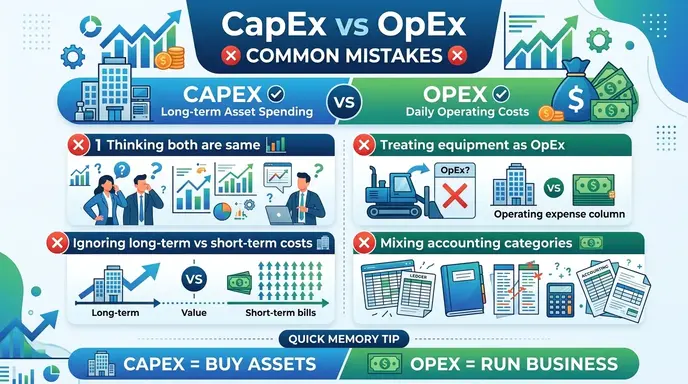
Thinking All Business Expenses Are OpEx
❌ Every company expense is operational spending.
✅ Long term investments are usually CapEx.
Asset lifespan matters.
Confusing Asset Purchases with Daily Costs
❌ Buying machinery is OpEx.
✅ Machinery purchases are typically CapEx.
Ownership matters.
Ignoring Depreciation Rules
❌ CapEx is always expensed immediately.
✅ CapEx is often depreciated over time.
Accounting treatment differs.
Assuming CapEx Is Better Than OpEx
❌ CapEx is always financially superior.
✅ Both serve important business purposes.
Business needs vary.
Misclassifying Technology Costs
❌ All software costs are classified the same way.
✅ Some software spending may fall under CapEx or OpEx depending on usage and structure.
Classification can vary.
🏡 Real Life Examples with CapEx and OpEx
🏭 Building a Factory
Constructing a factory is a CapEx investment.
💡 Paying Utility Bills
Electricity and water bills are OpEx expenses.
🚚 Purchasing Company Vehicles
Buying delivery trucks is CapEx.
👨💼 Employee Salaries
Monthly payroll expenses are OpEx.
🎯 WHEN TO USE EACH
Use CapEx When:
✔ Discussing long term investments
✔ Referring to asset purchases
✔ Talking about infrastructure growth
✔ Explaining capital budgeting
Use OpEx When:
✔ Discussing daily business expenses
✔ Referring to operating costs
✔ Talking about recurring payments
✔ Explaining routine operations
🤯 WHY PEOPLE GET CONFUSED IN CAPEX AND OPEX
- Both involve business spending
- Both affect company finances
- Some expenses may overlap
- Accounting treatment can be complex
⚙️ How Financial Experts Understand CapEx vs OpEx
Financial professionals separate these expenses based on:
- Asset lifespan
- Ownership value
- Accounting treatment
- Business purpose
👉 Long term value usually signals CapEx, while routine operational support signals OpEx.
🧑💼 EXPERT INSIGHT
In real business finance, the distinction between CapEx and OpEx is extremely important because it affects taxation, budgeting, profitability, and long term planning. Companies often evaluate whether spending should create a long term asset or simply support current operations.
One important insight many beginners overlook is that CapEx can improve future growth potential but often requires larger upfront investment and longer financial commitment. Meanwhile, OpEx provides operational flexibility because businesses can adjust recurring expenses more easily.
👉 Key insight:
CapEx builds long term business assets, while OpEx keeps daily business operations running.
❓ FAQ:
❓ What is the difference between CapEx and OpEx?
CapEx involves long term investments in assets, while OpEx covers daily operating expenses.
❓ Is buying equipment CapEx or OpEx?
Buying long term equipment is usually CapEx.
❓ Are salaries considered OpEx?
Yes, employee salaries are typically operating expenses.
❓ Why is CapEx depreciated?
Because the asset provides value over multiple years.
❓ Can software be CapEx?
Sometimes yes, depending on ownership and implementation.
❓ Which affects daily operations more?
OpEx directly supports everyday business activities.
❓ Does CapEx help business growth?
Yes, CapEx often supports expansion and infrastructure improvement.
❓ Why do businesses track CapEx separately?
Because it affects long term financial planning and accounting differently.
🏁 Conclusion
The difference between CapEx and OpEx mainly comes down to long term investment versus daily operational spending. CapEx focuses on purchasing or improving assets that provide long term value, while OpEx supports routine business operations and recurring expenses.
Understanding this difference helps businesses manage budgets, accounting, growth strategies, and financial planning more effectively. In simple terms, CapEx builds the business for the future, while OpEx keeps the business running today.
Once you understand how companies classify spending, the difference between CapEx and OpEx becomes much easier to recognize.
Discover More Articles:

Hi, I’m Nabeel Hassan. I love exploring interesting topics and explaining how different things compare with each other. Through my writing, I aim to provide clear, helpful, and easy to read explanations. I cover subjects related to learning, science, technology and general knowledge.