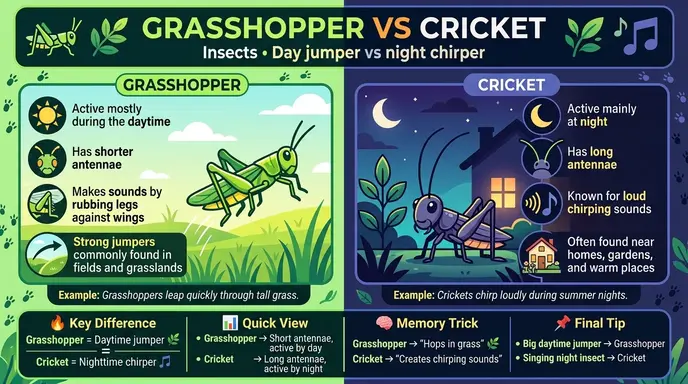
The difference between grasshopper and cricket is that grasshoppers are usually active during the day with shorter antennae and stronger jumping legs, while crickets are mostly active at night and have much longer antennae.
Many people get confused about the difference between grasshopper and cricket because both are jumping insects that belong to similar insect groups. However, they differ in appearance, behavior, sound production, habitat, and activity patterns.
If you’ve ever wondered what is a grasshopper vs cricket, which insect chirps at night, or how to identify them, this guide will clearly explain the difference between grasshopper and cricket in simple and practical language.
⚡ Quick Answer: Difference Between Grasshopper and Cricket
- Grasshopper: Day active insect with short antennae and strong jumping ability
- Cricket: Night active insect with long antennae and chirping sounds
👉 Example: If you hear chirping at night, it is more likely a cricket.
📖 Definition of Grasshopper and Cricket
- Grasshopper: A plant eating jumping insect known for its powerful hind legs and daytime activity.
- Cricket: A jumping insect recognized for long antennae and chirping sounds produced mainly at night.
🔊 Pronunciation (US & UK)
- Grasshopper: UK /ˈɡrɑːsˌhɒp.ə/ | US /ˈɡræsˌhɑː.pɚ/
- Cricket: UK /ˈkrɪk.ɪt/ | US /ˈkrɪk.ɪt/
Now let’s understand their differences clearly.
📊 Grasshopper vs Cricket Comparison Table
| Feature | Grasshopper | Cricket |
| Antennae | Shorter | Longer |
| Activity Time | Mostly daytime | Mostly nighttime |
| Body Color | Usually green or brown | Often brown or black |
| Sound | Less noticeable | Loud chirping |
| Diet | Mostly plants | Plants and small insects |
| Jumping Ability | Very strong | Strong |
| Habitat | Fields and grasslands | Gardens, soil, and dark areas |
| Wings | Often larger | Usually flatter |
🔍 KEY DIFFERENCES EXPLAINED BETWEEN GRASSHOPPER OR CRICKET
📡 Antennae Length
One of the easiest ways to identify them is by antennae length.
👉 Grasshoppers have relatively short antennae.
👉 Crickets have very long antennae, often longer than their bodies.
This is one of the clearest physical differences.
🌞 Day vs Night Activity
Grasshoppers are mostly active during the day.
Crickets are generally nocturnal and become active at night.
👉 Night chirping is commonly associated with crickets.
🎵 Sound Production
Crickets are famous for producing chirping sounds by rubbing their wings together.
Grasshoppers can make sounds too, but they are usually less noticeable.
👉 Cricket chirping is often heard in quiet evenings.
🦵 Jumping Ability
Both insects jump using powerful hind legs, but grasshoppers are especially known for long distance jumping.
👉 Grasshoppers can quickly escape predators by leaping away.
🌿 Habitat
Grasshoppers are commonly found in grassy fields and open vegetation.
Crickets often hide in soil, under rocks, or near dark moist areas.
👉 Habitat location can help identify the insect.
🍽️ Diet
Grasshoppers mainly eat plants and grasses.
Crickets eat plants but may also consume smaller insects and organic material.
👉 Crickets generally have a more varied diet.
🤔 What Is the Difference Between Grasshopper and Cricket in Simple Words?
In simple words, grasshoppers are daytime insects with short antennae, while crickets are nighttime insects with long antennae and loud chirping sounds.
👉 Grasshopper = short antennae
👉 Cricket = long antennae
🧠 Why Do People Confuse Grasshopper and Cricket?
Both insects:
- Jump using hind legs
- Belong to similar insect groups
- Have wings
- Produce sounds in some species
Main Difference:
- Grasshoppers are mostly active during the day
- Crickets are mostly active at night
👉 Their similar body shape causes confusion.
🌍 Difference Between Cricket and Grasshopper in Real Life
In practical observation:
- Grasshoppers are often seen jumping through grass during the daytime.
- Crickets are commonly heard chirping at night.
- Crickets may hide indoors or in dark places.
👉 Time of activity is often the easiest clue.
⚖️ DIFFERENCE + SIMILARITY TABLE
| Feature | Grasshopper | Cricket | Similarity |
| Insect | Yes | Yes | Arthropod |
| Jumping Legs | Yes | Yes | Powerful hind legs |
| Wings | Yes | Yes | Winged insects |
| Produce Sounds | Yes | Yes | Communication behavior |
| Egg Laying | Yes | Yes | Insect reproduction |
| Exoskeleton | Yes | Yes | Hard outer body |
| Found Outdoors | Yes | Yes | Natural habitats |
| Belong to Orthoptera | Yes | Yes | Related insect order |
This table clearly shows the difference and similarity between difference between grasshopper and cricket for quick understanding.
❌ Common Mistakes with Grasshopper or Cricket
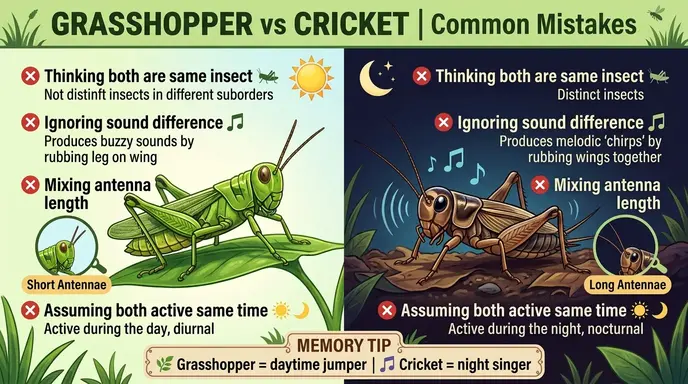
Thinking They Are the Same Insect
❌ Grasshoppers and crickets are identical.
✅ They are different types of insects with distinct characteristics.
Ignoring Antennae Length
❌ Antennae do not matter for identification.
✅ Antennae length is one of the easiest ways to tell them apart.
Assuming All Chirping Comes from Grasshoppers
❌ Grasshoppers create most nighttime chirping sounds.
✅ Crickets are the insects most associated with nighttime chirping.
Confusing Day and Night Activity
❌ Both insects behave the same throughout the day.
✅ Grasshoppers are mainly daytime insects, while crickets are mostly nocturnal.
Believing All Species Look the Same
❌ Every grasshopper and cricket species appears identical.
✅ Different species vary in size, color, and habitat.
🏡 Real Life Examples with Grasshopper and Cricket
🌾 Grasshopper in Fields
Grasshoppers are commonly seen jumping through tall grass.
🌙 Cricket Chirping at Night
Crickets often produce chirping sounds during warm evenings.
🪴 Garden Areas
Crickets may hide under rocks, leaves, or soil.
🦗 Agricultural Environments
Grasshoppers can sometimes damage crops and vegetation.
🎯 WHEN TO USE EACH
Use Grasshopper When:
✔ Referring to short antenna jumping insects
✔ Discussing daytime insect activity
✔ Talking about grassland insects
Use Cricket When:
✔ Referring to long antenna insects
✔ Discussing chirping sounds at night
✔ Talking about nocturnal jumping insects
🤯 WHY PEOPLE GET CONFUSED IN GRASSHOPPER AND CRICKET
- Similar body shape
- Both jump
- Both have wings
- Both belong to related insect groups
⚙️ How Entomologists Understand Grasshopper vs Cricket
Scientists distinguish them based on:
- Antennae length
- Activity patterns
- Sound production
- Body structure
- Feeding behavior
👉 Although related, they belong to different branches within the Orthoptera order.
🧑🔬 EXPERT INSIGHT
Entomologists classify grasshoppers and crickets as related insects with different evolutionary adaptations. Grasshoppers evolved for daytime movement in open grassy habitats, while crickets adapted to more hidden and nighttime environments with stronger sound based communication.
One important insight many people overlook is that cricket chirping is often influenced by temperature. Some species chirp faster during warmer conditions, making their sounds useful for studying environmental behavior.
👉 Key insight:
The easiest way to distinguish them is by antennae length and activity time—grasshoppers usually have short antennae and are active during the day, while crickets have long antennae and are active at night.
❓ FAQ:
❓ What is the difference between grasshopper and cricket?
Grasshoppers usually have short antennae and daytime activity, while crickets have long antennae and chirp mostly at night.
❓ Which insect chirps at night?
Crickets are most commonly associated with nighttime chirping.
❓ Do grasshoppers have long antennae?
No, grasshoppers generally have shorter antennae than crickets.
❓ Are both insects able to jump?
Yes, both use powerful hind legs for jumping.
❓ Which insect is more active during the day?
Grasshoppers are mainly active during the daytime.
❓ Do crickets bite?
Most crickets are harmless to humans.
❓ Are grasshoppers and crickets related?
Yes, both belong to the Orthoptera insect order.
❓ Which insect is commonly found in grass fields?
Grasshoppers are commonly found in grassy environments.
🏁 Conclusion
The difference between grasshopper and cricket mainly comes down to antennae length, activity patterns, sound production, and habitat preferences. Grasshoppers are usually daytime insects with short antennae and strong jumping ability, while crickets are mostly nighttime insects known for long antennae and chirping sounds.
Understanding these distinctions makes identification much easier. In simple terms, grasshoppers are day active field insects, while crickets are night active chirping insects.
Once you learn their key physical and behavioral differences, the difference between grasshopper and cricket becomes easy to recognize.
Discover More Articles:

Hi, I’m Nabeel Hassan. I love exploring interesting topics and explaining how different things compare with each other. Through my writing, I aim to provide clear, helpful, and easy to read explanations. I cover subjects related to learning, science, technology and general knowledge.