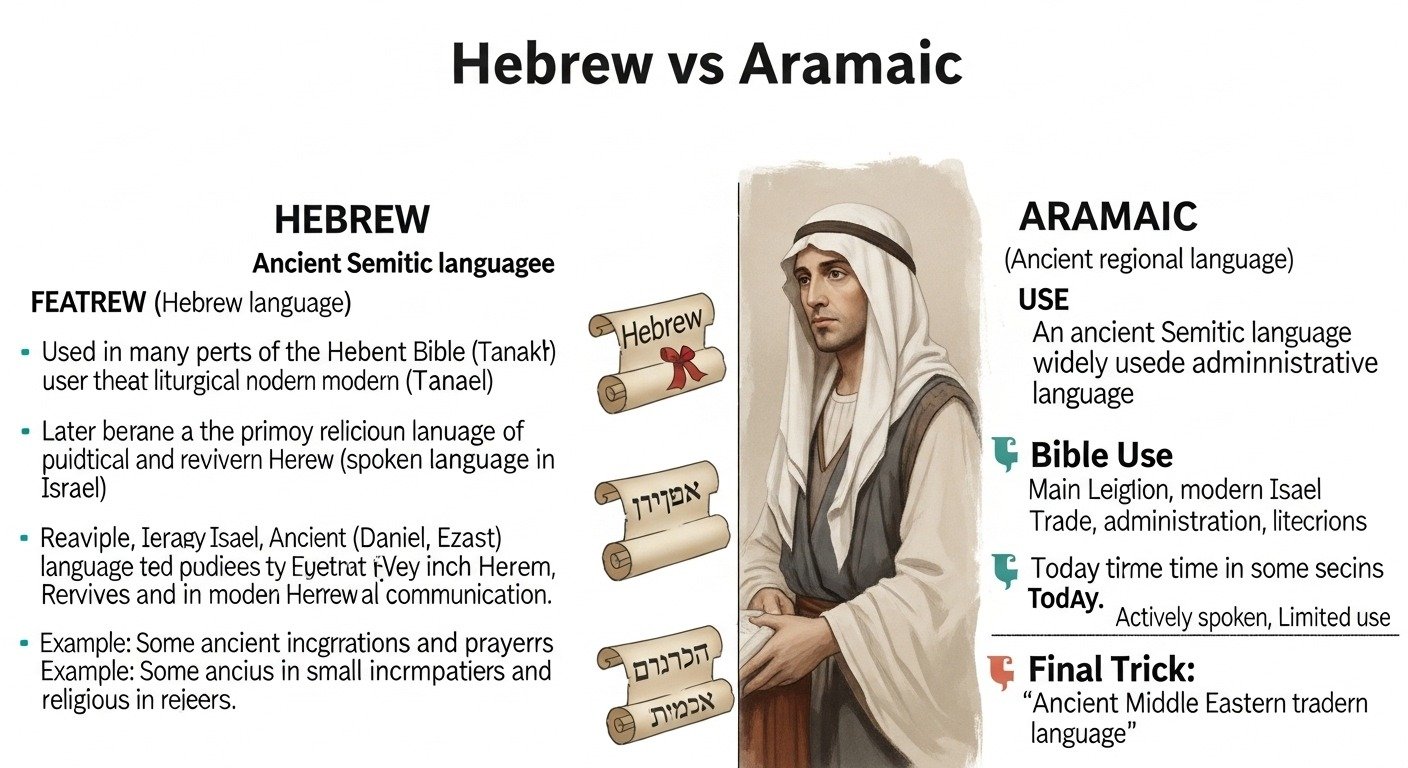
The difference between Hebrew and Aramaic is mainly based on their origin, usage, and historical role.
Both are ancient Semitic languages that were widely used in the Middle East and are closely related, but they served different communities and purposes.
Hebrew was primarily the language of the ancient Israelites and later became the language of Jewish religious tradition, while Aramaic was a common international language used across many ancient empires.
Understanding the difference between Hebrew and Aramaic helps in studying history, religion, and ancient texts.
🏛️ Key Difference Between the Both
The main difference lies in usage and spread.
- Hebrew: Sacred and cultural language of the Jewish people
- Aramaic: Common trade and communication language of ancient empires
Examples:
- Hebrew is used in Jewish prayers and Israel today.
- Aramaic was used across Mesopotamia and ancient kingdoms.
📜 Why Is Their Difference Important?
Understanding the difference between Hebrew and Aramaic is important for interpreting ancient scriptures, historical documents, and religious texts like the Bible. Parts of the Old Testament and many Jewish writings contain both languages. Knowing the difference between Hebrew and Aramaic helps scholars correctly understand meaning and context.
🔊 Pronunciation (US & UK)
| Language | US Pronunciation | UK Pronunciation |
| Hebrew | /ˈhiː.bruː/ | /ˈhiː.bruː/ |
| Aramaic | /ˌær.əˈmeɪ.ɪk/ | /ˌær.əˈmeɪ.ɪk/ |
➡️ Now let’s explore the detailed difference between Hebrew and Aramaic step by step.
🌐 Difference Between Hebrew and Aramaic
1️⃣ Origin
Hebrew originated in ancient Israel.
Aramaic originated in ancient Syria and Mesopotamia.
Examples:
- Hebrew developed among Israelites.
- Aramaic spread through empires.
2️⃣ Historical Usage
Hebrew was mainly used by Jewish people.
Aramaic was widely used as a regional lingua franca.
Examples:
- Hebrew for religious texts.
- Aramaic for trade and communication.
3️⃣ Script
Both use similar alphabets, but with differences.
Hebrew: Hebrew script
Aramaic: Aramaic script (influenced many later alphabets)
Examples:
- Hebrew letters are still used today.
- Aramaic script influenced Arabic and others.
4️⃣ Modern Usage
Hebrew is still a living language today.
Aramaic is mostly extinct but still used in small communities.
Examples:
- Hebrew is spoken in Israel.
- Aramaic survives in liturgy and villages.
5️⃣ Religious Importance
Hebrew is central to Judaism.
Aramaic appears in parts of the Bible and Talmud.
Examples:
- Hebrew used in Torah.
- Aramaic used in sections of Daniel and Ezra.
6️⃣ Grammar Structure
Hebrew has a more structured modern grammar.
Aramaic has simpler and older grammatical forms.
Examples:
- Hebrew evolved over time.
- Aramaic remained closer to ancient forms.
7️⃣ Geographic Spread
Hebrew was limited mainly to Israel region.
Aramaic spread across the Middle East.
Examples:
- Hebrew stayed regional.
- Aramaic became international language.
8️⃣ Cultural Role
Hebrew represents identity and tradition.
Aramaic represents communication and diplomacy.
Examples:
- Hebrew for culture and religion.
- Aramaic for empire communication.
9️⃣ Alphabet Influence
Hebrew alphabet is still in use today.
Aramaic alphabet influenced many modern writing systems.
Examples:
- Hebrew letters remain unchanged.
- Aramaic influenced Arabic and Syriac scripts.
🔟 Survival Today
Hebrew is fully revived and widely spoken.
Aramaic survives only in small religious and ethnic groups.
Examples:
- Hebrew is official language of Israel.
- Aramaic is rarely spoken today.
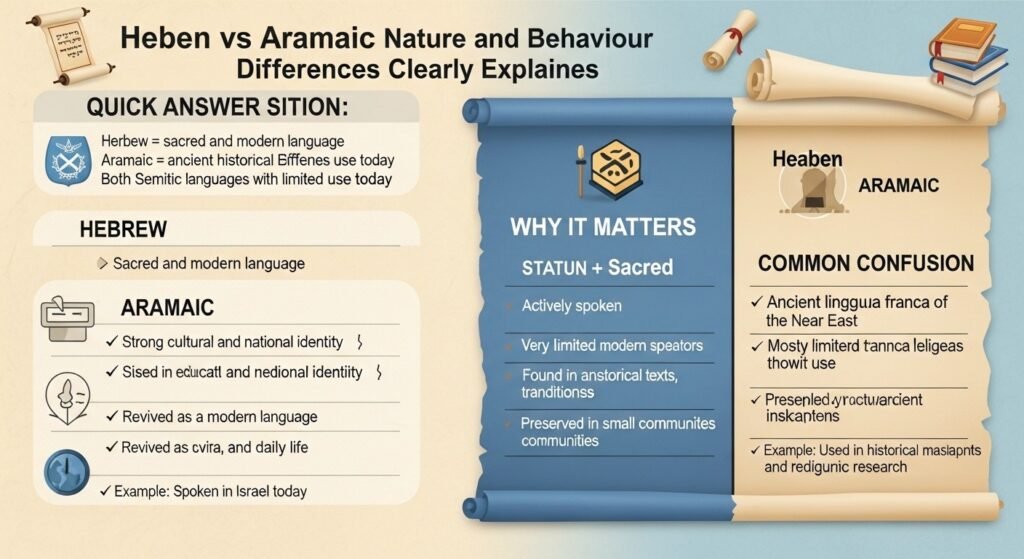
🧠 Nature and Behaviour of Both Hebrew and Aramaic
Hebrew
- Sacred and modern language
- Still actively spoken
- Strong cultural identity
Aramaic
- Ancient lingua franca
- Mostly historical use
- Limited modern speakers
📊 Comparison Chart
🏛️ Difference Between Hebrew and Aramaic
| Feature | Hebrew 🇮🇱 | Aramaic 🏺 |
| Origin | Ancient Israel | Ancient Mesopotamia |
| Usage | Religious & modern | Historical communication |
| Status Today | Living language | Mostly extinct |
| Script | Hebrew alphabet | Aramaic script |
| Religion | Judaism central | Appears in Bible texts |
| Spread | Regional | Wide ancient empire use |
| Grammar | Modern structured | Ancient simplified |
| Speakers | Millions | Very few |
| Role | Identity language | Trade/diplomacy |
| Importance | High today | Historical importance |
⚖️ Which Is More Important?
Hebrew is more important today because it is a living, widely used language.
Aramaic is more important historically for understanding ancient texts.
🎭 Use in Metaphors and Similes
Metaphor example:
- Hebrew is a living bridge to the present, while Aramaic is a window into the ancient past.
Simile example:
- Hebrew is like a living tree, while Aramaic is like ancient roots.
💬 Connotative Meaning
| Language | Connotation | Example |
| Hebrew | Living tradition | It feels like a modern Hebrew identity. |
| Aramaic | Ancient heritage | It sounds like ancient Aramaic history. |
🗣️ Expressions
- Biblical Hebrew texts
- Aramaic inscriptions
- Ancient Semitic languages
📚 Historical Context
Both languages are part of the Semitic language family and are crucial for understanding ancient Near Eastern history and religious scriptures.
❔ Frequently Asked Questions
1. Are Hebrew and Aramaic the same?
No, they are related but different languages.
2. Which is older?
Aramaic is slightly older in widespread use.
3. Is Hebrew still spoken?
Yes, it is the official language of Israel.
4. Is Aramaic still spoken?
Only in small communities.
5. Why are both important?
They are key to understanding ancient religious texts.
🌍 Importance in History and Religion
Understanding the difference between Hebrew and Aramaic is essential for studying the Bible, ancient history, and linguistic development in the Middle East.
✍️ Final Words
The difference between Hebrew and Aramaic lies in their role and survival. Hebrew is a living, evolving language of Jewish identity, while Aramaic is an ancient language that shaped communication in early civilizations.
🏁 Conclusion
Knowing the difference between Hebrew and Aramaic helps in understanding history, religion, and language evolution. Hebrew continues to thrive today, while Aramaic remains a key part of ancient heritage.
Discover More Articles:

I’m Owen Parker, and I write articles that focus on explaining the differences between common concepts, tools, and ideas. I enjoy simplifying complex information and turning it into clear comparisons that anyone can understand. My work often covers science , education, technology, and everyday knowledge topics.