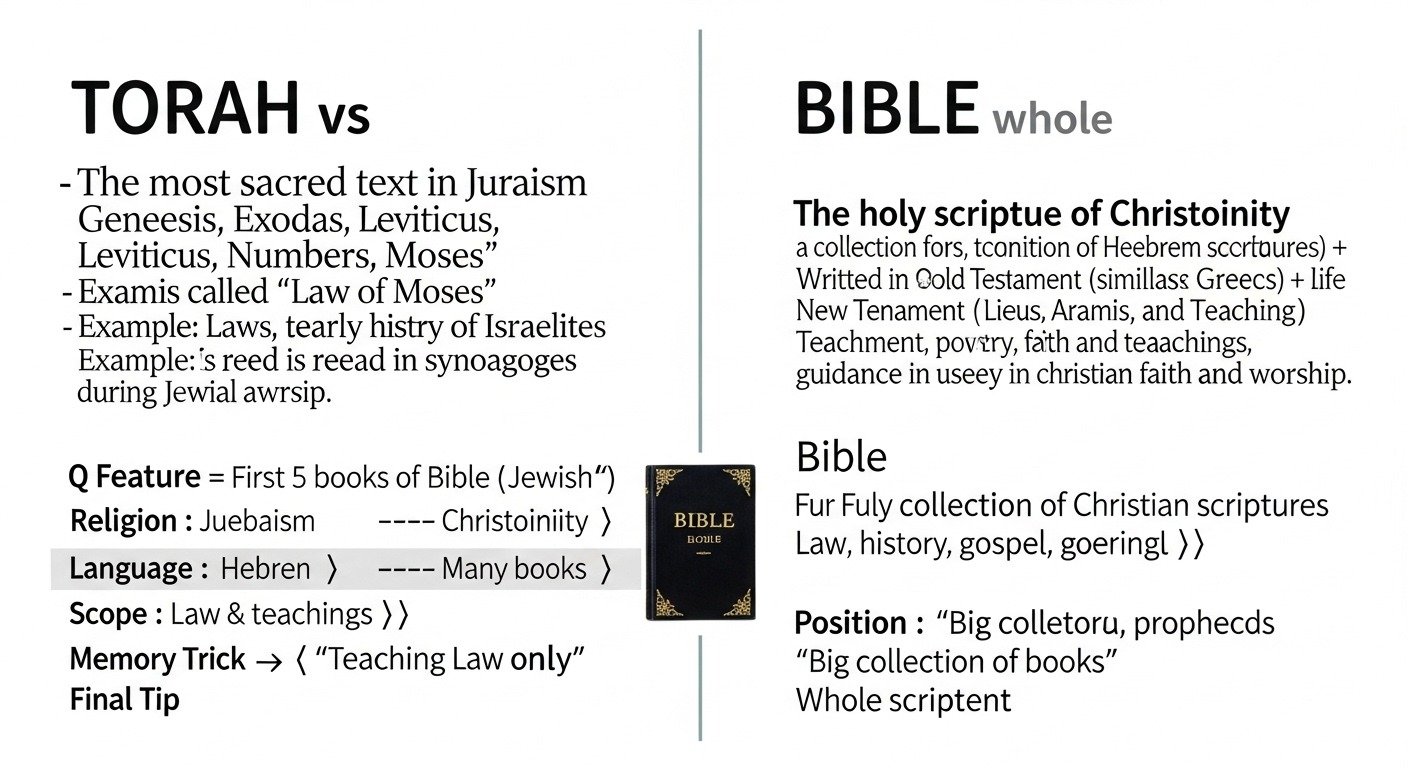
The difference between Torah and Bible is mainly about scope, structure, and religious tradition.
The Torah is the central sacred text of Judaism, while the Bible is a broader collection of sacred scriptures used in Christianity (and partly in Judaism in a different form).
Understanding the difference between Torah and Bible helps in studying religion, history, and theology more clearly. In simple terms, the Torah is a part of a larger tradition, while the Bible is a complete religious library.
📜 Key Difference Between the Both
The main difference lies in size and religious context.
- Torah: First and most sacred part of Jewish scripture
- Bible: Entire collection of sacred texts in Christianity
Examples:
- Torah contains foundational laws and teachings.
- Bible includes Old Testament + New Testament.
✡️ Why Is Their Difference Important?
Understanding the difference between Torah and Bible is important for religious studies, cultural understanding, and historical interpretation. Both texts are deeply connected but serve different religious communities. Knowing the difference between Torah and Bible helps avoid confusion when studying Judaism and Christianity.
🔊 Pronunciation (US & UK)
| Term | US Pronunciation | UK Pronunciation |
| Torah | /ˈtɔːr.ə/ | /ˈtɔːr.ə/ |
| Bible | /ˈbaɪ.bəl/ | /ˈbaɪ.bəl/ |
➡️ Now let’s explore the detailed difference between Torah and Bible step by step.
🌐 Difference Between Torah and Bible
1️⃣ Definition
Torah is the central sacred text of Judaism.
Bible is the holy scripture of Christianity.
Examples:
- Torah = teachings of Moses
- Bible = collection of many books
2️⃣ Composition
Torah consists of five books (Pentateuch).
Bible contains many books divided into Old and New Testaments.
Examples:
- Torah: Genesis, Exodus, Leviticus, Numbers, Deuteronomy
- Bible: 66 books (Protestant), more in other traditions
3️⃣ Religion
Torah is sacred in Judaism.
Bible is sacred in Christianity.
Examples:
- Jews follow Torah.
- Christians follow Bible.
4️⃣ Language
Torah is written in Hebrew.
Bible is written in Hebrew, Aramaic, and Greek (depending on section).
Examples:
- Torah = Hebrew only
- Bible = multiple languages
5️⃣ Structure
Torah is a single unified text.
Bible is a collection of books.
Examples:
- Torah = one scroll tradition
- Bible = library of scriptures
6️⃣ Content Focus
Torah focuses on laws, history, and commandments.
Bible includes laws, history, teachings, prophecy, and Jesus’ life.
Examples:
- Torah = law of Moses
- Bible = life of Jesus + teachings
7️⃣ Time Period
Torah describes early history of Israelites.
Bible covers a wider historical timeline.
Examples:
- Torah = ancient beginnings
- Bible = ancient + early Christian era
8️⃣ Religious Role
Torah is the foundation of Jewish law (Halakha).
Bible is the foundation of Christian belief.
Examples:
- Torah guides Jewish law
- Bible guides Christian faith
9️⃣ Structure Expansion
Torah is part of a larger Jewish scripture (Tanakh).
Bible includes Old Testament (similar to Tanakh) + New Testament.
Examples:
- Torah = 1st section of Tanakh
- Bible = expanded Christian canon
🔟 Usage in Worship
Torah is read in synagogues.
Bible is read in churches.
Examples:
- Torah scrolls are physically read
- Bible is read in services and study
🧠 Nature and Behaviour of Both Torah and Bible
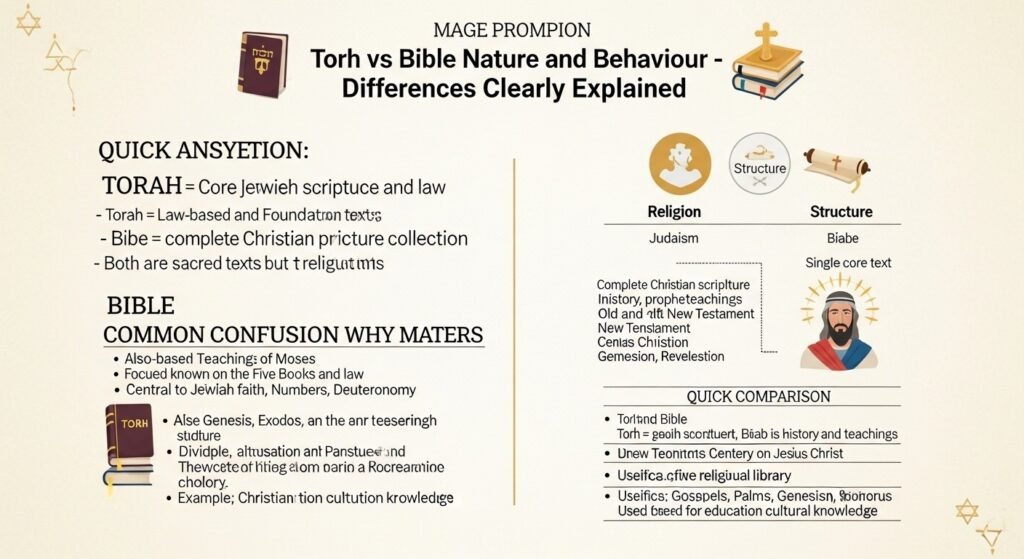
Torah
- Core Jewish scripture
- Law-based and foundational
- Focused on teachings of Moses
Bible
- Complete Christian scripture
- Includes history, prophecy, teachings
- Centers on Jesus Christ in New Testament
📊 Comparison Chart
📜 Difference Between Torah and Bible
| Feature | Torah ✡️ | Bible ✝️ |
| Religion | Judaism | Christianity |
| Scope | 5 books | Many books |
| Structure | Single collection | Old + New Testament |
| Language | Hebrew | Hebrew, Greek, Aramaic |
| Focus | Law & commandments | Faith, history, salvation |
| Role | Foundation of Judaism | Foundation of Christianity |
| Usage | Synagogue reading | Church reading |
| Content | Laws of Moses | Life of Jesus + more |
| Size | Smaller | Larger |
| Status | Central text | Complete scripture |
⚖️ Which Is More Important?
- Torah is more important within Judaism as the core law.
- Bible is more comprehensive within Christianity as full scripture.
Both are equally important within their own religions.
🎭 Use in Metaphors and Similes
Metaphor example:
- The Torah is the root of a tree, while the Bible is the full-grown tree with branches.
Simile example:
- The Torah is like a foundation stone, while the Bible is like a complete building.
💬 Connotative Meaning
| Term | Connotation | Example |
| Torah | Law, foundation | It felt like ancient divine law. |
| Bible | Guidance, salvation | It felt like a complete spiritual guide. |
🗣️ Expressions
- Study the Torah
- Read the Bible
- Biblical teachings
- Torah laws
📚 Religious Context
Both texts are central to Abrahamic religions and are studied in theology, history, and philosophy around the world.
❔ Frequently Asked Questions
1. Is Torah part of the Bible?
The Torah is not part of the Christian Bible but corresponds to the Old Testament section.
2. How many books are in the Torah?
Five books.
3. How many books are in the Bible?
Around 66 (Protestant version), more in others.
4. Who uses the Torah?
Jewish people.
5. Who uses the Bible?
Christians.
🌍 Importance in Religion and History
Understanding the difference between Torah and Bible is essential for studying Judaism, Christianity, and the historical development of religious texts.
✍️ Final Words
The difference between Torah and Bible is based on scope and religion. The Torah is the core Jewish scripture, while the Bible is a broader Christian collection of sacred writings.
🏁 Conclusion
Knowing the difference between Torah and Bible helps in understanding religious traditions and their sacred texts. The Torah is the foundation of Jewish law, while the Bible is the complete scripture of Christianity.
Discover More Articles:

I’m Owen Parker, and I write articles that focus on explaining the differences between common concepts, tools, and ideas. I enjoy simplifying complex information and turning it into clear comparisons that anyone can understand. My work often covers science , education, technology, and everyday knowledge topics.