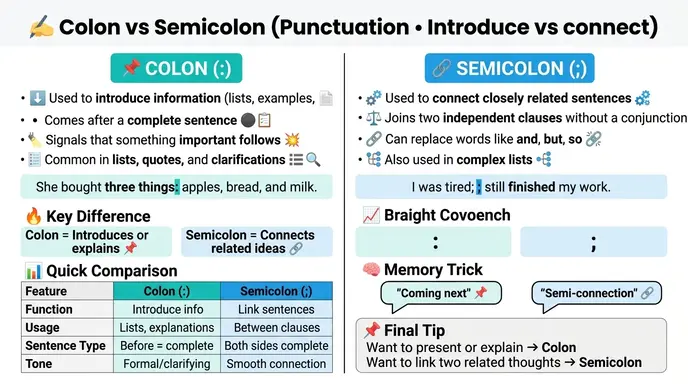
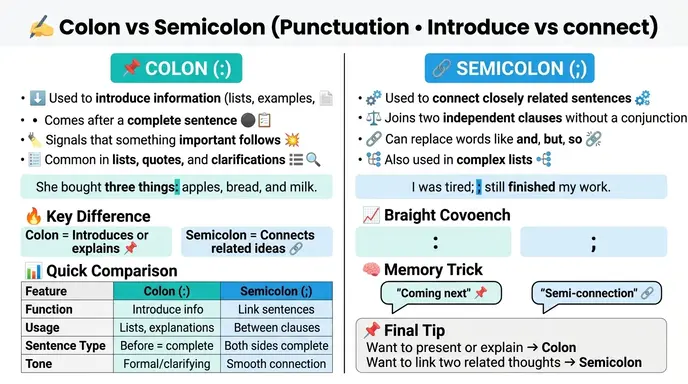
The difference between colon and semicolon is that a colon introduces or explains something, while a semicolon connects closely related independent sentences.
Many writers get confused about the difference between colon and semicolon because both are used to link ideas but serve different purposes in writing.
If you’ve ever wondered what is colon vs semicolon, when to use each, or how to avoid mistakes, this guide will clearly explain the difference between colon and semicolon in a simple and practical way.
⚡ Quick Answer: Difference Between Colon and Semicolon
- Colon (:) Introduces information, lists, or explanations
- Semicolon (;) Connects related sentences without a conjunction
👉 Example:
- I need three things: water, food, and rest.
- I was tired; I still finished my work.
📖 Definition of Difference Between Colon and Semicolon
- Colon (:): A punctuation mark used to introduce a list, explanation, or emphasis after a complete sentence.
- Semicolon (;): A punctuation mark used to link two closely related independent clauses or separate complex list items.
🔊 Pronunciation (US & UK)
- Colon: UK /ˈkəʊ.lɒn/ | US /ˈkoʊ.lən/
- Semicolon: UK /ˌsem.iˈkəʊ.lɒn/ | US /ˌsem.iˈkoʊ.lən/
Now let’s break it down clearly.
📊 Comparison Table: Colon vs Semicolon
| Feature | Colon (:) | Semicolon (;) | Explanation |
| Function | Introduces info | Connects sentences | Core difference |
| Use Case | Lists, explanations | Related clauses | Purpose |
| Sentence Requirement | Must follow complete clause | Connects two complete clauses | Grammar rule |
| Tone | Emphasis | Balance | Writing effect |
| Replacement | Can replace “such as” | Can replace “and/but” | Flexibility |
| Common Use | Lists, quotes | Complex sentences | Practical use |
| Pause Level | Strong pause | Medium pause | Reading flow |
| Example | She said this: be ready. | I came early; she was late. | Usage |
🔍 KEY DIFFERENCES EXPLAINED BETWEEN COLON AND SEMICOLON
1️⃣ Purpose
Colon introduces, semicolon connects.
👉 Example: Explanation vs connection
2️⃣ Sentence Structure
Colon follows a complete idea, semicolon joins two complete ideas.
👉 Example: Both sides must stand alone for semicolon
3️⃣ Usage Context
Colon used for lists or details, semicolon for linking thoughts.
👉 Example: Different writing needs
4️⃣ Writing Tone
Colon adds emphasis, semicolon creates flow.
👉 Example: Strong vs smooth connection
5️⃣ Complexity
Semicolons are often used in more complex sentences.
👉 Example: Advanced writing style
6️⃣ Common Mistake Area
People misuse semicolons where colons should be used.
👉 Example: Mixing list vs sentence connection
💡 What Is the Difference Between Colon and Semicolon in Simple Words?
In simple words, a colon introduces something, while a semicolon connects two related sentences.
👉 Introduce vs connect.
🧠 Why Do Colon and Semicolon Exist?
They exist to improve clarity in writing:
- Colon for explanation and structure
- Semicolon for linking ideas smoothly
👉 They help organize thoughts clearly.
🌍 Difference Between Colon and Semicolon in Real Life
In real scenarios:
- Colon used in lists, instructions, or explanations
- Semicolon used in formal writing and complex sentences
👉 Each has a specific writing role.
⚖️ DIFFERENCE + SIMILARITY TABLE GENERATION
| Feature | Colon | Semicolon | Similarity |
| Type | Punctuation | Punctuation | Writing tools |
| Use | Sentence structure | Sentence structure | Grammar role |
| Purpose | Clarity | Clarity | Improve writing |
| Function | Organize | Connect | Structure text |
| Placement | Within sentence | Between clauses | Sentence use |
| Impact | Emphasis | Flow | Better readability |
This table clearly shows the difference and similarity between difference between colon and semicolon for quick understanding.
❌ Common Mistakes with Colon or Semicolon
Using Semicolon Instead of Colon
❌ I need three things; water, food, and rest.
✅ I need three things: water, food, and rest.
Lists always use a colon.
Using Colon Between Two Sentences
❌ I was tired: I went to sleep.
✅ I was tired; I went to sleep.
Connecting sentences requires a semicolon.
Using Semicolon Without Complete Clauses
❌ Because I was tired; I slept early.
✅ Because I was tired, I slept early.
Semicolons need full sentences on both sides.
Overusing Colons
❌ There are many reasons: because it helps: because it works.
✅ There are many reasons because it helps and works.
Too many colons break readability.
Confusing Their Purpose
❌ Colon and semicolon do the same job.
✅ Colon introduces; semicolon connects.
Their roles are different.
🌍 Real Life Examples with Difference Between Colon or Semicolon
1️⃣ Writing Lists
Colon used to introduce items
2️⃣ Academic Writing
Semicolon connects related ideas
3️⃣ Emails
Colon introduces points
4️⃣ Essays
Semicolon improves sentence flow
🎯 WHEN TO USE EACH
Use colon (:) when:
✔ Introducing a list or explanation
✔ Adding emphasis after a statement
Use semicolon (;) when:
✔ Connecting related sentences
✔ Writing complex ideas clearly
🤔 WHY PEOPLE GET CONFUSED IN DIFFERENCE BETWEEN COLON AND SEMICOLON
- Similar punctuation marks
- Both connect ideas
- Grammar rules not well understood
- Misuse in writing
⚙️ How Language Systems Understand Colon vs Semicolon
Writing and grammar systems treat them differently:
- Colon = introduction signal
- Semicolon = connection signal
👉 This improves clarity and structure.
🧑💼 EXPERT INSIGHT
In real scenarios, most beginners avoid semicolons because they seem complex, but they are powerful tools in writing.
Experienced writers use colons to highlight important points and semicolons to connect ideas smoothly without breaking sentences. Mastering both improves writing clarity and professionalism.
👉 Key insight:
Colon highlights; semicolon connects.
❓ FAQ
❓ What is the difference between colon and semicolon?
Colon introduces information, semicolon connects related sentences.
❓ When should I use a colon?
Use it before lists or explanations.
❓ When should I use a semicolon?
Use it between two related sentences.
❓ Can I replace a semicolon with a comma?
Not always, it changes meaning.
❓ Are they interchangeable?
No, they serve different purposes.
❓ Which is stronger?
Colon creates stronger emphasis.
❓ Which is more formal?
Semicolons are often used in formal writing.
❓ Why are they confusing?
Because both link ideas in sentences.
🏁 Conclusion
The difference between colon and semicolon comes down to purpose and structure. A colon is used to introduce or explain something, while a semicolon connects two closely related sentences.
Understanding this difference helps you write more clearly and professionally. In simple terms, a colon introduces information, and a semicolon connects ideas.
Once you understand this, your writing becomes more structured, readable, and effective.
Discover More Articles:

Hi, I’m Nabeel Hassan. I love exploring interesting topics and explaining how different things compare with each other. Through my writing, I aim to provide clear, helpful, and easy to read explanations. I cover subjects related to learning, science, technology and general knowledge.