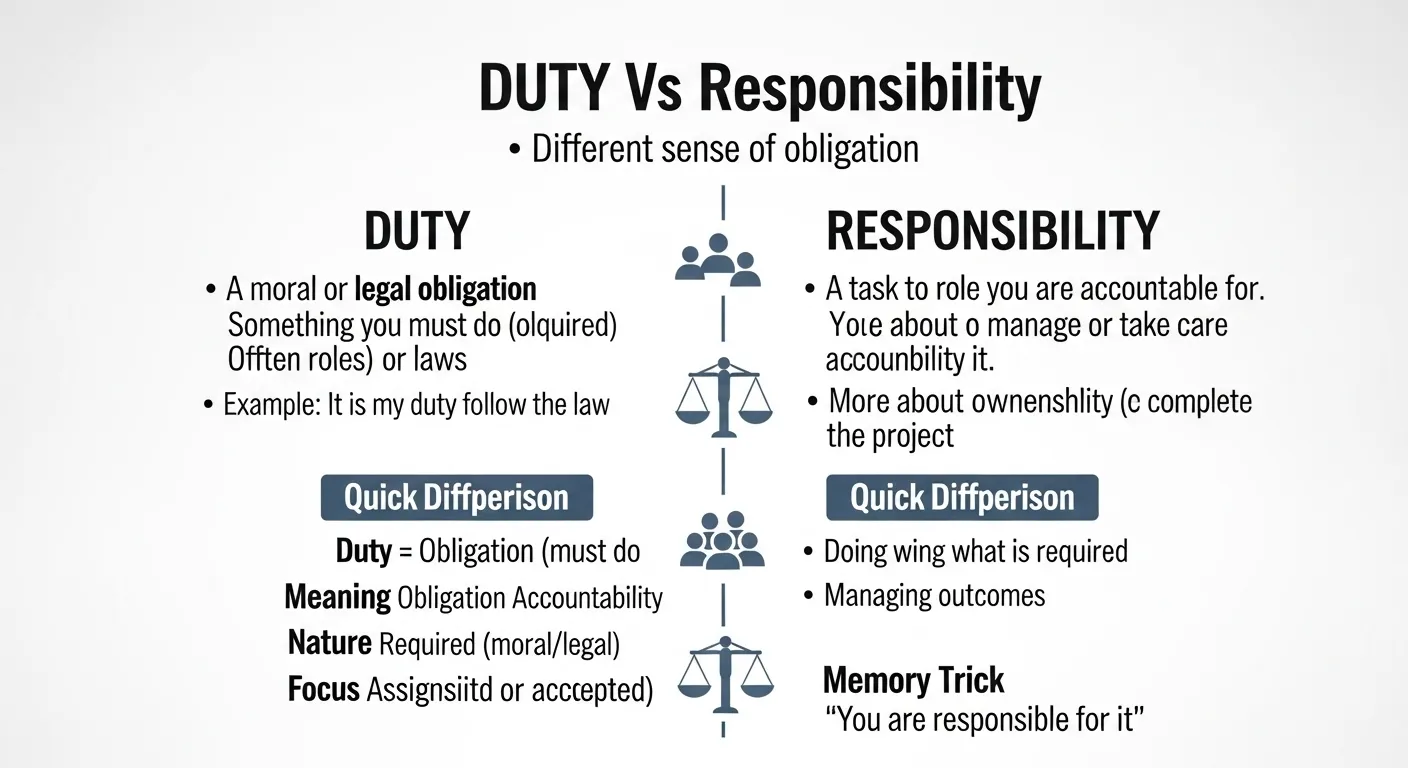
The difference between duty and responsibility is that duty is a task you are required to perform, while responsibility is something you are accountable for.
Imagine a teacher in a classroom. Teaching lessons is their duty, as it is part of their job. Ensuring students understand and perform well reflects their responsibility.
Understanding the difference between duty and responsibility helps people manage roles in personal and professional life. Knowing the difference between duty and responsibility also builds discipline and accountability.
The difference between duty and responsibility becomes clear when we see that duty is assigned, while responsibility is often accepted and owned.
🔑 Key Difference Between the Both
The main difference lies in obligation versus accountability.
- Duty: A required task or obligation.
- Responsibility: Accountability for actions and outcomes.
Examples:
- A police officer has a duty to enforce laws.
- Employees perform their duties at work.
Examples:
- A manager takes responsibility for team results.
- Parents hold responsibility for their children’s care.
🌍 Why Is Their Difference Necessary to Know?
Understanding the difference between duty and responsibility is important in daily life. People often perform duties without fully accepting responsibility for the results. Knowing this difference helps individuals become more reliable and trustworthy. In workplaces, duty ensures tasks are completed, while responsibility ensures quality and accountability. Learning the difference between duty and responsibility helps people develop better habits, improve teamwork, and build strong relationships. It also encourages individuals to take ownership of their actions and decisions.
🔊 Pronunciation (US & UK)
| Word | US Pronunciation | UK Pronunciation |
| Duty | /ˈduːti/ | /ˈdjuːti/ |
| Responsibility | /rɪˌspɑːnsəˈbɪləti/ | /rɪˌspɒnsəˈbɪləti/ |
➡️ Now let us explore the detailed difference between duty and responsibility step by step.
⚖️ Difference Between Duty and Responsibility
1️⃣ Definition
Duty is a task that must be performed.
Responsibility is being answerable for results.
Examples:
- Completing assigned work is a duty.
- Following rules is a duty.
Examples:
- Accepting outcomes shows responsibility.
- Owning mistakes reflects responsibility.
2️⃣ Nature
Duty is compulsory.
Responsibility involves accountability.
Examples:
- Workers must perform their duties.
- Students have a duty to study.
Examples:
- Leaders accept responsibility for decisions.
- Individuals take responsibility for actions.
3️⃣ Source
Duty is assigned by authority.
Responsibility can be accepted or assigned.
Examples:
- A job description defines duties.
- Laws create certain duties.
Examples:
- A person may accept responsibility voluntarily.
- Responsibility can grow with experience.
4️⃣ Focus
Duty focuses on tasks.
Responsibility focuses on outcomes.
Examples:
- Completing work is a duty.
- Tasks are part of duty.
Examples:
- Results reflect responsibility.
- Success depends on responsibility.
5️⃣ Scope
Duty is limited and specific.
Responsibility is broader.
Examples:
- A teacher’s duty is to teach.
- A worker’s duty is defined.
Examples:
- A teacher has responsibility for student learning.
- A manager has wider responsibility.
6️⃣ Relationship
Duty may exist without responsibility.
Responsibility often includes duties.
Examples:
- Someone may perform a duty without care.
- Tasks may be done without ownership.
Examples:
- Responsible people handle multiple duties.
- Responsibility includes task management.
7️⃣ Accountability
Duty has less accountability.
Responsibility has strong accountability.
Examples:
- Failing a duty may lead to warning.
- Duties are monitored.
Examples:
- Responsibility involves consequences.
- People are answerable for results.
8️⃣ Emotional Involvement
Duty may be performed without emotion.
Responsibility often involves commitment.
Examples:
- Duties can feel routine.
- People may do duties mechanically.
Examples:
- Responsibility involves care.
- It reflects commitment.
9️⃣ Flexibility
Duty is fixed.
Responsibility can expand.
Examples:
- Duties rarely change.
- Job roles define duties.
Examples:
- Responsibility grows with role.
- It changes with situations.
🔟 Impact
Duty ensures tasks are done.
Responsibility ensures quality results.
Examples:
- Duties maintain order.
- Tasks get completed.
Examples:
- Responsibility improves outcomes.
- It ensures success.
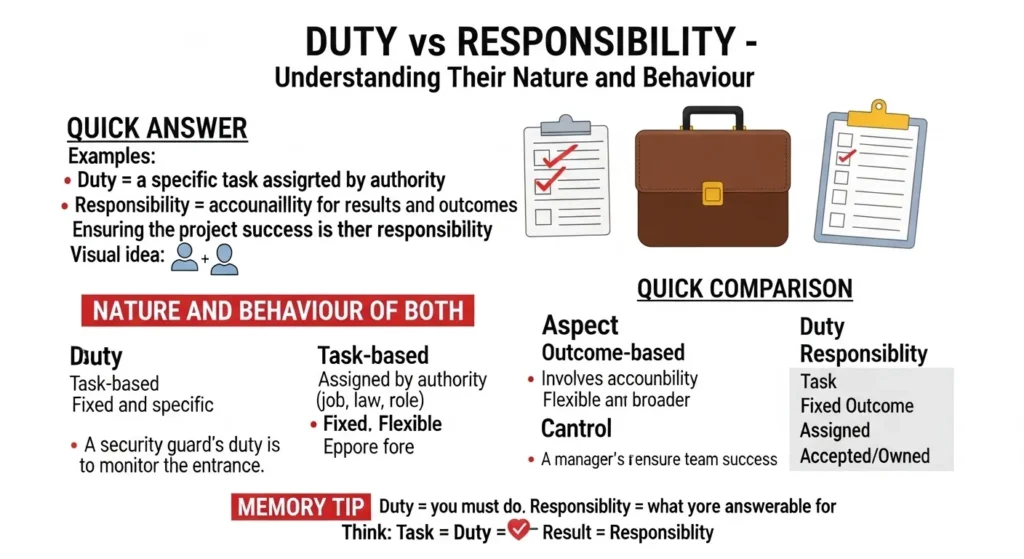
🧠 Nature and Behaviour of Duty and Responsibility
Duty
- Task-based
- Assigned by authority
- Fixed and specific
Responsibility
- Outcome-based
- Involves accountability
- Flexible and broader
❓ Why People Are Confused About Their Use
People often confuse duty and responsibility because both relate to obligations and roles. In daily language, they are sometimes used interchangeably. The confusion arises because performing duties often leads to responsibility, making it hard to separate the two clearly.
📋 Table: Difference and Similarity
| Feature | Duty | Responsibility |
| Meaning | Task | Accountability |
| Nature | Compulsory | Answerable |
| Focus | Work | Results |
| Scope | Limited | Broad |
| Flexibility | Fixed | Flexible |
⚖️ Which Is Better in What Situation?
Duty
Duty is important when tasks must be completed on time. It ensures discipline and structure in workplaces and daily life. People rely on duty to maintain order and consistency in routine activities.
Responsibility
Responsibility is important when outcomes matter. It ensures quality, accountability, and trust. People who take responsibility go beyond tasks and focus on achieving meaningful results.
🎭 Use in Metaphors and Similes
Metaphor example:
- His work was his duty, but his passion was his responsibility.
Simile example:
- She handled the project like a true responsibility, with care and focus.
💬 Connotative Meaning
| Word | Connotation | Example |
| Duty | Obligation, discipline | He performed his duty well. |
| Responsibility | Accountability, trust | She showed great responsibility. |
🗣️ Idioms or Expressions
Call of duty
Meaning: a strong sense of obligation.
Example:
- He answered the call of duty without hesitation.
📚 Works in Literature
- “Duty” – Robert M. Gates, 2014
- “Responsibility and Judgment” – Hannah Arendt, 2003
🎬 Movies Related to Duty
- “A Few Good Men” – 1992, USA
- “Saving Private Ryan” – 1998, USA
❔ Frequently Asked Questions
1. What is the main difference between duty and responsibility?
Duty is a task you must perform, while responsibility means being accountable for results.
2. Can duty exist without responsibility?
Yes, a person can perform duties without taking full responsibility.
3. Is responsibility broader than duty?
Yes, responsibility covers outcomes and accountability.
4. Are both important?
Yes, both are essential in personal and professional life.
5. Which one is more important?
Both are important, though responsibility often has a greater impact.
🌍 How Both Are Useful for Surroundings
Duty and responsibility help maintain order and accountability in society. Duty ensures tasks are completed, while responsibility ensures quality and trust. Together, they support teamwork, discipline, and growth.
✍️ Final Words for Both
Duty represents obligation and tasks.
Responsibility represents accountability and outcomes.
Both are essential for balanced and effective living.
🏁 Conclusion
Understanding the difference between duty and responsibility helps individuals perform tasks effectively while also taking ownership of results. Duty focuses on completing assigned work, while responsibility ensures accountability and quality.
Although both are closely related, they play different roles in personal and professional life.By learning their differences, people can improve discipline, build trust, and achieve better outcomes.
Discover More Articles:

I’m Owen Parker, and I write articles that focus on explaining the differences between common concepts, tools, and ideas. I enjoy simplifying complex information and turning it into clear comparisons that anyone can understand. My work often covers science , education, technology, and everyday knowledge topics.