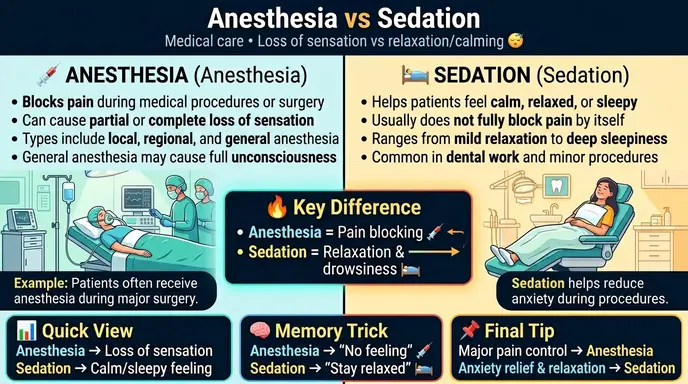
The difference between anesthesia and sedation is that anesthesia blocks pain and may cause complete unconsciousness during medical procedures, while sedation mainly helps patients relax, stay calm, or become sleepy without always causing full unconsciousness.
Many patients search for the difference between anesthesia and sedation before surgery, dental treatment, or medical procedures because both affect awareness and comfort, yet they work differently in depth, purpose, and monitoring.
In simple words, sedation reduces anxiety and awareness, while anesthesia controls pain more deeply and may completely prevent consciousness. Understanding the difference between anesthesia and sedation helps patients feel more informed and prepared before medical treatments.
💡 Quick Answer: Difference Between Anesthesia or Sedation
Sedation helps patients relax or become drowsy, while anesthesia blocks pain and may cause complete unconsciousness during procedures.
👉 Example:
A patient getting wisdom teeth removed may receive sedation to stay calm, while major surgery often requires general anesthesia.
📘 Definition of Anesthesia and Sedation
- Anesthesia: A medical treatment that blocks pain and sensation during procedures and may cause partial or complete unconsciousness.
- Sedation: A medical technique that relaxes patients, reduces anxiety, and creates drowsiness during medical or dental procedures.
🗣️ Pronunciation (US & UK)
- Anesthesia
- US: /ˌæn.əsˈθiː.ʒə/
- UK: /ˌæn.əsˈθiː.zi.ə/
- Sedation
- US: /sɪˈdeɪ.ʃən/
- UK: /sɪˈdeɪ.ʃən/
These terms are commonly used in surgery, dentistry, emergency medicine, cosmetic procedures, and hospital care.
📊 Comparison Table: Anesthesia vs Sedation
| Feature | Anesthesia | Sedation | Similarity |
| Main Purpose | Block pain and sensation | Relax and calm the patient | Both improve patient comfort |
| Consciousness Level | May cause unconsciousness | Usually partial awareness remains | Both used during procedures |
| Pain Control | Strong pain prevention | Limited pain control alone | Both may involve medications |
| Usage Type | Major surgeries and procedures | Minor procedures and anxiety reduction | Both require medical supervision |
| Awareness | Often little or no awareness | Reduced awareness or relaxation | Both affect mental state |
| Monitoring Level | Intensive monitoring common | Monitoring still important | Both prioritize safety |
| Recovery Experience | Often longer recovery | Usually quicker recovery | Both may cause drowsiness |
| Procedure Complexity | Often used for major operations | Common in less invasive treatments | Both support medical treatment |
This table clearly shows the difference and similarity between anesthesia and sedation for quick understanding.
🧠 Key Differences Explained Between Sedation and Anesthesia
😴 Consciousness Level
The biggest difference between anesthesia and sedation is awareness. General anesthesia may make patients fully unconscious, while sedation usually keeps some level of consciousness.
👉 Example:
A sedated dental patient may still respond to instructions.
💉 Pain Control Strength
Anesthesia provides stronger pain prevention than sedation alone.
🏥 Procedure Type
Major surgeries commonly require anesthesia, while minor procedures often use sedation.
👉 Example:
Colonoscopies may use moderate sedation rather than full anesthesia.
⏳ Recovery Time
Sedation usually allows faster recovery and discharge compared to general anesthesia.
🩺 Medical Monitoring
Both require monitoring, but anesthesia often needs more advanced airway and vital sign management.
😌 Anxiety Reduction
Sedation is frequently used to reduce fear and anxiety before procedures.
🧠 Memory Effects
Some sedation methods may reduce memory of the procedure without causing full unconsciousness.
🧠 Why Anesthesia and Sedation Get Confused
The difference between anesthesia and sedation becomes confusing because both involve medications that affect awareness, comfort, and consciousness during medical procedures.
Many people also hear terms like:
- Local anesthesia
- General anesthesia
- Mild sedation
- Deep sedation
These overlapping medical terms can make understanding difficult for patients.
🌐 How Medical Systems Use Anesthesia and Sedation
Medical systems classify:
- Anesthesia as pain blocking medical treatment
- Sedation as relaxation and awareness reducing treatment
Organizations like American Society of Anesthesiologists and hospitals worldwide use detailed safety guidelines for:
- Medication dosing
- Airway management
- Monitoring systems
- Patient recovery
Medical education platforms and hospital resources also help explain these concepts to patients before procedures.
📊 Difference + Similarity Table
| Feature | Anesthesia | Sedation | Similarity |
| Meaning | Pain blocking medical treatment | Relaxation focused medical treatment | Both used during procedures |
| Consciousness Effect | Often unconsciousness | Reduced awareness or calmness | Both affect mental state |
| Pain Prevention | Strong pain control | Limited direct pain control | Both improve patient comfort |
| Common Usage | Major surgeries | Minor procedures and anxiety relief | Both require supervision |
| Recovery Style | Longer recovery possible | Faster recovery common | Both may cause temporary drowsiness |
| Medical Monitoring | Higher monitoring intensity | Monitoring still necessary | Both involve healthcare professionals |
| Patient Experience | No awareness possible | Relaxed or sleepy feeling | Both support safer procedures |
| Treatment Goal | Surgery and pain prevention | Comfort and relaxation | Both assist medical care |
This table clearly shows the difference and similarity between anesthesia and sedation for quick understanding.
🩺 Deep Explanation: Different Levels of Sedation and Anesthesia
Medical treatments can range from mild relaxation to complete unconsciousness:
- Mild sedation → relaxed but awake
- Moderate sedation → sleepy but responsive
- Deep sedation → difficult to wake fully
- General anesthesia → complete unconsciousness
👉 Example:
- A patient getting a cavity filled may receive local anesthesia
- A patient undergoing heart surgery may require general anesthesia
This range allows doctors to match comfort and safety to each procedure.
⚠️ Common Mistakes with Difference Between Anesthesia and Sedation
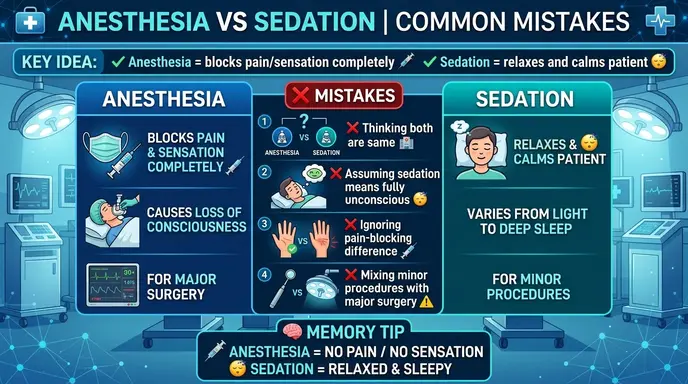
Thinking Sedation and Anesthesia Are Identical
❌ Sedation and anesthesia always mean complete unconsciousness.
✅ Sedation often allows partial awareness.
Ignoring Pain Control Differences
❌ Sedation alone completely blocks surgical pain.
✅ Anesthesia provides stronger pain prevention.
Assuming Sedation Is Risk Free
❌ Sedation never requires monitoring.
✅ Medical supervision is still important during sedation.
Using Terms Incorrectly
❌ Every medical procedure requires general anesthesia.
✅ Many procedures only require sedation or local anesthesia.
Believing Patients Always Remember Sedation Procedures
❌ Sedation never affects memory.
✅ Some sedation methods reduce memory of the procedure.
Confusing Local Anesthesia with Sedation
❌ Local anesthesia and sedation are the same thing.
✅ Local anesthesia numbs an area, while sedation affects awareness.
🧑⚕️ Real Life Examples with Anesthesia and Sedation
- General anesthesia during major surgery
- Sedation for dental procedures
- Colonoscopy procedures using moderate sedation
- Cosmetic treatments with local anesthesia
- Emergency surgeries requiring anesthesia
- Anxiety reducing sedation before medical imaging
🎯 When Doctors Use Anesthesia or Sedation
- Major surgery → anesthesia
- Minor procedures → sedation
- Pain control during operations → anesthesia
- Anxiety reduction → sedation
- Complex invasive treatments → anesthesia
- Quick outpatient procedures → sedation commonly used
🤔 Why People Get Confused in Anesthesia and Sedation
- Both use medications affecting awareness
- Medical terms sound similar
- Different sedation levels overlap with anesthesia concepts
- Patients often hear simplified explanations
- Both are used during procedures
🧠 How Medical Systems Understand Anesthesia and Sedation
Medical systems analyze:
- Pain level of procedure
- Patient comfort needs
- Consciousness requirements
- Airway safety
- Recovery expectations
This helps healthcare teams choose the safest and most effective approach.
🧠 Expert Insight
The difference between anesthesia and sedation mainly comes from consciousness level, pain control, and medical purpose. Anesthesia focuses heavily on pain prevention and may involve complete unconsciousness, while sedation primarily focuses on relaxation and reduced awareness.
In practical healthcare settings, doctors select the appropriate method based on procedure complexity, patient safety, anxiety level, and pain management needs.
❓ FAQ: Difference Between Anesthesia and Sedation
1. What is the main difference between anesthesia and sedation?
Anesthesia blocks pain and may cause unconsciousness, while sedation mainly relaxes the patient.
2. Can sedation keep patients awake?
Yes, many sedation methods allow partial awareness.
3. Is anesthesia stronger than sedation?
General anesthesia usually affects awareness and pain control more deeply.
4. Do both require medical monitoring?
Yes, both require professional supervision.
5. Is sedation used in dental procedures?
Yes, sedation is common in dentistry.
6. Does anesthesia always cause unconsciousness?
Not always. Some types like local anesthesia numb only part of the body.
7. Why do people confuse anesthesia and sedation?
Because both involve medications affecting awareness during procedures.
🧾 Conclusion
The difference between anesthesia and sedation comes from pain control, awareness level, and medical purpose. Anesthesia focuses on preventing pain and may involve complete unconsciousness during major procedures, while sedation mainly helps patients relax and remain comfortable during less invasive treatments.
Understanding the difference between anesthesia and sedation helps patients feel more informed and confident before medical or dental procedures. Once you connect anesthesia with deeper pain control and unconsciousness and sedation with relaxation and reduced awareness, the distinction becomes much easier to understand in modern healthcare.
Discover More Articles:

I’m Owen Parker, and I write articles that focus on explaining the differences between common concepts, tools, and ideas. I enjoy simplifying complex information and turning it into clear comparisons that anyone can understand. My work often covers science , education, technology, and everyday knowledge topics.